Showing posts with label History. Show all posts

Friday, August 1, 2014

Mandatory Finishing-School

Appendix 3.

In our previous installment, all the way back in Chapter 10, we discussed the importance of deportment and etiquette to be a well-rounded, as well as a well-dressed, person. Actually, the phrase I used was, "We seem to be desperately, hopelessly in need of mandatory finishing-schools." I left you at the end of that essay with the exhortation, "You can do something about you. Start with you."

Well, for those of you who have been left hanging by that rather broad, vague dictum, I have a couple of books to share with you. Think of it as a virtual finishing-school, that will help put the polish on your actions. Both books are included here for your use: old and musty, but still full of the classic goodness that modern men need to know.

There's also, amongst the useful bits, a fair amount of antiquated curiositae, and detailed regulations for activities and events that simply don't exist anymore; so I'll summarize each book first by their chapter headings. You can then skip to the relevant sections, or read the less-relevant passages for the historical interest.

(These books are currently hosted and imbedded with GoogleDrive; if bandwidth limits prevent them appearing below, click the "download" link in the window, which will switch the window from a GoogleDrive viewer to a PDF viewer. If this continues to be a problem, I'll try to find a more suitable hosting service.)

First, we have the  
Gentlemen's Book of Etiquette 
and Manual of Politeness, 
written by Cecil B. Hartley. The publishers specialized in books for young men, with a focus on history and self-improvement. Because it's geared toward young men just entering society, it's exceptionally easy-reading for a book published in 1873. Tellingly, Hartley notes that etiquette may seem unnatural, but stiffness is not the same as politeness. This is utterly at variance to what most people today think of mid-19th century manners!

Chapter 1, covering "Conversation," (p.11) is useful no matter what the era, and just as applicable to the social-media driven world of today, as well as the oft-neglected art of face-to-face communication.

Chapter 2, "Politeness," (p.31) is defined as how we treat those that we find personally disagreeable, and is distinguished from etiquette; one being internal thought, the other the external manifestation of rules. There are several good thoughts in this chapter that would be good to internalize, (although it tends to run a bit long into the Quality of a Gentleman that today rings a tad rustic.)

Chapter 3, about "Table Etiquette," (p.50) at first blush seems hopelessly dated in the details, but it contains so much common-sense wisdom, and is written so well, it is worth a read to take the spirit of the chapter to heart.

Chapter 4, "Etiquette In the Street," (p.66) is largely antiquated today in its detail, beyond the observations of general courtesy; and chapter 5, "Etiquette for Calling," (p.75) is a mere historical oddity -- the shorthand of calling cards were the Victorian equivalent of instant messaging.

Chapter 6, "Etiquette for the Ballroom," (p.91) although the specifics are far past their sell-date, contains many useful tips for proper deportment when entertaining in general. (If one is into ballroom dancing, some of the details are historically enlightening.)

Chapter 7, on "Dress," (p.115) is the one that should be mandatory reading for all men. A more concise summary of the attitude of proper dress, and its attendant hygiene, has rarely been written. Even taking into account the peculiarities of whiskers, hairstyles, and subtle classism, the wisdom underlying the words remains.

Chapter 8 concerns itself with "Manly Exercises." (p.154) Today we're if anything over-educated on rigorous exercise programs, but this look at some more practical and enjoyable 19th century pursuits, like riding and driving, boxing, sailing, hunting, skating, swimming, and yes, even cricket, is worth a read.

Chapter 9, "Traveling," (p.176) is deceptively useful, whether you actually travel regularly or not.

Chapter 10, "Etiquette in Church," (p.183) is a good general guide when you are in any unfamiliar situation, church or not.

Chapter 11 is "One Hundred Hints for Gentlemanly Deportment." (p.186) This is another mandatory chapter, and indeed could be a separate book in its own right. Some 'hints' are summaries of points previously mentioned in detail, and some are 'catch-all' generalities that don't fit into neat categories. Each point is short, to the point, and most of them are general enough to be just as true today as much as they were in 1870.

Chapter 12, "Parties," (p.222) has become passè in its detail for the most part, as the sort of soirèe described is not seen today outside the realm of historical re-creationists. Similarly, chapter 13, "Courtesy at Home," (p.228) presents antiquated specifics of keeping house, and is only relevant today in its broadest strokes, which are amply covered by other chapters.

Chapter 14, "True Courtesy," (p.244) is an elegant presentation of politeness without affectation, native dignity without vulgarity -- this chapter is essential reading.

Chapter 15, "Letter Writing," (p.252) is almost shockingly relevant, in this world of e-mails, tweets, and IMs.

Chapter 16, "Wedding Etiquette," (p.280) is somewhat out of the sphere of common use, but weddings are so poorly done today, following this chapter would be a vast improvement. Chapter 17, "Etiquette for Places of Amusement," (p.294) is along the same vein. Going to the theatre or opera are not now commonplace...but if you were to go, this is how to go about it and not look like Larry the Cable Guy.

And finally, chapter 18 is a "Miscellaneous" (p.298) melting-pot of ideas, some relevant, some less so, and a couple bordering on ridiculousness.


The second example we'll look at is
Martine's Hand-Book of Etiquette 
and Guide to True Politeness
written by Arthur Martine in 1866.  In counterpoint to the well-ordered chapters of Hartley, Martine's sections, written only a decade earlier, read like collections of 'bullet points,' which hit wide targets like scattershot through a musket.

Martine's is pointed to both men and women, and is more noticeably dated because of it. The suggestions given to men are the more timeless, fortunately, and should not be shunned because of the old-fashioned advice he gives to the gals.

"The Art of Conversation" (p.8) and "General Rules for Conversation" (p.24) are excellent companion pieces to Chapter 1 of Hartley's book.

"On Dress" (p.48) treats mostly of women, but the words to men echo Chapter 7 of Hartley nicely.

"Introductions" (p.57) and "Letters of Introduction" (p.61) have largely passed into history, and there is little here to recommend it to the modern reader.

Martine has much to say about eating. "Dinner Parties" (p.63) are seldom given today, and when they are, are usually not given well. If you are inclined to attempt them, it's a useful section.

However, "Habits At Table" (p.67) "Wine At Table" (p.74) and "Carving" (p.82) are equal parts surprising common-sense and high manners to modern sensibilities, and are an essential read, superior to Hartley's Chapter 3.

"Etiquette of the Ball and Assembly Room" (p.93) and "Evening Parties" (p.104) are best read as adjuncts to Hartley's Chapters 6 and 12: useful for re-enactments, but little else today. "Visiting" (p.113) is interesting only as a historical curiosity--but it's very interesting, as is "Street Etiquette" (p.127)

"Traveling" (p.133) has some good pointers for those who still use public or mass transit.

"Marriage" (p.136) and "Domestic Etiquette and Duties" (p.144) are addressed primarily to the chicks, and of all the sections in Martine's, suffers the most from outdated standards -- but there are still good-intentioned ideas for men to glean as regards La Bonheur Domestique that is applicable to modern life.

"On General Society" (p.154) is a mixed bag, out of which may be plucked the occasional plum.


Wednesday, June 4, 2014

The Art of Tying the Cravat.

Appendix 1.

In the previous Installment Chapter 80, entitled "Taking Stock of the Cravat," I had made reference to two little volumes published in the early nineteenth century; and these innocuous tomes are so invaluable, (and in some ways so misunderstood,) it warrants a further and closer look at them. The original post imbedded the scans as presented from GoogleBooks. In this Appendix, they have been re-edited and presented with minor helpful annotations and insertions to make it more readily accessible for my readers, most notably the inclusion of the original illustrations.

(These books are currently hosted and imbedded with GoogleDrive; which features onerous restrictions on bandwidth -- if the limit has been reached, and they do not appear below, click the "download" link in the window, which will switch the window from a GoogleDrive viewer to a PDF viewer. If this continues to be a problem, I'll try to find a more suitable hosting service.)

The Art of Tying the Cravat is a serious essay on the history and crafting of cravats, and would be an invaluable resource to those that actually want to learn what the various styles were and how to tie them -- if it were possible to actually read this rare book online with the illustrations, which are never scanned and included. Thus, I have produced a version myself for Dress Like A Grownup! that contains the illustrations for you. Read through it, and you will discover not just a slice of history, and how to form the historical cravats from a contemporary source, but you will discover within its pages the direct forerunner of every variety of modern neckwear, from ties to scarves.


Neckclothitania, on the other hand, has been referenced by many online sources that proport to expound the ancient art of the starched cravat. The illustrated frontispiece is most often shown, unfortunately separate from the text of the book. Well-meaning costumers, living history aficionados, and amateur historians have gone so far as to attempt to recreate the illustrations in actuality.

What all of these people fail to recognize or make mention of, is that Neckclothitania is a college student's work of social satire. It is not to be taken seriously -- it is a humorous work, the subtlety of which is lost on modern readers; largely because we are not familiar with the style of the serious Essays published at the time, that this work is lampooning.

The first clue is the title itself: To young scholars, "Titania" would have been a well-known reference to both Ovid's Metamorphoses, as the daughters of the Titans, and as the name of the Fairy Queen in Shakespeare's A Midsummer Night's Dream, (make of that what you will,) so the pun of TIEtania would have been instantly understood. Virgil's quote on the title page holds a sly double entendre in this light. Nods to the formal essays of the time that you may notice, are the ridiculously pompous Dedication, the liberal sprinkling of high-sounding French and Latin phrases throughout (notice especially the description of cravat colors!) and the many referenced "sources," which are themselves contemporary works of satire.

Notice, too, that half of the cravats shown are exactly the same, differing only in the number and position of creases in the starch! (These are not the "actual" forms of the starchers; for that you must go to The Art of Tying the Cravat.) The other half dozen are roundly ridiculed for their ridiculousness. The subtext is that to the untrained eye, all Starchers look the same, and the endless minutiae and variations lavished upon them can be seen as just a bit silly -- much like those today that agonize over the proper tie knot to use, when the average person can't tell a Four-in-Hand from a Half Windsor.

Tietania does have its purposes, though, aside from the first recorded use of the word "tie" to refer to a cravat. Namely, it is an invaluable contemporary look at the culture of the "Starcher" from the perspective of a sardonic student with a keen sense of humor. Read it with tongue firmly in cheek!


Click here to go back to the original installment that this Appendix references: "Taking Stock of the Cravat."

Friday, December 28, 2012

The 2012 Year in Posts

Chapter 99
Dress Like a Grownup!'s second year is now behind us! If our first year was the Year of the Average Guy, which introduced you to the world of the well-dressed; our second is the Year of the Miniseries -- for we delved into multi-part topics that added some meat to your knowledge stew. A new reader who finds us through a websearch will be unceremoniously plopped smack in the middle of an ocean of seeming disjointed data: this easy-to-use cross-linkable summary index can be a sort of compass to navigate these waters and find his way around.

Giovanni Battista Moroni's Der Schneider (The Cutter,) 1570

We'll pick up where 2011's Year at a Glance left off.

We had a full gauntlet of men's formalwear critiques this year. The entertainment industry's offerings ran the gamut, from the decidedly casual Screen Actor's Guild and Billboard Music Awards, to the more formal Golden Globes and Emmys. My coverage of the Oscars was a dual-part affair, also covered at dandyism.net, and we even had time to take a peek at the Kentucky Derby's fashions. 2012 being an election year, we took a look at political fashion as well, from everyday campaign wear, to the black-tie White House Correspondents' Association dinner, and (also our Halloween special!) the white-tie Alfred E. Smith dinner.

We didn't neglect the Average Guy in 2012: there were several essays aimed squarely at the novice just starting out on his sartorial education. The Second Great Secret of Dressing Well was aptly illustrated, (viz., a man tends to dress back to the time when he was most happy,) using real-life examples of celebrities, and the Third Great Secret of Dressing Well (viz., A man cannot break the rules successfully, unless he knows exactly what those rules are,) was observed in the previously-mentioned Kentucky Derby installment. Spring is the ideal time to jump-start changes to your wardrobe, with at least one lightweight coat in your arsenal. We stressed the importance of wardrobe rotation and packing your seasonal items away properly. And we looked at some practical advice on how to match your clothes to the seasons, as well as a close look at the humble sock, and the popular newsboy cap as a proper alternative to a baseball cap. The Average Guy got a taste of some advanced theory with a mathematical look at stylistic balance using the continuum cube.

We completed the Island of Misfit Clothes series that we started in 2011, with re-working a suit jacket that was several sizes too large. After re-shaping the side seams, we narrowed the shoulders, tightened the sleeveheads, set the sleeves in, and put in the lining and finished off the hem. We took a look at fine-tuning the button stance, this time using shanked buttons. And we showed how to make a fine summer-time jacket by way of a quick and simple unlining operation.

There were a great many essays this year with an emphasis on history. We took a look at what Downton Abbey can teach us about dressing well, and used a decoded Mayan apocalypse to introduce a new TT&S Razor Square. The aforementioned political fashion critiques included a comparison to presidential styles of years gone by, as well.

We turned our attention to the history of men's neckwear in a multi-part series; from 1500 to 1800, then from 1800 to 1900. We overviewed men's modern tie choices, then looked at each in turn: long ties, bow ties, ascots, cravats, squares, and scarves.

Our contemplative gaze was directed to the history of tobacco use, to find if an equivalency exists between smokers and being well-dressed. After looking at the timeline from antiquity to 1820, and then from 1820 to the present, we drew our correlations, and concluded that the modern alternative to tobacco would be most useful.

We looked at economies of dressing well, both the economy of time, and the more literal economy of using your purchasing power effectively.

The tale of the Fighting Yank, that was begun last year, was completed this year in two parts: the capture of the criminals, and the raising of the Yank again.

The year ended up with a mechanic's special: a multi-part series that renovated a classic iron -- an essential weapon in the well-dressed man's arsenal. We disassembled, cleaned, repaired, reassembled, and tested an old General Electric to like-new condition.

And of course, we rang out the year with the Razor Square and Bow Tie Men of the Year, our own yearly tradition.

As 2013 rolls on, we will continue to bring you sartorial goodness in one form or another...guaranteed! Stay tuned.

Click here to go to the next essay chronologically.

Click here to go back to the previous essay chronologically.

Click here to go back to the beginning.

Friday, November 9, 2012

The Political Uniform

Chapter 92
The election is over. This isn't a political blog, so I'll spare you any of that which you doubtless are already inundated. I was correct in my prediction as to the outcome, however:

The man in the black suit will win.

This isn't a large stretch of prognostication. Let's take a quick tour of the last couple of political months.

We'll start with the Republican nominating process. Observe: from left to right, black suit, black suit, black suit, black suit, black suit, and black suit. Not shown is Herman Cain, in a black suit, and Michelle Bachmann, who was not a man, and thus beyond the scope of this blog. So the Republicans chose the man in the black suit.

Let's skip to the conventions now. First, the Democrat convention. Obama at the podium, basking in the adulation with his court jester: black suit, and black suit.

Bill Clinton? Black suit.

Even Los Angeles Mayor Antonio Villaraigosa, the convention chair, provided comic relief with his "maybe you didn't understand the question" routine in a black suit.

Perhaps there is a trend here. Let's compare this with the Republican convention: RNC Chair Reice Preibus -- black suit.

Reice and John Boehner? Black suit and black suit.

Ebullient Chris Christie -- in a slimming black suit.

Clint Eastwood, the Republican's answer to Villaraigosa, also a black suit.

Even Wisconsonian Sol Grosskopf, with a chessehead hat and purple polka-dotted bow tie, somehow can't shun the black suit.

Surely at the debates this dreary costume must be averted?

No. Presidential debates: black suit, black suit.

Vice presidential debate: black suit, black suit.

What do we see here? A depressing uniformity and a stultifying lack of imagination. Arenas full of ill-fitting black suits. A House and Senate full of black suits. A Capitol full of black suits. Men at the highest levels of American government, no matter their party, have given up on their sartorial free expression. And what happens on the surface is an indication of what is going on underneath.

Let's draw a quick comparison between the modern day and Presidents past -- and just to keep it fair, we'll look at past political conventions here as well. The dapper haberdasher, Harry S. Truman, makes his acceptance speech at the Democrat National Convention in style, with a double-breasted linen suit.

Notice the light, breezy, and confident air a bright suit gives. It's hard to tell in monochrome, but this is likely a very light eggshell or cream linen.

Let's jump forward to Eisenhower in 1952, greeting the press outside the Republican National Convention, at a constituent's house. Hardly a dark suit to be seen. Ike is most likely in a salt-and-pepper suit, whilst his glad-handed throng are in a variety of tans, creams, and rusts. Notice the straw fedoras, and the spectator shoes on the gents at the far left.

Here is a jubilant Richard Nixon also at the RNC in 1952, looking far from dour in a light, possibly straw-colored, suit.

Moving ahead to 1972, Ronald Reagan hands off the ceremonial chair's gavel to Gerald Ford at the RNC. Gerry's in a dark suit, perhaps a sign of things to come, while the Gipper is in what appears to be light grey.

Up until the 1976 Republican Convention, light suits were still seen, although less rarely than in previous years. RNC Chair Bob Dole is wearing a poly suit in what I think might be a then-fashionable light brick color. But beyond the bicentennial, dark tones predominated, and for the last several decades, color has disappeared completely from the palette of the politician.

When everyone wears black, it's more difficult to tell who the good guys are. If there are any, that is.

Click here to go to the next essay chronologically.

Click here to go back to the previous essay chronologically.

Click here to go back to the beginning.

Friday, October 19, 2012

Da Capo

Chapter 89
Hello, Average Guys! As you know, I try to maintain a certain kind of balance here at Dress Like a Grownup!, and keep a few different kinds of plates spinning at once. Some plates are the equivalent of a doctoral degree, continuing education for lifelong dandies, all the way down to some plates that are Dressing 101, core curriculum for the freshman youth. After some time in the more advanced topics, like our recent History of Neckwear series, I like to go back and spend some time at the basics, for the benefit of Average Guys like yourself who are just starting along your mature sartorial journey. 

Of all the changes that need to be made, to cast off the shackles of the children's clothes you currently wear, and make a neat transition to the attire of adults, some are easier than others. The most difficult transition, is to that of a proper hat. 

This is understandable. The transformation of the core of your attire, trousers and shirts, is merely a shift in style from your current jeans and tee-shirts; as is the addition of a jacket. The metamorphosis from sneakers to proper shoes is likewise largely a shift of style: after all, you have always worn shoes of some sort: you are merely aiming to shift its nature. In other words, you are modifying your current articles of clothing to different, but related, articles. 

Not so the hat. For many, the inclusion of a hat is ex nihilo; the addition of an article that is totally new, and at first very strange. It is impossible to ignore a hat: it is always there, an unfamiliar pressure around your skull, an unfamiliar weight on your head, an unfamiliar sight at the periphery of your vision. You feel uncomfortable, and awkward, and uncertain; and your behavior will reflect that. And as you know, your attitude toward what you wear is just as important as the articles themselves -- if you feel awkward wearing a hat, others will feel awkward for you wearing a hat.

And yet, there are millions upon millions of Average Guys who think nothing of wearing a baseball cap. The odd little beanie-with-a-bill has become completely ubiquitous. But, just because everyone does something, doesn't mean it's right. If you're playing baseball, that's just fine -- wear a baseball cap. If you're not, don't -- wear a proper hat instead.

Fortunately, there IS a way for an Average Guy to transition into a proper hat easily and gently, without the jarring impact of the Sudden Fedora. If you are currently one of those fellows who does wear a baseball hat everywhere, this transition will be completely painless and very natural. If you have never worn a hat at all, it can be nearly an unnoticeable transition, for this particular sort of hat is actually very closely related to the baseball cap. 

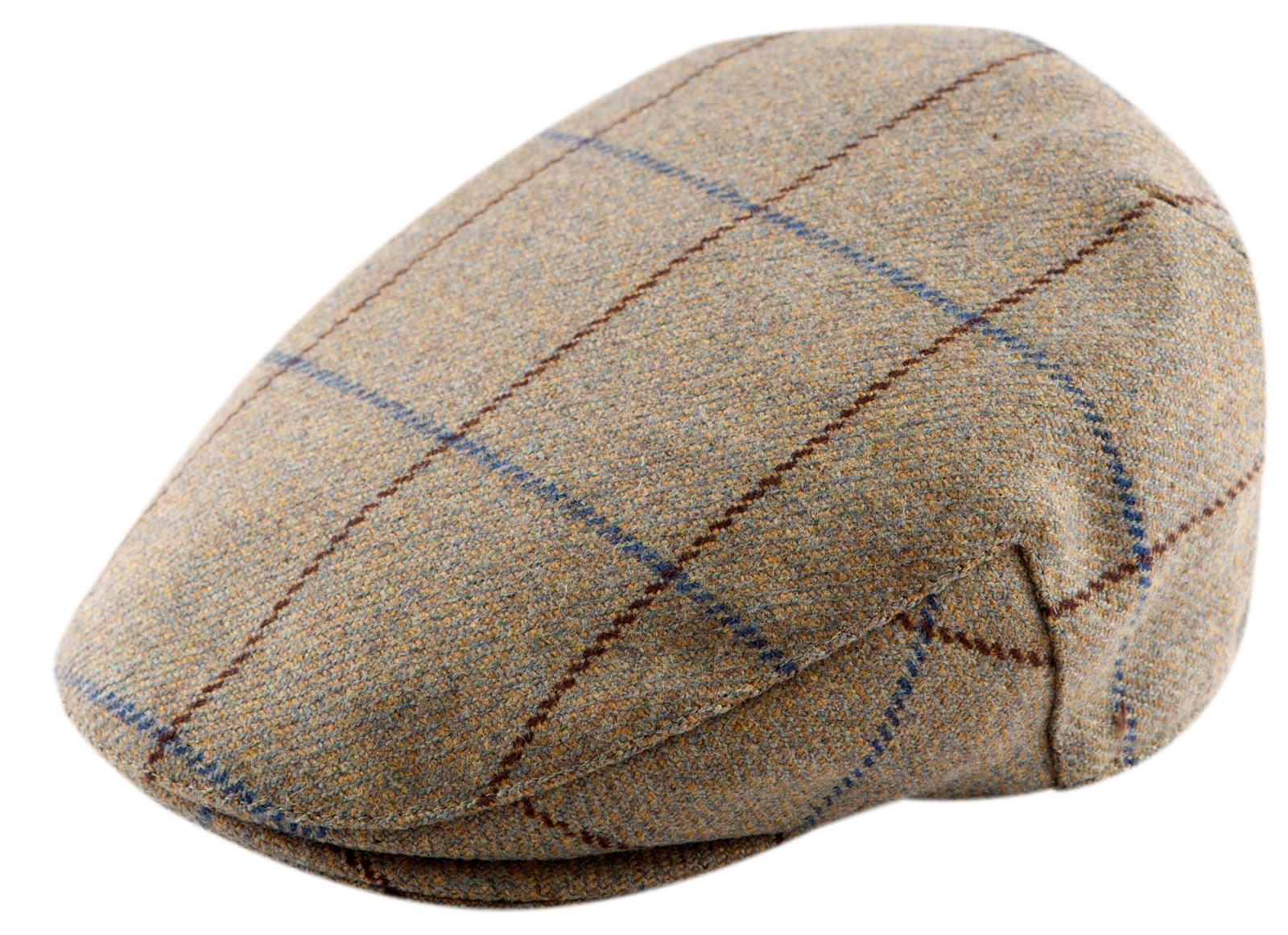
I refer, of course, to the flat cap; also called the driver's cap, newsboy cap, taxi cap, dai cap, golf cap, ivy cap, or scally cap. They all refer to basically the same thing: low, wedge-shaped, with a visor in front instead of a brim all 'round.

They are universally worn, breaking boundaries of class, age, and nationality. In practice, they feel very much like the baseball cap with which you are familiar: snug around the circumference, sitting lightly upon the crown of the head, a brim over the eyes, the ears out in the open. Traditionally a sporty sort of outdoor hat, they can be worn pretty much anywhere today. If you are reticent about wearing a trilby or fedora until you get used to the idea, the flat cap is the ideal way for the Average Guy to break into the World of the Hatted.

The flat cap can trace its ancestry to the Tudor period. Tom Ring's 1566 Portrait of a Man wears a simply constructed cap.

The Tudor cap developed into to the widely-used military cap. They were constructed like this mau cap: rectangular front and back panels, a circular crown, and a demilune-shaped brim. The height of the front panel and the width of the brim were the same, so if the front panel was brought down and attached to the brim...

...the result was the distinctive wedge-shape of the flat cap. Notice the front panel remains, but the back panel is now in one piece with the crown. Many flat caps are made like this, but there are many variations. They are made from just about any fabric imaginable: cotton, tweed, felt, wool...even leather. One benefit of this type of cap is that it can be folded flat and put in a jacket pocket.

For cold weather, flat caps can have ear flaps for warmth; either tucked up inside or tied over the top when not in use.

Some flat caps are made of one piece of shaped and stretched fabric. As a rule, the smoother and plainer, with fewer seams a cap has, the more dressy it looks; since it takes more work to form the shape than just sewing panels together.


The ultimate expression of this is the ascot cap. They are in appearance like a flat cap, but shaped and blocked on a form like a fedora, with no seams. They are made of felt, and quite stiff.


There is another breed of flat cap, that is not derived from the Tudor military cap. It comes from another Tudor hat, like this one painted by Raphael in 1506 of Angelo Doni. It is made of pie-shaped wedges sewn together, with a drawstring around the circumference. It survives today virtually unchanged, in the form of the doctoral cap of academic regalia.

From it we get the eight quarter cap. Less wedge-shaped than the one-panel cap, the eight pieces that form the crown are topped by a button. You can see the resemblance to the baseball cap immediately.

The six quarter cap is identically constructed to the 8/4 cap, but with two fewer pieces for a slightly more streamlined profile.

The five panel cap is a hybrid of the two styles -- the front half is made with a half-circle crown and a front panel, the back half is made with pie wedges like an 8/4! 


There is a flat cap for every taste, and the shape and feel is similar enough to its cousin the baseball cap, that the Average Guy who finds himself hat-shy can slip into proper headwear without a second thought about it. After a time in a flat cap, with which you can practice proper hatiquette, you can decide to expand your horizons with a fedora or a trilby, or not. Many gents are content to spend their entire lives in a flat cap.

Click here to go to the next essay chronologically.

Click here to go back to the previous essay chronologically.

Click here to go back to the beginning.


Friday, October 5, 2012

It's Hip to Be Square

(Part 8 of the series, "The Secret Life of the Tie.")
Chapter 87
This week, we'll return from the land of the Emmys, and talk some more on our series of modern neckwear...for there is one more variation yet to be discussed! We've worked our way through history, from ruffs to stocks, from cravats and steinkirks to ties. We've looked at modern ties, from bow ties and long ties to ascots and day cravats. 

This week, we honor the simple square: the neckerchief. Let's look at its history, its modern use, and uncover a surprising secret.

Unlike the cravats and ties of gentlemen, the neckerchief was the neckwear of the working classes: the blacksmiths, the farmers, the ranchers, the sailors, the cowboys, carpenters and cooks. And like the working men themselves, their neckwear was not simple adornment, but multi-functional. Neckerchiefs are always worn diagonally, with two opposing points tied together. As a simple cotton square tied about the neck, it sopped up sweat while you toiled in the sun. Soak it in in a stream and tie it about your head, and it kept you from overheating in the summer. Worn over your nose and mouth, it was a filter from dust or fumes. In the event of an accident, it could be used as a sling, (or more direly, as a tourniquet.) And it could even be worn under your collar like a "normal" tie, if that need arose.  

The neckerchief is thus an image inseparable from the cowboy/ranch-hand of the American West. Today, it is seeing a resurgence of sorts, due to its ease of use, the ability to be worn with an open collar, and its versatility. Many people see the day cravat as an upper-class affectation, and the earthy roots of the humble neckerchief provide an alternative that nevertheless produces the same sartorial effect: something to take up space under an open collar. 

The neckerchief is most often seen with Naval uniforms worldwide, where it has been worn in that utilitarian capacity since the 16th century. The Navy style is to fold it in a triangle, and roll from the point to the ends to form a tube. Then it is tightly twisted, placed around the neck under the collar, and tied low in a square knot. 

The U.S. Navy standard for the neckerchief is thirty-six inches square, (that's a yard, for you Europeans, 91.5 cm) and technically anything called a "neckerchief" must be close to that dimension. Not only is 36 a nice round number, it gives a diagonal measure of fifty-one inches, which (if you will recall from our study of "starcher" cravats) is ample enough to wrap around the neck twice with room for a large knot. Let's take a quick look at some examples of the neckerchief. 


Sean Connery (1968, as Shalako) wears his neckerchief tightly rolled up, and knotted like a steinkirk, with the ends falling freely. This is the classic cinematic "cowboy style."


This (real) cowboy wears his neckerchief unrolled and loose, in the simplest way possible: with the ends twisted together in front in a simple knot. He wears it over (and covering) his shirt-collar.


Roy Rogers wore his in a showman-like style, with the knot at the side of his neck, and the ends flowing and loose as a ponytail. It looks odd today, but you need to bear in mind that in the mid-twentieth century, all things cowboy and western were very much in vogue in entertainment and popular culture, and rugged manly men in flamboyant outfits like this were more or less the standard for cowboy troubadours. Remember, too, that in black-and-white on a twelve-inch television screen, this would have appeared much less jarring; likewise from a hundred feet away on stage at the Grand Old Opry.


Here's a modern example of wearing the neckerchief. Notice it is worn wrapped front-to-back-to-front, with a small knot. In modern parlance, this is called a "cowboy turtleneck."

The ability to wear a large neckerchief is limited in everyday use, so many wear the smaller version of the neckerchief, the bandanna. A bandanna averages twenty-six inches square or so, which gives the ability to tie around the neck without the extra length of a neckerchief. Why 26 inches? Because diagonally, it measures 36 inches -- in other words, a neckerchief with the points turned toward the center; which was undoubtedly how the first bandannas were formed. This cowboy wears an unrolled bandanna under his shirtcollar like a tie, and simply knotted. (Although arguably neater, the trimmed bandanna was less useful than a neckerchief in emergencies.)


Gene Autry wore a rolled bandanna like this, and it became the ad hoc "cowboy tie." It is rarely seen today under shirtcollars; most opt for the under-the-shirt look, exemplified by Cary Grant in the first image of this post. 


Prince Charles demonstrates the same look as Gene Autry above, but with a slightly smaller bandanna worn right around the neck, with the ends showing. The effect, you'll notice, is reminiscent of a bow tie, with the points standing out.


Robert Downy Jr. (Zodiac) shows the most common way to wear a neckerchief today: bandanna sized, loose around the neck, under the shirt, with the points out.


A more-put-together look crosses the line between neckerchief and day cravat, with a folded style, a Gordien knot, and the points nearly hidden.

There is no doubt that we are seeing more neckerchiefs of all sorts in recent months, but whether this is a long-term shift in style consciousness, or merely a flash fad, only time will tell. That a simple silk square under a shirt is easier and more comfortable than a tie, there is no doubt. As fewer modern men wear ties in their everyday lives, perhaps we will see an increasing number taking up the neckerchief as an alternative.

There is no "wrong" way to tie a neckerchief. Unlike the highly-structured cravats of yore, the multitude of tie knots, and the "proper" way to tie an ascot that we've seen in previous weeks, the working-man's neck scarf reveals its rustic roots in that there is no set method of wearing it! Fold it, twist it, roll it, scrunch it, under shirt or over, under collar or over, and tie with a simple knot, a square knot, a Gordien knot, a four-in-hand knot, pin it, or woggle it. There's not a lot of variety even possible with a bandanna due to its diminutive size, but the extra length of a true yard-wide neckerchief lends itself to a greater amount of sartorial expression.

Of course, just because there is no set method of wearing them, doesn't mean that there is anything new under the sun. Wear a neckerchief like Cary Grant above, and you're wearing a Cravate Collier de Cheval, although you may not realize it. Likewise, Gene Autry is wearing his like a Cravate à la Colin. There may be new names, like a "Cowboy Turtleneck," but scratch the surface and you find a simple Cravate à l'Oriental! You may think you are being cutting-edge by twisting the points in front and then tying them in back, but in fact you have just "discovered" the Cravate à l'Irlandaise!

The reason for these similarities becomes immediately clear if you've been paying attention through our Weeks of History: for a neckerchief is in fact nothing more nor less than the cravat of 1830, merely unstarched and worn under the shirt. Once you have that "light-bulb moment," and realize that The Art of Tying the Cravat isn't as pointless and obsolete as you thought it was, and may in fact be re-inventing itself day by day, you should go back and read it with renewed vigor. You'll start seeing those hoary old knots re-appearing, being worn by folks today who think they are being hip and trendy. And then you can be hip and trendy, too.

Click here to go to the next essay chronologically, Part Nine of The Secret Life of the Tie.

Click here to go back to the previous essay chronologically.

Click here to go back to Part Seven of The Secret Life of the Tie.

Click here to go back to Part One of The Secret Life of the Tie.

Click here to go back to the beginning.

Friday, September 14, 2012

You Bet Your Ascot

(Part 6 of the series, "The Secret Life of the Tie.")
Chapter 84
Well, here it is -- you knew it had to happen sooner or later. Yes, this week is your introduction to the ascot, the little-known, seldom-used daytime-formal neckwear option. Long ties are universal, and bow ties are becoming common enough that you may see one everyday, and you should certainly wear one at least occasionally. But a man can live his entire life and count with the fingers on one hand the times he's seen an ascot worn, and those usually only in the sort of movies that his wife watches -- and most men will play out their span of years never, ever having worn one. 

So woebetide the humble ascot, the orphaned neckcloth, the last remaining relic relegated to a bygone era of formalwear. It uniquely functions with one foot in the present and one foot in the past, but that doesn't mean it is a mode of clothing without purpose in today's world. 

For who wears morning dress anymore? Precious few even know what "morning dress" is, or when to wear it. Many "fashion bloggers" think that daytime formalwear is dead and buried, a relic of the nineteenth century. Others think it is a rigid and proscribed thing, that must be followed exactly lest one look an uneducated and bumbling fool, or (worse,) a poseur who doesn't know what he's doing. Both, are of course wrong, in Your Humble Author's perfect and inerrant opinion. 

Let's take a quick look and review a little, to make sure we're all singin' from the same sheet of music, so to speak. We've discussed evening wear a few times before, and critiqued countless celebrities, but rarely mentioned morning formals. Simply, formalwear is formalwear: the styles to be worn are different for daylight and nighttime, but they are worn to the same sorts of events. They aren't sombre or bleak, but party clothes, meant to be worn to festive events, balls, and situations where you should be enjoying yourself. The usual demarcation line is "before six" and "after six," but practically, it's the presence of sunlight when the event ends that counts. If the sun hasn't set when you're done -- morning wear. If the stars are out -- evening wear. Simple, in theory. 

The morning dress suit, is directly equivalent to the evening dress suit. They serve the same function, and represent the same relative level of formality. The cutaway coat sweeps away from the waist button and is quite long: longer than a tailcoat. Rather than black, the morning coat is dark grey. The trousers are light grey, in stripes or patterns. The waistcoat has a high crossover. And the colors --oh, the colors! Quite unlike the military precision and stark monochromatism of the evening suit, there is a tremendous amount of latitude in cut and color and expression in the morning suit. Unlike evening wear, much more particular attention must be paid to the season, the weather, and the venue, to use colors and patterns effectively.

The stroller suit is likewise the direct equivalent to the dinner suit. It is considered "undress," and in fact the stroller was not too long ago everyday business wear. In its particulars it is identical to the morning suit, with the exception of the jacket, which is not cut long. It usually has peak lapels and a single button, and is Oxford grey.

There are some critics that will descry the use of an ascot with a stroller, claiming that as an undress suit, it needs a fold collar and simple long tie. My response to that is simple: really? You wear a long tie every day of your life, you have one opportunity to wear a stroller, and you're gonna stick with another long tie? I say paugh to the pundits and nay-sayers: if you have an opportunity to wear morning dress, for crying out loud, for the sake of all that is beautiful and good in the world, wear it with an ascot.

That being said, let's look at the ascot itself. There is nothing more piteous than a pre-tied ascot, especially now in the twenty-first century when you may only have one opportunity to wear one properly! Study this diagram until you fully understand it. It's important. We will be referring to these seven steps throughout the remainder of this post.

You'll notice that an ascot isn't made like a long tie. For one thing, both ends are wide. You can purchase ascots today; most of them look like this, with wide paddles, a thin neckstrap, and a definite "right side" and "wrong side."

This, of course, makes the ascot a single-purpose item. Factor in that they are not inexpensive pieces of neckwear, and you have a couple choices ahead of you. The first is to make one yourself, or have one made for you. This illustration should tell you everything you need to know.

The other option is to do it the old-fashioned way, with a single piece of fabric. I picked this up at my favorite secondhand store. It's a woman's scarf, (I won't tell anyone if you won't,) silk, 4" by 70", and it's absolutely perfect for this purpose. It's just what would have been used historically. Like the rest of my tie demonstrations, I'm tying right on my tailor's form, without shirt or collar or waistcoat to get in the way of a clear view. Remember these are all worn with a waistcoat -- no exceptions -- and the collar can be either stand or fold. In keeping with the day/night symmetry, I would go with a stand collar for morning dress, and fold collar for the stroller, but that's just me. There are no hard and fast rules, really, and don't believe anyone that says there are. There are only traditions, and those traditions are not nearly so ingrained in morning dress as they are in evening dress, 

The first step is to fold the scarf over twice, to make a strap of about an inch to go around your neck. In the above diagram, this is Step 1, just before the LiCo maneuver in Step 2.

This is Step 4. At this point, take the two ends and unfold them to their full width.

This is Step 6...

...and this is Step 7, with the ends crossed and ready to pin to the shirt. A stick-pin is traditional, put through the two blades just below the knot, that hold the knot in place. 

To answer your next question, (you were going to ask a question, right?) this is the same knot, made with a scarf of single-thickness. These types of scarves are readily available, so it'd be great if they would work, but they are just too diaphanous and lightweight to hold the knot. You'd really have to go with a thick silk of double-thickness to tie an ascot, short of buying a purpose-built model.

If you've done your homework and studied the cravat constructions of a few weeks ago, the ascot should seem oddly familiar to you. Yes, this same knot, with a front-to-back-to-front wrap, is none other than a Cravate à l' Anglaise -- an unstarched Nœud Gordien cravat!

You can replicate all the classic cravats with a scarf like this, like this cravat à la Paresseuse. They have limited practical use because of the high neckline, BUT, with a high standing wing collar, you could have a bit of fun with a traditional cravat...at the right venue, when such a knot would be seen as a charming eccentricity, and not a gauche error in judgement. They tend to look more pleasant to modern eyes without the starch, but again that's just my opinion.

While we're talking about traditional knots, keeping the scarf folded along its length, and tying it in a simple square knot, results in the Steinkirk of yore, that we've looked at before.

The Ruche tie, which is simply an ascot tied like a four-in-hand, is sometimes used where the ascot would seem too showy, or where the personality of the wearer is not strong enough to carry off a true ascot. Some prefer the Ruche with a stroller, but as mentioned before, I don't hold with that. This example is tied with a Cross Kelvin knot, for a bit more interest.

The Ruche has roots in history, as this photo shows: it's not just a short-cut for those that don't know how to tie a proper ascot. Still, the universality of long ties makes the Ruche a bit twee as a formal option. I'd sooner wear it with an everyday suit!

The ascot can be approximated with a long tie. Although not my first option when others are available, this demonstrates that it can be done with acceptable results in a pinch. 

Why you'd find yourself at a daytime formal event with a suit but not a tie, I have no idea -- but in the interest of the acquisition of knowledge, I'll show you how it's done. 

We start inside-out and backwards, tying the thin end around the thick end. This would be Step 1. 

Step 2 would be a LoRiCo movement, like the beginning of an Oriental knot.

This is Step 4...

...and Step 6...

...and Step 7, ready to pin. As you can see, the thin end is completely covered by the thick end. With a stand collar, the neckstrap would have to be twisted so its right-side out, but it gives a very nice shape overall: the thick tie lining gives the knot some geometric interest.

The other method "normalizes" the tie ends, with the thick end tying around the thin end, also with a LoRiCo. It also starts inside-out. This is Step 1...

...Step 4...

...Step 5...

...and Step 7. The knot is large and square, and gives a much different ascot effect. This version looks nice with a fold collar.

So, to answer the rhetorical question posed earlier, who wears morning dress anymore? The answer: you can, if you go to the right venue. Full morning dress is still worn occasionally for daytime weddings in Europe and the UK, although strollers would most likely be the suit of choice for most American venues. Day outings, wine tastings, garden parties, luncheons, picnics, all hold promise for formal fun. If you want to exercise your right to formality, in most cases you'll have to be the instigator. Find a group of like-minded chums (or chums with like-minded wives, if it comes down to it,) and organize your own. You may have to blend in a few evening events to exercise those dinner suits as well. A Superbowl party with ascots and striped trousers? Why not? Why not, I say?