Showing posts with label Insouciance. Show all posts

Friday, July 4, 2014

The Calculus of Dressing

Appendix 2.

Back in the installment Chapter 70, called “Keeping Your Balance,” we looked at the concept of weighing specific style variations, each against each other, to achieve a harmonious whole within a single outfit. To help visualize this, I devised a graphic representation of the continuum of balance as a three-dimensional cube, each of the axes standing for one range of opposites—the Continuum Cube.

That was all well and good for an overview, but it was the stripped down, basic version – there’s actually more to the theory than what I posted there! I gave a more complete view in my published works, but here in the Appendices I am going to share with you the fully-realized, advanced theory.

The complete theory of balance is visualized scientifically here by use of a four-dimensional theoretical construct of the Continuum Cube—a Grand Unified Theory of dressing well, if you will, that graphs every possible option of menswear for every possible circumstance.

There have been numerous philosophical postulations over the years concerning the art of dressing well. To those we can now add a mathematical theorem, a graphic distillation of the musings of D’Aurevilly, Wilde, Bulwer-Lytton and de Balzac, which clarifies and concretizes their ideas in a clear way: that dressing well is an ethos, an attitude and outlook on the world that just happens to be reflected in its external appearance. The most obvious aspect of your appearance is your refinement of the art of dressing well: to be correctly and impeccably attired in any given situation. As Brummel said, “If John Bull turns to look after you, you are not well-dressed, but either too stiff, too tight, or too fashionable.”

Let’s start with the idea of formality. You have an innate sense of the degree of formality of any outfit you might be called upon to wear. You wear nicer clothes to church than you do to work, and nicer clothes to a wedding than you do to church; and if you were playing golf, you would be dressed better than if you were playing tennis. If you were to graph all the different sorts of clothes you wear, you could represent them as a line, with the dressiest at one end, and the most casual at the other. We'll call the two extremes “formal” and “sporty.” What we would have is a bit of geometry: a line. It would look like this:


Notice that from any point on the line, you could choose something more formal, or sportier (you could also call it “casual” or “informal.”) Our line extends forever in both directions, as lines do, but that won't do for us; for you can't go on increasing formality forever.


The solution is to make the line asymptotic and the end-points as a limit, which can be approached infinitely closely, but you actually can’t truly “get there.” Reaching the limit is relativistic—the closer you get, the further you have to go, and the harder it is to get there. One limit is the point beyond which you can't get any more formal. That point represents the dress suit: for white tie and tails is the most formal thing a man can wear in the Western world. In other cultures it may take a different form, but the result is the same.


Logically, at the other end is an asymptotic limit beyond which one can't get more casual – which, it stands to reason, is being entirely naked. (Why is this, you may ask? Patience…we'll discover why soon.)


So our line segment, our X axis, if you will, looks like this:


Every element and article you wear fits somewhere along this line. The goal is an average between two extremes that is not too far out of the range of “normal” for your particular place and circumstance; whether this is attending a wedding or shopping for groceries. In other words, for any point on the line, any deviation on one side of the point must be weighed carefully against its variation on the opposite side of the point, to achieve a harmonious whole. The problem in today's world arises when a man doesn't know what to wear at all, much less how to find what an average value is, and even less how to work the extremes to maintain that balance properly.

As an example: everyone has at some point been subjected to such aberrations as a tuxedo jacket that has been paired with sneakers, or a patterned shirt, or a loosely-knotted long tie, or a silly hat, or sloppy jeans. Their misguided thinking is that a dinner jackets' formality will be offset by the other things, and the average will be dressy-casual.

This doesn't work in practice, because the attempt to balance two variations is increasingly unlikely to create a harmonious average the farther apart those extremes are. In fact, dinner dress is so extremely proscribed, it takes very little to push its balance to a place of informality: all that is needed are minor alterations to detail, like a subtly-colored boutonniere, a flash of pocket square, a rakishly-designed waistcoat, or even the material of the jacket itself.

It seems pretty easy so far, doesn't it? Well, we have another line, which describes another dimension of being properly dressed: the difference between “town” and “country” wear. Whilst the “Formal/Sporty” line describes the differences in the purpose and cut of your clothes, the “Town/Country” line is concerned with your clothes' color and pattern: for mens' clothes should properly match the environment in which they are worn. A “town suit,” for instance, is plainly cut and conservatively tailored, with smooth fabrics and dark colors, usually in shades of black or blue: the colors of steel and iron and concrete, the textures of glass and chrome and macadam.


A “country suit” tends toward the rough tweeds, pebbly or textured fabrics, in browns or greens, in plaids, checks, or other patterns, with details like collar tabs, elbow patches, or flapped pockets: the colors and textures of nature, with details that reflect outdoor pursuits.


This line, too, has two asymptotic limits, and those limits are of necessity the same as with the formality continuum: the most “Town” you can get is a dress suit of white tie and tails, and the most “Country” is not dressed at all. The two scales that we have seen operate independently of each other: for every point of formality, there can be applied the complete range of values in possible color and pattern. We can graph these against each other on an X and Y axis.


Most men have a passing experience in the art of color and pattern matching. At its most basic, it is an intuitive reflex. A dark suit needs a light shirt and a bright tie, for instance; or else the suit looks muddy and somber. A light suit looks better with a patterned shirt of a darker color, and so on. Making informed decisions regarding pattern takes more experience, but is also largely intuitive. Matching a plaid shirt with a plaid tie may look busy if they are in the same color range and size, especially if paired with a plain suit; but a suit with a subtle pattern paired with a very light plaid shirt and a very strong plaid tie may look very handsome indeed. It's all in the balance created between the factors.

If we were to graph every possible combination of these two groups of extremes, we would discover the result is the limit of a square, each point of which describes one individual shade of purpose and cut, color and pattern.


Dressing well now becomes a matter of determining your purpose and location at any given time, charting that point on the graph, and making your clothing suitable to that point on the X-Y axis. The closer the average effect of your clothing is to that point, the more “correctly” you will be seen to be dressed. On this square, the front right-hand corner, representing maximum values of Town-Formal, would represent the dress suit; and the rear left corner, representing maximum values of Country-Sporty, would be nudity. (This latter corner, naturally, is to be avoided if you desire to be a well-dressed fellow.) The relationship of all four factors taken together is the balance of your outfit.

Where the axes cross, (we'll call it point 0,0) is a theoretical neutral outfit that is all-purpose, neither too dressy nor too sporty, that would not look too out of place either in the city or out camping. This theoretical middle-of-the-road outfit would not be a panacea that would be instantly accepted anywhere, mind you! It would, rather, be bland porridge, neither one thing nor another, and you would likely be seen everywhere as not quite fitting in, no matter where you were or what you were doing. The neutral point at the center of the graph is not a target at which to aim – it is a sinkhole to be avoided!

Before we continue, let's look at some examples of how to use the scale as we have constructed it thus far.

You can adjust the balance to your immediate purpose, by changing a single detail to adjust the point along both axes. A matching three-piece looks official and professional for a business meeting, and would occupy a place well in the Town scale, and moderately in the Formal scale. Simply change out the matching waistcoat for a tattersall version, and the outfit looks less stuffy for an evening out, by skewing the point both towards the Sporty and Country.

You can also make an adjustment to either scale independently. Running to the auto-parts store to buy an oil filter and spark plugs in a suit and tie may raise some eyebrows, but you can keep the same point along the Formal continuum and slide the Town continuum strongly into the Country realm with a hardy tweed jacket, open-collar shirt and dungarees: the message is that grungy business is at hand. A seersucker suit, loafers, and a bow tie looks fine on the boardwalk, firmly in the Sporty-Country quadrant, but you wouldn't wear it to church without skewing it into the Country-Formal quadrant.

These basic style decisions can be complicated with variable factors such as the time of year and the immediate weather conditions. For instance, on a bright day, a pair of tan trousers may look fine with a mid-gray plain weave jacket; but on an overcast day, it would appear too Country, and a darker gray herringbone jacket to skew it slightly towards the Town side may look better. In the heat of summer, a shirt and tie may look overdressed in lieu of a simple polo shirt under your jacket; but in the fall, going without a tie may result in an underdressed appearance.

Now that you've gotten familiar with the two-axis system of clothing balance, we'll add a third measure to the continuum. Just like the other two, this third balance factor operates independently, and can be applied to every point in the square. This scale will be applied to your clothes' style and detail.


At one end, we have the historical extreme – the traditional, conservative, classic styles. At the other end, the contemporary extreme – the avant-garde, imaginative, futuristic, and innovative styles. We'll place this continuum at right angles to the other two, along the Z-axis: and call the extremes “Historical” and “Innovative.” Simply, the further along the “Innovative” direction you go, the further away you get from tried-and-true style trends.


When we graph every possibility of style against our other two measures, all the major factors of sartorial balance are accounted for and can be reduced to three continua. These continua can be visualized and plotted against each other as axes on a three-dimensional graph.


This is the Continuum Cube. Any point within this cube is defined by our three balance factors. The continuum is the limit of a cube; it is not unbounded on all sides. The ideal, as it was with the two-axis plane, is not the intersection of the axes at the exact center of the cube. Near the external faces of the cube are the limits of perspicacity, where clothes become costume. And just as you've seen with each individual scale, and also with the X-Y axis, the X-Y-Z axis has the same oppositional value, viz., the “Fully Dressed Point” at maximum Town-Formal-Historical is counterbalanced by its logical opposite at maximum Sporty-Country-Innovative – the “Fully Undressed Point.”

Let's use the Continuum Cube now to briefly demonstrate how skewing works along all three axes. We'll start at an easy point to visualize: the top right corner of the cube that pegs all three scales for formal, town, historical wear. Of course, it's the dress suit again: bespoke tailcoat and trousers, boiled-front shirt, pique Marcella waistcoat, stiff detachable wing collar, white tie, and patent leather pumps, with all the accompanying studs, links, straps, braces, and buttons that go with it. You can't get more Formal-Town-Historical than that. It's a very exacting and unforgiving point on the cube, right at the end of the limits, and must be followed precisely, because right on the apex of the cube is where it belongs.

Because of its precarious position, the dress suit is easily knocked off its apex by the addition or alteration of any detail. A simple boutonniere will skew the outfit slightly down the X axis, ever so slightly away from Formal. Substitute balmorals for pumps, and the skew jumps further down the Sporty scale, as well as the Country, and even slightly Innovative, and just like that – you're off the face of the cube and into the interior. This lone example also demonstrates why proper white tie is as exacting as it is.

Why is nudity the “Fully Undressed Point,” and not, say, swimming trunks, or even underwear? Because even swim trunks are subject to variations in sportiness, color, texture, and historicity, all of which will place it somewhere within the boundaries of the Cube, even if it is just adjacent to the apex. There just isn't a garment that is the opposite of a dress suit: as the limits of the axes are reached, the options of the furthermost point dwindle down, until the point of the apex is...nothing.

The apex and surface points are for our purposes theoretical: since a limit by definition can never be reached, you won't be dealing with the extremes on the faces of the cube. You will be dealing with any number of factors that will average into a value somewhere in the middle interior of the continuum.

Now, the three-dimensional Continuum Cube only works as far as the physical aspect of your clothes – but as we’ve found, how you wear your clothes, your degree of insouciance and panache, has an effect on where they skew on the Cube as well. This is of particular interest, as a properly insouciant attitude is integral to being perceived as well-dressed. So we must bring another axis in play – a W axis, at right angles to the other three, to make a hypercube.

What’s that you say? You’ve no idea how that works? Well, let’s work through the progression mentally. Take a point, and put another point at right angles to it. (Since a point has no dimension, technically “right angles” is any direction at all, but we’ll call it “right angles” for the sake of consistency of the illustration.) These two points form a one-dimensional figure: a line segment. It runs in one direction—length. Now take a line segment, and put four of them at right angles to each other such that they define an area. You have made a two-dimensional square: it runs in two directions—length and width. Now take six squares, and put them at right angles to each other so that they define an area. You have a cube now: three dimensions, three directions—length, width, and depth. Of course, here on your computer screen it’s merely a shadow of a three-dimensional form, but your brain recognizes it as a cube, even though all the sides aren’t the same length and the angles aren’t ninety degrees.


So far so good, but now it gets tricky. Continue the pattern: two points, four lines, six squares – now what? Of course, eight cubes; at right angles to each other such that they define an area of four dimensions. The problem comes when we try to imagine the W-axis, at right angles to the X, Y, and Z axes. What’s after height, width, and depth? The best we can see is a three-dimensional shadow, reduced again to two dimensions on your screen – a mere shadow of a shadow.


Because it is so devilishly hard to imagine a four-dimensional hypercube, and even more difficult to represent it on a two-dimensional computer screen, I won't even attempt to include it graphically. That fourth dimension represents the manner of the method and attitude of wearing your clothing and the degree of precision of its physical execution. At one limit, we have nonchalant, detached, easygoing, and breezy. At the other extreme, calculated, purposeful, precise, and severe. 


Graphed against the other 3 axes, the limit of Nonchalance coincides with the “Fully Dressed Limit” of Town-Formal-Historical, and the limit of Precision coincides with the “Fully Undressed Limit” of Sporty-Country-Innovative; thus, the closer to fully dressed one is, the more nonchalance is required. Contrariwise, the more casual your clothing, the more precision is required to offset the ever-present danger of slovenliness.

This presents a useful method of representing the fourth dimension of the Continuum Cube in relation to the other three directions. We know the limits of Nonchalance/Precision coincide with the limits of the other three continua, and we know each three-dimensional point is subject to the complete four-dimensional variance. (If this is befuddling, just reduce the exercise by one dimension: every single point on the two-dimensional graph of Formal/Sporty and Town/Country is subject to the entire scope of the Historical/Innovative variation.)

If the four extreme limits located at opposite apices of our hypercube (the F/T/H/N and the S/C/I/P limits) are then connected by a line, it will also pass through the midpoint of the W, X, Y, and Z axes, (at 0,0,0,0,) and a new axis is created: what I shall call the DANDY AXIS. (Dandy in its historical sense: as representing the apex of the art of dressing well from a holistic mind/body standpoint.)


Quite simply, for any circumstance, the most elegant mode of dress will exist at some particular point along the Dandy Axis, wherein all four continuua shift together in an equalinear progression. All four factors will then be in harmony, no one variation will stand out among the others, and for any given situation there exists a correlating given point on the Dandy Axis wherein you will assuredly be properly dressed, and John Bull will be given no reason to turn his head to look after you.

The relationship of the Dandy Axis to the four directional axes W, X, Y, and Z can be easily illustrated by separating the four dimensions out and placing them alongside each other, as scales on a slide rule. The Dandy Axis is represented by the movable cursor, which intersects all four axes perpendicularly along congruent points. This is a handy mental tool for determining correct dress: when only one factor is known, the other three are immediately apparent. In other words, for any given known Purpose (X-axis,) the proper relative degrees of Location (Y-axis,) Tradition (Z-axis,) and Execution (W-axis) are revealed in their correct place.


But now, back to the Continuum Cube itself. The Dandy Axis is the average of all the values at each point of the cube. This is an important relationship: for at whichever point in the interior of the cube you may find yourself, that point will always be perpendicular to a correlating point somewhere along the length of the Dandy Axis, as well as set a certain distance apart from it.

The Dandy Axis is thus very useful in revealing instantly, in a relative way, both “how dressed” you are, as a function of the point along the Dandy Axis' length, as well as any deviation from the proper standard, as a function of your point's distance from the Axis.

It can also be a useful compass, to give you an “absolute value” of just how dressed you are compared to any other point in the Continuum Cube. Let's take an example, and a rather obvious one, that demonstrates graphically how “more dressed” doesn't necessarily equate to “more clothes.” First, we'll take a tee-shirt, flip-flops, and cargo shorts, and plot its point within the Cube.


This graphic is looking straight down along the Dandy Axis, through the cube, to its S/C/I/P apex. The cube has been “sliced” through our point on a plane perpendicular to the Axis, resulting in the small tetrahedral figure. The size of the tetrahedron indicates that our point is close to the “undress limit” of the cube. Note, too, the distance of our point from the Dandy Axis.

Now, let us compare this to a different point, this one representative of a polo shirt, Bermuda shorts, and boat shoes.


This outfit covers the same amount of skin, and fulfills the same function, as the previous one. Its relative position in the Cube, skewed toward the Historical and Formal ranges slightly, cause it to sit perpendicularly to the Dandy Axis further along its length from the “undress apex,” (indicated by the larger size of the tetrahedron; due to the larger “bite” of the cube the cut has taken) and closer to the Dandy Axis itself: resulting in being “more correctly dressed,” with the same amount of clothing. (This assumes the optimal dandy values along the W axis for each point, as well.)

With practice, you can keep the Continuum Cube in your minds' eye as you decide what to wear, place a target point within the cube along the Dandy Axis, and choose clothes that will average into that target point. By looking at what you wear in this theoretical way, and fitting it into this matrix, you needn't be operating solely on intuition and guesswork, and you will have a solid guide for making wise sartorial decisions that will never inadvertently hit wide of the mark, by being too showy, anachronistic, or situationally inappropriate...or as Brummel would say, “too stiff, tight, or fashionable.”

Click here to go back to the installment that this Appendix references.

Friday, September 28, 2012

Em & Emmy

(The second annual "Best Dressed Man at the Emmys" award)
Chapter 86
It's time for the Emmys, and that means it's time for the Dress Like A Grown-up! critical eye to be cast once again on the Men of Fashion and Influence in tinseltown!

It's been awhile since we've played this game, so for the benefit of our newer followers, let's go over the groundrules.

There are several large Hollywoody awards presentations throughout the year, and each of them has its own shade of formality and elegance. Using the standards that each one sets for itself, we look at what people are wearing, for good or for ill.

We don't care what the women are wearing. Every other blog in the universe is covering all the gowns and dresses, fawning and drooling all over themselves and playing who-wore-it-best games. Not here! We're concerned solely with the gents' evening wear. 

We don't care who made the dinner suits and tuxedos. Cut, finish, style, and panache trumps a label and a designer's ego everytime. So we'll look purely at the execution: the cut, design, style, and wearability.

We don't care how famous these blokes are or what they won. The Emmy awards are nothing but a mutual back-slapping party for television actors, whose sole contribution to society is to be able to repeat words that other people had written for them. It is at best a show of bread and circuses to distract the somnambulent public from much more important and life-changing issues that loom darkly just over the horizon.

This is not intended to be a comprehensive view, as images of male attendees are relatively few and far between, and are covered not at all for their fashion choices. I watch the whole painful affair, so you don't have to: I take notes and pay attention to folk in the audience as well as on stage; and hopefully, some of them get enough lens-time to accommodate our analysis afterward.

We'll look at men on the Red Carpet, just as they arrive for the show. Ideally, this will show the men at their best and freshest of the evening. I will present some examples for our excoriation or exultation, as needed. If necessary, I will alter the contrast and brightness of the images to give a clearer view of the details of the article in question, and we'll conclude with my choice of the Best Dressed Man at the Emmys.

In centuries past, the host of an event set the tone for the standard of formality. Let's test this by looking at Jimmy Kimmel, the host of the evening.
Jimmy is dressed in a dinner suit with details that push it further into the casual spectrum than average. Notice the immaculate tailoring, the pagoda shoulders and roped sleeveheads, the roll of the silk lapels, the amount of waist suppression, and the length of the skirts. All very classic, and very well done. It is worn unbuttoned, with a waistcoat, exactly as it should be.

Now look at the details, that would be more at home with a business suit than a tuxedo: two buttons on the jacket, flapped pockets, and notch lapels that are a touch too insubstantial for a dinner suit. Notice, too, that his five-button waistcoat has a medium crossover, which is a further casual touch. Dinner suit waistcoats should have a lower crossover, three or four close-set buttons, that show more shirtfront. His shirt has an attached fold collar, which is perfectly acceptable for a dinner suit, and the bow tie is elegant. You may not realize this, but Kimmel is walking a razor's edge. The perfect cut of the coat is the only thing that makes this deviation into a business suit acceptable: any less, and it would be "just a black suit," and not a tuxedo. A lesser cut would demand more strict adherence to true evening wear in the details, to achieve the same level of casualness.

Men exist to make women look better at events like this, so it's important that both sides of the gender equation have a certain amount of equivalency. The womens' full-length evening gowns are enough to verify that this is indeed a semi-formal (or undress or black tie) event. The standard for semi-formal evening wear is of course the dinner suit, also called the tuxedo. And Kimmel's tuxedo sets the evening's tone within the dinner suit's spectrum. It's a shame that we have to work backwards to suss out what men need to be wearing like this nowadays -- it used to be that women gauged what they needed to wear, off of the tone that the men set for the event.

This is what happens when the equation is unequal. This is not an interchange of coequals, rather, it is a mother taking her kid to the first day of kindergarten. Nicole Kidman does herself no favors by taking the dominant role and leading Keith Urban forward by the hand, but neither does Urban do his albino amazonian dominatrix any favors by trailing meekly behind with stooped shoulders and pensive expression. His suit reflects that weakness. The small collar and long tie, the cuffs down to his knuckles, the skinny pants that crumple awkwardly over his high-laced boots, all conspire to push him strongly into the background, which rather than emphasizing Kidman, serves to diminishes her.


Compare this to Alec Baldwin, who makes a different grievous error. Apparently he has just come from Hilaria Thomas' prom. Matching your tie to her dress, Alec? Really? This sort of splash-o-color really never works with formal wear. The ill-fitting suit and a long tie just make you look like an insurance salesman. You still have a lot to learn from Jack Donaghy, apparently.

Ben Falcone comes a step closer, but demonstrates yet another error. If your wife, the Breadwinner McCarthy, is willing to go to great lengths and expense to get dresses especially made to fit her, why the hell can't you even hem your own damn pants? It's bad enough that she's married to an Edward Gorey illustration -- you really should take a little effort to make sure you augment her appearance. She's putting in the effort to look incredible; you need to back her up and harmonize with her efforts. I'll give you props for the link-front closure, the black boutonnière, and the bow tie. Well done. But next time, do us all a favor, wear a jacket that fits both your chest and your arms. Wider peak lapels wouldn't hurt. Leave the link in your pocket, hike your pants up, and wear a cummerbund. Melissa will thank you. As will we all. 


Ricky Gervais copies his Golden Globes ensemble from earlier this year, right down to the tacky you-can't-see-me shades and open-collar black shirt. At least the jacket isn't maroon this time. But formalwear, this isn't. Silk lapels on a hacking jacket do not make a Tuxedo. An Englishman should know better.


Oh, Carson, where to start? Are you attending or working as a parking valet? I don't know how you left the house thinking this looked acceptable, so I'll just start you off simple: dinner suits don't have belts.


David Benioff: ditto. It's a rare opportunity for you to be featured on this side of the lens: stop screwing it up. Unless you're trying to be some sort of ironic hipster. In which case, you're still doing it wrong.


Michael Hall has come from a funeral, apparently. An odd choice for a fun occasion. Just 'cuz it's black doesn't mean it's formal!


Kevin Costner, you are responsible for an outbreak of facepalms all over the world right now. Just wanted to let you know.


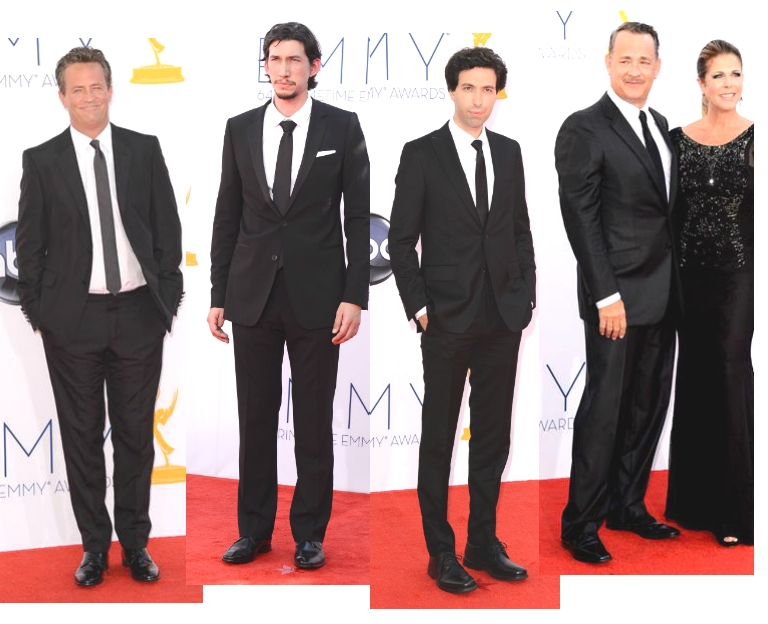
In every awards show, we're faced with a Man in Black Brigade: guys who really don't get black tie at all, and the nearest they can figure is to wear a black suit with a black long tie. Befuddling, considering what these people do for a living. 
Matthew Perry, Adam Driver, Alex Karpovsky, I can understand. But what is Tom Hanks doing in this lineup? Can this be the same man who was the best dressed at the Oscars earlier this year?


Every year, every awards show, Steve Buschemi comes close but misses the target, and I ridicule him mercilessly. But he's gotten much better. Perhaps he reads Dress Like A Grownup! for hints...but his jacket fits well this time, without his usual gap at the back of the collar. His trousers are still a tad long, pooling instead of breaking cleanly. He's still afraid of the bow tie, though. C'mon, Stevey, go for it. With a bow, this outfit would look really good on you. You're tall, you're thin, you're made to wear stuff like this. Don't fear the bow.

Not even children are immune from bad decisions. This is particularly tragic, because it's not their fault. They're young, they're stupid, and they have highly-paid consultants to make sure they're appropriately dressed. So what happened to Rico Rodriguez? He played an annoyingly large role in the awards this week, so one would think he would be dressed adequately. Nope.

This begs the question: should boys even be dressed in proper evening wear? My answer is NO. Dinner suits are grown-up clothes, and are not for children. That being said, this three-piece suit is a good one, dark grey and quite nice. The primary problem is the tailoring -- it's just far too long in the sleeves and legs. I don't even have a problem with the wingtip spectator shoes: hey, he's a kid, why not? It's cute. An adult couldn't get away with it, though. The black shirt/white tie combo is simply a terrible idea. A simple white shirt and a dark patterned bow tie, worn with the jacket open, would be just the way to go. Rico would look like a mature young man, instead of a small pudgy clown.


This is another example of too-cute-by-half misdressing. Shoes are nice, trousers a bit long, but the wee tux is too precious for a bairn. And the blue body with black sleeves makes Nolan Gould look a bit like a hobbit footman in an oversized service waistcoat.


This is what happens when otherwise well-intentioned people attempt to do things right, but don't understand the basics. Pocket-hockey-playing Evan Peters is giving it the old college try. Shiny shoes, trouser legs better than most, bow tie, even a pocket square. His waistband is what fails him, for he is ignorant of the fact that his shirt should never show below the button-point of his jacket. His hipster low-rise pants show a shocking eight inches of The White Triangle of Doom below the button. Next time, Evan -- taller pants, a low-button jacket, a cummerbund, a waistcoat, anything


Same error, Reid Scott. Another member of the pocket-hockey team, his difficulty is exacerbated by the use of a belt. Braces yes; belt no. Another simple rule.


Let's leave the pocket-hockey players, and look at some errors in fit next. Eric Stonestreet is a barrel-chested fellow, and his ill-fitting jacket is both too long in the sleeves, and too tight in the chest. This awkward off-balance train wreck is the unhappy result. It would be no trouble at all for a bespoke tailor to make a dinner jacket with broad shoulders, an athletic shape, and strong lapels that would make Eric look every inch a movie star, instead of an out-of-breath maitre d'. Why does he not? Who knows.


Now let's look at the opposite predicament. Max Greenfield is wearing a tuxedo that, in theory, fits. Everything is at least hemmed and cut to length. No, the problem here is the minisuit styling. The button-point is at his sternum, the skirts at his hips, the lapels twee and insubstantial. Max is a tall enough fellow, but this just makes him look taller and more gangly and out of proportion than he already is. The lesson here is that sometimes, fashion sucks and needs to be ignored. A true Tuxedo in classic proportions is what is called for here.

We've mentioned Peter Dinklage before, and this would seem to be the same suit he wore for the Golden Globes this year. As before, the challenge is cutting a dinner suit to fit his unique physiogomy, without drawing attention to it, as well as being an unmistakably adult suit. For a bespoke tailor, this would present no greater problem than fitting any other man.

This suit's casual characteristics would be more suited for a youth, like Nolan Gould. The excess length in the arms and legs make him appear shorter than he is, and the thin lapels don't harmonize with the shape of his chest. The long tie also shortens his shirtfront visually.

'Twere me, I would recommend a slightly taller shirtcollar with a narrower spread, a proper bow tie, and a dinner suit with generous peaked silk lapels, single-button, with a low-crossover waistcoat, all cut and tailored to within a sixteenth of an inch. That would solve all problems of "scale" that we see here.

We'll finish off with the best of the evening. First, the "worst of the best," was Andy Cohen. Andy looks smashing. It's a great dinner suit, everything fits him, is tailored well, and hits the right classic notes. It is right in line with the tone set by Host Kimmel, by playing the details ever so slightly casual: balmoral shoes, buttons that aren't silk-covered, a lapel that is ever so slightly narrowed, a dashing tie with a bit of velvet contrast, and pleated shirtfronts. And then he has to go blow the whole thing with a blue shirt. Why, Andy, why? A blue boutonniere, a blue pocket square, is all the color you ever needed to introduce. I'm so disappointed in you. Shame, for being so very, very close.


Jimmy Fallon has a long track record of doing black-tie very well, and this was no exception. He was in a very traditionally tailored dinner suit, cut well with an impeccable fit. His trousers fall with no break at all. His tie is rakishly slightly askew. So many of the clueless men who were there that night could learn how to do the basics by simply following his example.


Jim Parsons played it the same as last year's Emmys, with a midnight-blue velvet dinner jacket. It's not the same jacket though: this one is cut better, has flapped pockets, and the lapels are much improved over last year in their shape and breadth. He's sticking with a look that works for him, and he's pulling it off well, and improving over time. Good marks for the lad.


Jon Hamm has learned something from his years on Mad Men, not least of which is how to dress well. Note the proper trousers with the satin outside stripe, and the heavier cashmere that gives everything a nice drape and fall. He's wearing a two-button jacket, which we'll credit to the Tone of the Host...although I'd rather have seen this in a one-button style.


Hamm almost takes the evening for best-dressed, except for three minor --very minor-- details. At this level of perfection, it behooves one to be picky. First, the lapels are quite shiny. The silk would have worked better if it were slightly more matte. Second, the bow tie is wrong for the shape of Hamm's head: the shape of the knot and the rounded ends of the leaves are too small and weak for Jon's jaw and high forehead. I would have gone with a stronger tie, with broad square leaves and a larger knot. And the third is that he does not unfasten his jacket the entire evening. 


Which is especially tragic, because when he does, at the after-party, we find that he has been wearing a waistcoat the entire time! A low-cross four button, no less. It's too bad we didn't see this throughout the evening. It would have made him a lock for best-dressed.

 But he must give up that accolade to Damian Lewis, who hit all the notes, was completely correct, and hit it out of the park. Damian's tuxedo fit, was expertly cut and trimmed, and worn correctly. He was the sole attendee who wore a cummerbund, which was a perfect complement to his draped, shawl-collar dinner jacket. His bow tie was the perfect size and shape. Even the white pocket square was sublime. But, the characteristic that puts him over the top, is the easy, casual insouciance that he exudes. He makes his wife Helen McCrory look better just by virtue of his proximity to her. He's calm, confident, and completely at ease in his clothes, not an awkward boy being led around, buttoned up with his hands crammed in his pockets.

Let's look a little closer at the details. His shirt collar is a deep, broad spread, that matches his bow tie, which has an atypical four inch leaf, which suits him. His shawl lapels are shaped just as they should be, with a beautiful belly and curve, and very matte in sheen. The Edwardian turn-back cuffs are a nice retro nod. His shirtfront is narrowly pleated, which is a good match for the casual nature of the shawl collar. The cummerbund hides the waistband of the trousers, and sits at the jacket's button point. Pop quiz: you get 10 brownie points if you can find what he's doing wrong to accommodate the fit of the jacket. (Roll over and highlight the bars below to see the answer.)
Hint: Look at his shirt buttons. 
Answer: The cummerbund is sitting very low on Damian's waist. Notice his shirt has a blank space where his fourth shirt stud would be. The shirt was designed for either a waistcoat crossover or cummerbund to sit where that fourth button is. So, faced with a choice between a proper cummerbund placement that would appear too high, or a low-rise cummerbund that shows the missing shirt button, he opted for the latter.

But whatever you may think of the "error," (Did you figure it out without peeking?) because of the combination of the use of classic style, traditional details, adherence to the Tone of the Host, proper grooming, and old-school attitude, it gives me no end of joy to announce that 
you, Damian Lewis, win the award for the 
Second Annual Dress Like A Grownup! 

Friday, September 7, 2012

Bow Diddley.

(Part 5 of the series, "The Secret Life of the Tie.")
Chapter 83
If you're just joining us, we've spent about a month on a Grand Tour of the History of Mens' Neckwear so far, and we're bookending that series with a month-long look at modern neckwear -- we are spending time on one distinct variation per week. By the time we're done here, you will know everything you need to know about making wise neckwear choices both common and esoteric. 

Just in time, too -- Labor Day is come and gone already, and before you know it the trees will be turning, the weather cooling, and the time for autumn coats and tweeds will be here. We discussed the turning of the wardrobes last year at this time, if you're in the mood for a more seasonally-relevant installment.

Last week we cast our gaze toward the long tie, so it follows that this week, we'll look at the counterpoint to the long tie: the second-most popular form of neckwear -- the bow tie.

It is the opinion of many popular fashion bloggers on the Interwebs, intelligent chaps many of them, that a bow tie should not be worn every day. 'At best, bow ties should be sprinkled lightly throughout your wardrobe, perhaps once a week or so,' they say. (They place no such bounds on the long tie, and would happily dictate that they be worn every day of your life until you die.) These bloggers, some with hundreds of thousands of loyal followers who hang on their every word, are adamant that a bow tie breaks some unspoken bound of propriety if worn with any regularity. 

Read closely, O followers of mine -- these bloggers are WRONG. Completely, utterly, wrong. There is absolutely nothing wrong or improper with wearing a bow tie every day of your life. Those that disagree, simply have an improper understanding of the bow tie.

Nye wears not the tie:
the tie wears Nye.
If your idea of a bow tie is a big, loud, jarring splash of color jutting out awkwardly under your chin, you can be forgiven for thinking a bow tie is only for the especially festive occasion, or where you really want to be the center of attention. If you've been a reader of Dress Like A Grownup! for any length of time, you know the thread that wends its way throughout all my posts -- my maxim for dressing well is balance. All parts of any outfit have to be in harmony with each other, and with your own personality. No one element must stand out or attract undue attention to itself, but contribute to a cohesive whole.

McCallum is McCorrect. See the difference?
This applies to the bow tie as well. The bow tie itself is unusual enough in its form, that its color and pattern can be muted considerably in comparision to a long tie, to preserve a balance in the outfit. Many mass-produced bows are, in my opinion, far too bright and garish for everyday use. The solution is simply to tone down its colors to be more in line with the palatte of your jacket. 

Most importantly, the bow tie is uniquely suited to complement the shape and size of your face. It frames the face, drawing the eyes of an observer up to your expression. It shouldn't overpower your face or dazzle an observer's eyes. Indeed, the tie itself should be unobtrusive, lending support but not taking center-stage. Women understand this better than men do, as a rule, for more of their clothing is designed specifically at directing attention to various parts of their anatomy. 

Any individual bow tie has limited flexibility in accommodating differing face shapes. The typical bow tie works with a wide variety of "normal" morphologies, fortunately. For odd face shapes, a well-crafted custom bow tie can work wonders in a subtle "normalizing" of wide jaws, long necks, pointy chins, jowly cheeks, or any number of facial peculiarities, by visually offsetting them with their counterpoint.

Knowing how to tie a bow, is of course prerequisite to being able to follow what we're talking about here. It's been mentioned in a previous installment, but here is a refresher course if you need it. There are two methods, some may find one way more natural than the other:
The First Way.
The Second Way. 
Now let's look at what can be done with a humble bow tie, merely through slight alterations in the cut. First, let's get a baseline reference with the average proportional standard for a bow tie.
This is the proportion to which most mass-produced ties are cut. It produces a smallish, square knot, which gathers the leaves into a dimpled pinch and gracefully curved butterfly-shaped silhouette. A tie should be sized so that the spread is equal to the width of your jaw, and the pinch through the neck should follow the prominence of your chin. (The ties' neck, that is: not yours. It's important to have the terminology well in-mind for this post.) This average proportional style will suit most men tolerably well. 

For men who are not "average," custom or bespoke ties are an appealing alternative for the bow tie wearer. For example, the standard sort of store-bought bow tie may look out of proportion on very large or small men, but a custom bow can be scaled up or down to suit large or small men as needed.

Let's look at what happens when we take this proportional standard, and change one dimension at a time. We'll start with a slight increase in the height of the leaf, while all the other dimensions remain the same. The shape of the butterfly becomes exaggerated, both in profile as well as three-dimensionality: the leaves curve out at the tips and the dimple deepens. The added height of the leaf causes both spread and knot to appear smaller. This can offset a short neck or double-chin, by visually emphasizing the point of  the chin, or adding verticality to the neck.


Next, we'll take the proportional standard, and increase the width of the spread.

The effect is the opposite of the tall leaf, and visually corrects the opposite issues, viz., a pointy chin or long neck, by emphasizing the horizontal lines.


Now, using the same proportional standard, we'll apply a tall knot, by tying the strap loosely around the neck, without compressing the neck overly much. This is a good method to counter a slender build with a weak chest, by giving the tie a flat, broad face.


This is the same proportional standard, but this time the strap is wide, perhaps to give a good effect to a stand collar. Tying a wide strap around the neck results in triangular leaves, well-separated, with a deep dimple running though a barrel knot. It tends to counter a husky build with broad shoulders.


A proportional standard tie can be constructed with a wide strap, by cutting the strap down just where it forms the knot. This separates the width of the knot and the width of the strap, which can enable the tie to compensate for multiple issues.


Reducing the leaf, neck, and strap to the same width results in a ribbon bow. The strong horizontality can offset many issues with over-verticality in morphology, especially a long or oval head-shape. 


Eliminating the neck from the bow, forms a "straight" or "paddle" shape. The leaves are gathered strongly into the knot, giving the bow a three-dimensionality and economy of line to help offset a lean or craggy face.


Adding pointed tips to the leaves, caused by finishing the ends along the grain of the fabric instead of along the bias, creates the "batwing" shape. The tapered leaves add visual width to the bow without bulk. It can help the square jawed, broad shouldered but thin build, more effectively than a tie with simply a wider spread, which adds bulk to the width.

A common way for bow ties to be constructed is without any sort of reinforcing lining inside. The resulting bow is quite floppy, and the fabric squeezes into a tiny knot. This was a popular style in the 1940s, as the minimal knot offset the broad-shouldered suits of the era. 

The postwar droopy bow tie:
Wear with caution.

The effect is decidedly insouciant, but there is always the danger that an unlined bow tie will appear too droopy and sloppy in today's dress-down world. 

Don't fear the bow -- give it a try, even if you never have given a thought to it before. Go to any men's store, and they'll have a few on hand. If you're lucky, your go-to second-hand store may have some as well. Go exercise your sartorial prowess*, pick out a sedate pattern in the proportionate style, and give it a try!

* If you have any doubts re: your sartorial prowess, read this blog from the very beginning right now.

Next week, we'll move on to a form of neckwear you definitely won't be wearing every day!