Showing posts with label Average Guy. Show all posts

Friday, January 4, 2013

Epilogue

Chapter 100
When Fred Rogers filmed the last Mr Rogers' Neighborhood on August 31, 2001, it was the end of an era. He had been on the air every week since 1963, an American (and even before that, Canadian) institution, and a cultural icon for a generation. When asked why he was shutting down production, his reasoning was simple: "I've said everything I set out to say."

This is Dress Like A Grownup!'s 100th Chapter. I set out with a goal: the Average Guy, who dressed in jeans and tee-shirts and sneakers every day of his life, should be able to start at Chapter One, and come out the other end with the knowledge, impetus, desire, and ability to be Well-Dressed. I think I have accomplished that goal, and to continue in the same vein would be to add unnecessary content that would either be repetitive, confuse the issue, or dilute the knowledge already set down.

So, starting in 2013, we're going to switch things up a bit, in content, style, and frequency. 

Most notably, you won't see a new installment each and every week. The extended-essay format that Dress Like A Grownup! has evolved into takes a lot of time to produce, what with research, editing, writing, and compositing; and it takes a sizable chunk of the week to get it online -- usually the better part of a day or more, since I don't have a staff, and do all the work myself. 

I could dial back on the length and complexity to keep the installments coming regularly, but to be honest, I don't want to skimp on content -- I'd rather take a little extra time, put the installments out less often, and keep up the quality of the essays.

Since we can put a final bookend on the Average Guy series, this will free us up to delve into some topics of a more advanced and tangential nature. Off the top of my head, we can look forward to a proper series on waistcoats, and a series on all the ways you can re-bash a fedora (that is, change the crease by hand without re-blocking.) I've wanted to do a series on detachable collars for quite a while, and we will surely get around to that; and that may lead into a series on shirtmaking. 

For a while now, I've wanted to do a series on how to make all the cravats in "The Art of Tying The Cravat," in real life -- whalebone stiffeners, starch, and all. Of course, that wouldn't do at all in the old format, since the Average Guy has no reason to know such minutia...but in the new format, we can go a little crazy. (The Cravat series may actually warrant an entirely new blog to house it, since it will undoubtedly be popular with a certain number of historical costumers...we'll see how it goes.)

Most importantly, though, not tying myself to a one-a-week-installment plan will give me more time to do other things. The first thing I shall do is take a few weeks off, because no matter what you do, taking time off is important, and don't let anyone tell you otherwise. 

After that, I'm going to go back through the first 100 chapters, to sand some rough edges down in the early posts as regards their tone and style, and to make the entire series more internally consistent.  
(For example, in some of the early posts I referred to a "day cravat" as an "ascot." It was acceptable at the time, for I thought I'd never need to make the distinction -- but now that we've covered the difference, I saw the need to go back and change those posts to reflect the correct term.)

I'm also going to add direct links at the end of the posts to make it easier to navigate between the Chapters and the Series. One of the major drawbacks of a blog format is that it's deucedly difficult to simply read the posts in the proper order, especially if a Google search drops you in the middle of a series, so I'm going to address that.

Spacing out the installments, to maybe 3-4 major essays per year, will give me time to do other stuff. I have at least two more books in my head (not of a sartorial nature) that I'd like to get published, and the less writing I do here, the more writing I can do there, if you know what I mean. I also need to devote more time to Mr Thompson's Ties & Squares, as regards advertising and merchandising; and I have a plan to get my products in some brick-and-mortar stores this year as well. If my schedule comes down to This or That, I can pursue the business end without the pressure of getting the weekly blog installment out as well.

I'll keep a weather eye out on the awards shows, as always, and if something new and egregious happens that warrants a scathing post, I will of course be there...but it seems as if men are repeating the same mistakes of late, and I won't post after every show just to repeat myself endlessly about the low waists, bad fit, mini-jackets, long ties, and cheap tuxes, that I've covered many times before.

So stay tuned and fear not, Faithful Readers; I may not be readily apparent, but the blog is not forgotten -- I'm either working on old posts, or behind the scenes, or researching new essays for the future. And the previous 100 weeks will always be there, for new readers to discover how to Dress Like A Grownup!

Click here to go to the previous essay chronologically.
Click here to go back to the beginning.

Friday, October 19, 2012

Da Capo

Chapter 89
Hello, Average Guys! As you know, I try to maintain a certain kind of balance here at Dress Like a Grownup!, and keep a few different kinds of plates spinning at once. Some plates are the equivalent of a doctoral degree, continuing education for lifelong dandies, all the way down to some plates that are Dressing 101, core curriculum for the freshman youth. After some time in the more advanced topics, like our recent History of Neckwear series, I like to go back and spend some time at the basics, for the benefit of Average Guys like yourself who are just starting along your mature sartorial journey. 

Of all the changes that need to be made, to cast off the shackles of the children's clothes you currently wear, and make a neat transition to the attire of adults, some are easier than others. The most difficult transition, is to that of a proper hat. 

This is understandable. The transformation of the core of your attire, trousers and shirts, is merely a shift in style from your current jeans and tee-shirts; as is the addition of a jacket. The metamorphosis from sneakers to proper shoes is likewise largely a shift of style: after all, you have always worn shoes of some sort: you are merely aiming to shift its nature. In other words, you are modifying your current articles of clothing to different, but related, articles. 

Not so the hat. For many, the inclusion of a hat is ex nihilo; the addition of an article that is totally new, and at first very strange. It is impossible to ignore a hat: it is always there, an unfamiliar pressure around your skull, an unfamiliar weight on your head, an unfamiliar sight at the periphery of your vision. You feel uncomfortable, and awkward, and uncertain; and your behavior will reflect that. And as you know, your attitude toward what you wear is just as important as the articles themselves -- if you feel awkward wearing a hat, others will feel awkward for you wearing a hat.

And yet, there are millions upon millions of Average Guys who think nothing of wearing a baseball cap. The odd little beanie-with-a-bill has become completely ubiquitous. But, just because everyone does something, doesn't mean it's right. If you're playing baseball, that's just fine -- wear a baseball cap. If you're not, don't -- wear a proper hat instead.

Fortunately, there IS a way for an Average Guy to transition into a proper hat easily and gently, without the jarring impact of the Sudden Fedora. If you are currently one of those fellows who does wear a baseball hat everywhere, this transition will be completely painless and very natural. If you have never worn a hat at all, it can be nearly an unnoticeable transition, for this particular sort of hat is actually very closely related to the baseball cap. 

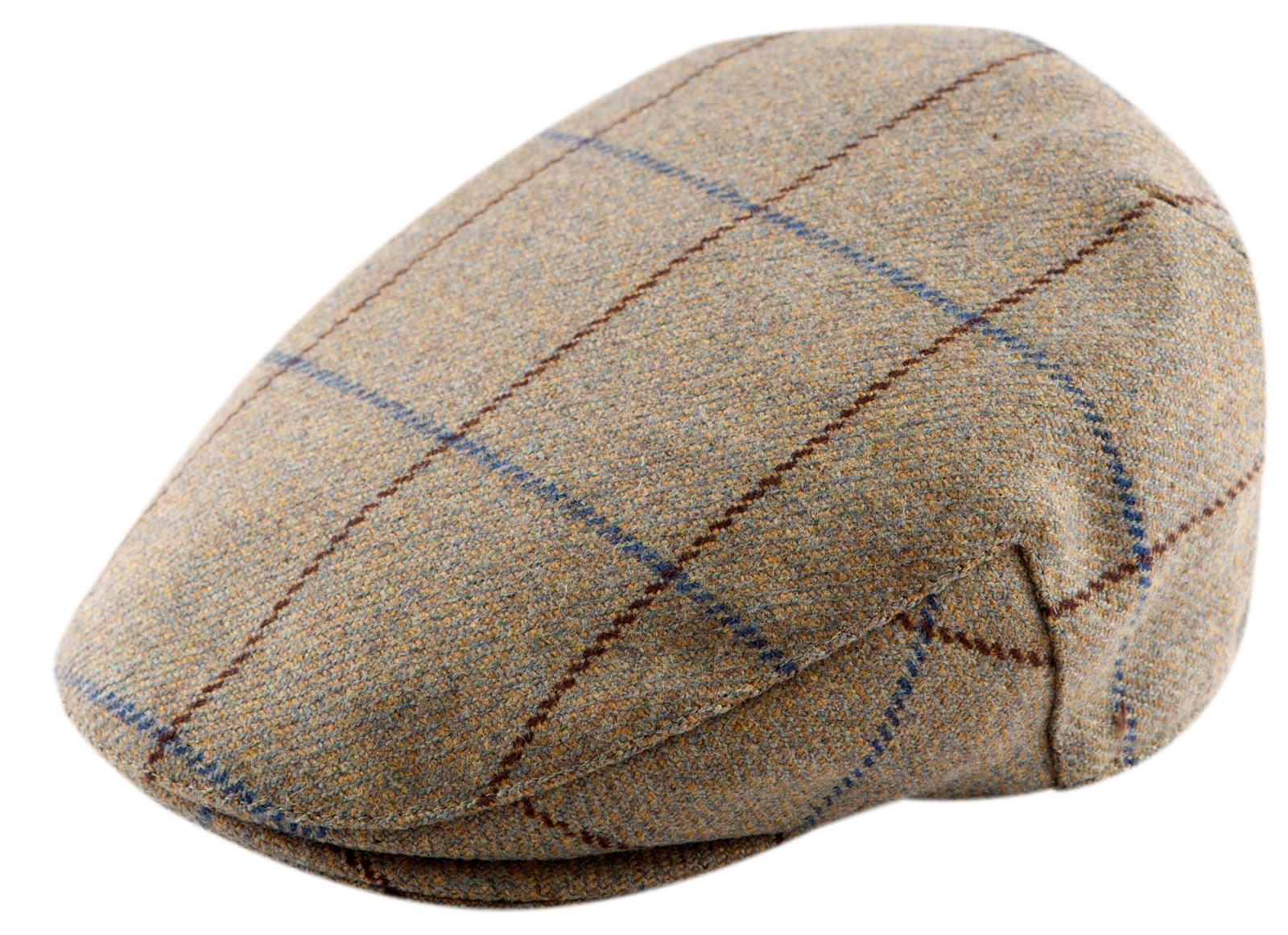
I refer, of course, to the flat cap; also called the driver's cap, newsboy cap, taxi cap, dai cap, golf cap, ivy cap, or scally cap. They all refer to basically the same thing: low, wedge-shaped, with a visor in front instead of a brim all 'round.

They are universally worn, breaking boundaries of class, age, and nationality. In practice, they feel very much like the baseball cap with which you are familiar: snug around the circumference, sitting lightly upon the crown of the head, a brim over the eyes, the ears out in the open. Traditionally a sporty sort of outdoor hat, they can be worn pretty much anywhere today. If you are reticent about wearing a trilby or fedora until you get used to the idea, the flat cap is the ideal way for the Average Guy to break into the World of the Hatted.

The flat cap can trace its ancestry to the Tudor period. Tom Ring's 1566 Portrait of a Man wears a simply constructed cap.

The Tudor cap developed into to the widely-used military cap. They were constructed like this mau cap: rectangular front and back panels, a circular crown, and a demilune-shaped brim. The height of the front panel and the width of the brim were the same, so if the front panel was brought down and attached to the brim...

...the result was the distinctive wedge-shape of the flat cap. Notice the front panel remains, but the back panel is now in one piece with the crown. Many flat caps are made like this, but there are many variations. They are made from just about any fabric imaginable: cotton, tweed, felt, wool...even leather. One benefit of this type of cap is that it can be folded flat and put in a jacket pocket.

For cold weather, flat caps can have ear flaps for warmth; either tucked up inside or tied over the top when not in use.

Some flat caps are made of one piece of shaped and stretched fabric. As a rule, the smoother and plainer, with fewer seams a cap has, the more dressy it looks; since it takes more work to form the shape than just sewing panels together.


The ultimate expression of this is the ascot cap. They are in appearance like a flat cap, but shaped and blocked on a form like a fedora, with no seams. They are made of felt, and quite stiff.


There is another breed of flat cap, that is not derived from the Tudor military cap. It comes from another Tudor hat, like this one painted by Raphael in 1506 of Angelo Doni. It is made of pie-shaped wedges sewn together, with a drawstring around the circumference. It survives today virtually unchanged, in the form of the doctoral cap of academic regalia.

From it we get the eight quarter cap. Less wedge-shaped than the one-panel cap, the eight pieces that form the crown are topped by a button. You can see the resemblance to the baseball cap immediately.

The six quarter cap is identically constructed to the 8/4 cap, but with two fewer pieces for a slightly more streamlined profile.

The five panel cap is a hybrid of the two styles -- the front half is made with a half-circle crown and a front panel, the back half is made with pie wedges like an 8/4! 


There is a flat cap for every taste, and the shape and feel is similar enough to its cousin the baseball cap, that the Average Guy who finds himself hat-shy can slip into proper headwear without a second thought about it. After a time in a flat cap, with which you can practice proper hatiquette, you can decide to expand your horizons with a fedora or a trilby, or not. Many gents are content to spend their entire lives in a flat cap.

Click here to go to the next essay chronologically.

Click here to go back to the previous essay chronologically.

Click here to go back to the beginning.


Friday, August 3, 2012

The Need for Tweed

Chapter 78
This week: a clarification of one of the tenets of dressing well, by way of some handy examples. In a recent installment, I emphasized the importance of "tone matching." The Average Guy who desires to dress like a grownup may have a bit of trouble with this concept, if he is not properly introduced to it.

The Average Guy's  knowledge of "matching clothes" usually comes from the observation of his mother. Women are voracious matchers, as a rule. It has been beaten into girls from a very young age that every article of clothing worn must have at least one precisely-matching color amongst them; including shoes, jewelry, accessories, even cosmetics. There are further rules as to what colors and patterns "should" and "should not" be worn together.

It stands to reason that a young lad, barring any specific male tutelage, will adopt the aforementioned rationale as a universal maxim. Unfortunately, the history of menswear bears out that the concept of "matching" is vastly different among men than it is with the Fairer Sex. The difference is this: women match their clothing to itself. Men match their clothing to their environment. The reasoning is simple: historically, women worked largely in the home, and men worked largely outside. When you are tracking a mobile protein source, you don't want to stand out.

In other words, suits are camouflage. In today's world, where many men don't set foot outside at all, this may be a puzzling concept for some. If you agree with Poirot when he says, "If the outdoors are so good, Hastings, why did they invent indoors?" then you may have particular trouble with the idea.

Fortunately, there is a simple exercise which will make the whole concept crystal clear: we must turn our attention to Scotland, and its national fabric of tweed.

If you have spent any time at all in a secondhand shop hunting for suitable jackets in your quest for adulthood, you have run across tweed jackets. In addition to the grey or tan plain twills and herringbones, you have probably seen plaids and checks that to your untrained eyes looked strangely garish; yellows and blues and reds all together.

In order to make sense of it all, one merely has to look at the colors of the heaths, heathers, and glens of Bonnie Scotland. You may not think that plaids and checks of red and green can be camouflage; but observe!

For instance, take this hillside...
...and compare its rusts, greys, and browns to this example of tweed.
Let's take another example of a Scottish hill, this one in tan and brown and grey-blues:
And again, compare the tones and colors to this dogtooth check.
Let's give another example, this time a foggy blue-grey with lush greens:
And one more:

As you can imagine, this is no mere co-incidence. Wealthy landowners chose "estate tweeds," that were unique to that location. The man of the house would stand upon his balcony, and send his employees out, each with a different bolt of fabric across his shoulders. As they walked away and up the hill, the cloth that most closely matched the colors of the landscape would disappear from view first on the hillside, and that bolt would be chosen as the tweed for that estate.

In other words, "tone matching." Of course, it's impossible to choose your clothes in such a manner today...but the idea of matching your clothes to your environment is a timeless and valid one. This is, in fact, the very essence of the division between "town wear" and "city wear." Cities are dominated by greys, charcoals, and blacks, clean lines, and smooth textures; thus, that became the "city suiting." Likewise, when out of the city, look around you --take a picture if it will help-- and pull those colors into your outfits. Keep track of the changing of the seasons, and continually adjust your colors accordingly.

Of course, you needn't try to combine every hue in one item. Unless you get very lucky with a secondhand estate tweed, your jacket, shirt, and trousers can capture single hues in broad strokes, and your accessories can add the stronger ancillary colors. Autumn is the best season for putting this into practice, due to its abundance of strong, manly, earthy colors.

Into the winter, (and yes, it will be just around the corner,) the colors of your autumn attire should gradually wash into the monochromatic. This isn't to say winter wear need be bleak; the peculiar bright crispness of winter light can be woven into your attire as well.

The hues of spring are in many ways the brighter, more saturated versions of those of autumn. Unlike the gradual transition of autumn-into-winter hues, traditionally, Easter is the time for exploding the color back into your attire all at once, to kick off your spring wardrobe. And summer, as you well know, is the time for getting a little crazy.

Don't be caught up in matching socks to slacks, or ties to shirts, or hats to coats. Be more concerned with matching your adult clothes "outward" to the tones of your environment, and you need never fear being mis-dressed.

Click here to go to the next essay chronologically.

Click here to go to the previous essay chronologically.

Click here to go back to the beginning.

Friday, July 20, 2012

Sock It To Me

Chapter 76
This week, we're going to dial it back a little, and go back to the basics of an Average Guy sartorial education. It's summer, it's hot, you're on vacation, and the last thing you want to do on vacation is overly tax your brains. So we'll keep it simple -- a topic so simple, it's often overlooked among the suits and hats and shoes, which get all the attention.

Let's consider socks. That's right: socks, the part of your attire that is quite literally the furthest from your mind. Socks are important, but too often overlooked in the heady rush to find the perfect jacket, the most awesome tie, or the ideal hat. The sock serves a mundane, utilitarian function: in winter, thick wooly ones keep your ankles warm; in summer, light cottony ones keep your shoes from getting sweaty and smelly. The sock is a small part of your attire from the point of view of fashion, but it is an important one nonetheless.

If you think of your socks as something that is never seen, then you are wearing your trousers too long. If your trousers are the proper length in the leg, whether straight or cuffed, the front should just break over the instep of your shoe, and cut back at a slight angle toward the rear, long enough to cover your socks completely, and the top ¼ to ½ inch of your shoes. When standing, no sock should be seen -- but when walking briskly, a flash of sock should be visible. When sitting normally in a chair, a couple inches of sock should be shown -- and when sitting cross-legged, several inches of sock is very visible.

What should your socks look like? Patience: we'll get there...

Let's deal with the issue of length first. When wearing trousers, your socks should be long enough that you never show a hint of leg, at any time. Test this by kneeling down, or by pulling your knee up to your chest. If there's as much as a glimpse of your hairy old calves, your socks are too short, and you need to purchase a longer size: calf-length or over-the-calf. When you wear shorts (e.g., on vacation) you need socks that are ankle-length. Calf-length socks with shorts are verboten. Don't cheat by scrunching long socks down, or rolling them: one looks sloppy, the other effeminate. True ankle-length only, that covers the ankle bones: for low-rise socks are an abomination. No socks are worn while swimming, approaching the sea to swim, or walking from the sea after having swum. Period.

If you like hand-knitted socks, garters are still made. 


Next, we move on to construction. Most socks are made with elastic sewn into the top these days, rendering sock garters unnecessary and wrinkled, droopy socks a thing of the past. If you have muscled calves that push your socks down, wear an over-the-calf model. There's no reason for droopy socks in today's world. Stay away from tube-style socks: your feet aren't shaped like tubes, nor should your socks be. Good socks will have reinforced toe caps, be made with a heel, and fit within a narrow range of shoe sizes -- not a one-size-fits-all.

Now, let's discuss materials. Stout wool is good insulation from the cold, cotton for heat and sportswear (although thin merino wool wicks perspiration better than cotton ever could,) any number of manufactured rayon/dacron/etc. blends are available, as well as more exotic materials like cashmere. There is but one place for thin black silk, and that is formalwear. A modern trend that bears consideration, and my personal preference, are socks made of bamboo viscose fiber; they have antimicrobial properties, as well as being remarkably soft and comfortable, they wick well, and are reasonably hard-wearing. Ultimately, you should be less concerned with exactly of what your socks are made, and more concerned with how much they cost, how long they last, how well they work, and how good they look.

That leads us to value. While it may seem to be a good deal to reach for the cheapest bag-o-socks at the big box store at five dollars a dozen, you will get a better bang for your buck by purchasing single pairs of higher quality. Pick and choose your selected colors and patterns, rotate through your socks, and discard them out of rotation at the first sign of thinning at the heel, and you will get more wears per dollar than "discount" socks can give you. This doesn't mean more expensive means longer lasting; by that logic, some Italian socks would last forever!


The price-value curve is a sharply-flattening asymptotic one in sockdom: a very small investment over the bargain-basement offerings can yield a sock of much higher quality, but you won't see much more improvement than that, even at a much higher price.

Now, the best quality and value sock on the planet will be of no use if it looks like moldy burlap, so now we'll turn our attention to appearances.

First, white socks of any description should not be worn with trousers -- ever. Wear them for sportswear, or at the gym. They have no other place in an adult's wardrobe.

As to color, pay no attention to the fashion bloggers who argue amongst themselves as to whether socks should match the trousers, match the shoes, match the tie, et cetera. Be more concerned with tone matching. Don't wear bright-colored socks for business use. Your work suiting will be in charcoals and greys and perhaps browns, maybe with pinstripes or overchecks, on largely smooth and plain fabrics -- in old-fashioned terms, "town wear." Match your socks to the sombre tone, with charcoals and greys and blacks. Don't go more extravagant than pindots or birdseyes, and keep the socks in a smooth or lightly ribbed texture. At work, your socks should be thoroughly in the background, and your tie should do the work of personalization alone.

After work, or with "country wear," is where you can let your personality show a bit more. Think of the relationship of sock to trousers as parallel to that of pocket square and jacket; a bit of color that enhances the overall impact of an outfit without overwhelming it. In the cooler months, where your suiting tends toward heavier or more textured wools and corduroys, your socks should become proportionately thicker and more heavily ribbed or textured as well. Your palette can run to the colors of fall, the rusts, russets, greens, greys, and burgundys; but muted and darkened in hue, and always tone-matched to your outfit. Patterns of herringbone, checks, stripes, houndstooth, tartan, and the ubiquitous Argyle can add some variety and interest to your lower extremities in the winter months.

As winter gives way to spring, and the world brightens around you, the muted tones can give way to brighter hues. As the dark suits of January gradually melt into the sport coats and tan trousers of April, your socks should brighten as well. Lighter tans and browns with stripes, checks, or figures work well with khakis and loafers, and your Argyle and houndstooth selections can become more vibrant as the weather clears and the trees awaken.

The heat of summer, with its commensurate explosion of color and style and general air of vacationality, is the time to go more experimental, like socks that exactly match your shirt or pocket square. Pastel socks in complementary colors: canary yellow against light blue trousers? Why not! Horizontal stripes, or bright multi checks? Sure! Anything goes; summer is the time to go a little crazy, as long as the outfit is in proper balance. For instance, a Bermuda suit with an aloha shirt needs a light solid-color ankle sock to ground it somewhat. Remember that all resort shorts need ankle socks, and unless you are playing shuffleboard or tennis, they should not be white, should tone-match the outfit, and most likely be plain.

The perfectly-engineered sock hanger.
Just a final few words about care: don't store your socks by pairing them together and turning them inside out in a bundle. Everyone does it, I know...but stop. It wears the elastic out prematurely, pulls them out of shape, and hides any wear (and the patterns and colors!) from view. If your socks come on wee little hangers, save them. Smooth your socks flat out of the dryer, re-hang them, and either lay them in a drawer or hang them up. You can choose a pair much easier, and inspect the heel wear at the same time. It may seem a bit fussy at first, but trust me: you'll thank me after the first two weeks.

Oh, one last thing: you will notice, in your sock shopping, that men's socks in the mid-price range are disturbingly mundane. Most are plain and dark; fine for work. Some are tan and grey and figured, and there are a few subtle checks and several Argyles. Once you find those, you will find yourself against a wall fairly rapidly. You will look in vain for the bright colors and vibrant patterns you know exist, but apparently not in your price range. Here's a secret: peek in the women's-wear section of the store. Socks are unisex, despite their packaging: if it fits, it fits. Sometimes the careful application of The Other Side's socks can give just the right effect to a bright summer ensemble. (Shh...I won't tell if you won't.)

Click here to go to the next essay chronologically.

Click here to go back to the previous essay chronologically.

Click here to go back to the beginning.

Friday, July 13, 2012

Liner Notes

Chapter 75
As the weeks of summer wend ever onward, the average guy who aspires to dress like a functioning member of society may come to an impasse; for there are some days that wearing a jacket --any jacket-- seems like an impossible task. A jacket, as I hope I have impressed upon you by this time, is an indispensable part of dressing not just well, but merely adequately.

In previous installments, I have alluded to the Bermuda suit and the unlined jacket for dealing with the heat on vacation, the classic Aloha shirt for casual days at home, as well as the jacket-and-scarf combo for tropical seaside resort wear. But what about those interminable weeks where you are simply going about your business at home and about town? How do you deal with the rising mercury then? Do you give up on proper clothing, put suits on hiatus, and break out the suntan oil and flip flops for the trip to the market or the walk to class?

I hope not, for there is a solution. Not all summer jackets have to be those cotton or seersucker candy-colored featherweight jobs. That's fine for the beach, but it may raise some eyebrows at the office. It's entirely possible to wear a perfectly normal-looking jacket that is no thicker or heavier than a shirt. It's all about what happens under the surface.

A great deal of the comfort of a jacket has to do with the lining. A silk or satin lined jacket serves two purposes: it slips smoothly over your shirt and waistcoat without snagging, and it serves as insulation. Most jackets are fully lined: that is, every bit of the interior surface is covered. Very nice in the winter...but it can be a bit stuffy in July.

The jacket I introduced you to last week is half-lined: silk on the front, sleeves, and shoulders, but the back is a single layer of shell fabric. Sometimes the raw edges of the back seam are covered with a thin roll of silk to prevent fraying. Quite nice when, for instance, you have to sit in a chair for extended periods. Having just that one breathable layer on your back makes a world of difference.

Taking that a step further is the quarter-lined jacket. In this case, the front and back are bare of silk, and the only lining is in the sleeves, and small triangular panels over the shoulders. In fact, when most people refer to an "unlined" coat, they actually mean quarter-lined. They are usually quite loose and unstructured: since there is no front lining, there is also no chest padding nor canvassing.

We can go even further, to skeleton-lined jackets. These have no lining at all except for the sleeves, and all the raw edges are covered with rolled silk strips. Since these don't have shoulder padding or chest padding, they have to be rather carefully fitted so as to not look overly sloppy. Some of the summery resort jackets you find are constructed this way.

Ultimately, jackets can be completely unlined: nothing in the sleeves, nothing on the edges, and but one layer of fabric all 'round. All the raw edges are rolled and basted in place. These jackets have to be fitted nearly like shirts.

One might think that the less lining a jacket has, the less expensive it would be; after all, there's less stuff to sew in, so it would be less work, right? Not at all! Lining covers a multitude of sins, raw edges, and sloppy needling. The more you can see of the interior, the more finished it has to be. Seam turn-unders have to be perfectly even, all the edges have to be carefully dealt with, and the pocket bags are hanging out on the inside and not hidden by silk, so they have to be very carefully made and finished as well. The overall cut is more sensitive to errors: instead of hanging off of the constructed shapes of the pad and canvas on your shoulders, the jacket simply hangs off of YOU.

The solution is simple. Either shell out three times as much for an off-the-peg summer jacket, or hire a tailor to make one for you. But what is the Average Guy to do? We can't afford to throw down good cash for  luxuries like unlined summer jackets...right?

I think you know where I'm going with this. That's right: we're going to make our own! This is a fun, quick-and-easy project at its most basic, or you can go into as much finishing work as you want to...it's one of those things that you can do no matter how much needling experience you have. If you've been following along with The Island of Misfit Clothes, it'll be a piece of cake!

A few caveats, first. This, like all the tailoring projects we handle here, is a compromise of factors. We'll start from a fully-lined jacket, and strip it down as far as we can, hot-rod style. The ugly interior will be exposed, and we'll clean up as best we can, but the result will be decidedly "function over form." Without a lining, the jacket will not drop into place as you are used to; it will be have to be more carefully placed and smoothed to remove snags and wrinkles. The upshot is you will be rewarded with a "stealth" jacket that looks and works like any other, but is as light as a shirt...and it will cost you nothing but your time.

This is the jacket I'll use. It's a salt-and-pepper tweed that is a light and loose weave. I've had it a couple of years now; it's an old alteration that started out as a size 44. It fits well enough, but I have other tweeds I like more for the cooler weather, and other linens I like more for warmer weather. So it's sort of an orphan, always passed over. Gutting it and using it as a "summer unliner" will give it a lot more use!

The point is, don't do this with a new jacket. Start from a secondhand model at best, and preferably use a donor jacket that you're saving from the dustbin. Unlined jackets wear quickly, so this should be reserved for those jackets you're giving a last lease on life.


First, get a good sharp X-acto knife (or a seam ripper) and settle into a comfortable chair. Start by freeing the lining from the rear vent, then the bottom edge, all the way around.

When the bottom hem is loose, start working your way up the front edges. You will see many new and interesting things, as shown here. Cut as far up as you can. In most cases the chest pocket overlaps the lining and into the lapel fabric. No fear; just cut up to that point on both sides for now.

Then turn your attention to the sleeves. Remove the cuff buttons, and cut the lining loose all around the cuff. There may be a stitch or two that holds the sleeve lining up inside the sleeve around the elbow: carefully nip them if needed. Since the sleeve lining is still held in place at the armscye, turn your attention back to the inside of the jacket.

Start from the back of the collar, and carefully release the lining, working around the lapels and down to the top side of the chest pocket. Now you can get to the armscyes and release the sleeve lining, and pull them out. You can see the shoulder padding and chest canvas now, as well as all the raw edges along the seams. The top of the chest pocket bag is tacked in place; nip those off, and the entire lining should now be held in place by the ends of the two chest pockets. If there are any other tack stitches in odd places, now is the place to nip those as well.

About an inch from the mouth of the pocket, cut the lining free. Don't cut the pocket bag! Just the lining, and don't cut it too close, either.

Now is the time to take some attention to prettying up those pocket bags.There's nothing we can do about the fabric or the color, but at least we can hide the raw edges and make things square. Fortunately, it's not hard; just roll the edges under and sew them in place with a hidden running pick-stitch, and press the edges flat. Pay particular attention to the mouth of the chest pocket, and don't inadvertently sew the pocket shut! (Yes, I've done it myself. More than once.)

This is what the pocket bag looks like when it's neatened up.

With the pockets taken care of, unfold the lapel and turn your attention to the canvas. This jacket was pretty lightly canvassed in the first place: the fronts and lapels were interfaced along their length, and the chest pad is a pretty small package of felt and horsehair. If this was a hand-padded and canvassed jacket, it would be a shame to rip it out...fortunately, this is all machine-made stuff, and easy to nip free of the fronts with a few sweeps of the knife. Pay attention to how the canvas is sewn to the armscye. It might be smarter (and less trouble) to cut the canvas out along the seam if it is sewn to the armscye and sleeve together. Same with the shoulder pads.

With the jacket now well and truly unlined, you're nearly done. Tack the end of the pocket bag in place, to keep the pocket from sagging. Don't forget to replace the cuff buttons, and your jacket can be worn as-is, right now, and you can finish it off to whatever degree you want at your leisure. Primarily, you need to decide what to do with the raw edges. Your choices are 1) do nothing, 2) bind the edges and hold them in place with a blind zigzag stitch, 3) roll and tack the edges and hold them down as you did with the pocket bags, with a running blind pick stitch, or 4) use silk bias tape to bind the edges with a true skeleton lining.


Since I had altered this jacket to fit previously, this didn't generate enough slop in the fit to make further alterations necessary. As you can see, with the internal structure gone, it assumes a much more casual and drapey cut. You may be tempted to take in the shoulders and side seams at this point to get a nice tight shoulder line and silhouette -- but remember the whole point of the exercise is to make as light and breezy a jacket as possible for the Unbearable Days! With linen trousers and a light summer shirt, this is as comfortable a jacket to wear now as anyone could ask for.

Click here to go to the next essay chronologically.

Click here to go back to the previous essay chronologically.

Click here to go back to the beginning.

Friday, June 15, 2012

Proving the Rule

(Part Thirteen of the series, "Dressing the Average Guy.")
Chapter 71
You might think this week would be my traditional look at recent formal awards ceremonies in the media, for there have been a couple noticeably influential ones: The Tonys and the Cannes festival. In fact, that was my plan going into this week: but something much more interesting has come up. Besides, we've covered formal wear quite a lot this year, and there's much more to Dressing Like A Grownup than mere tuxedos.

The impetus for this week's change of venue was a typical sort of what-are-the-stars-wearing feature on the web's MSN. At first blush, just another filler article chock-full of jiggling Kardashians. "Stars who don't dress their age," or some such fluff. Nothing to see here, move along. But then, a fascinating subtext hit me across the face, and I knew it had to be this week's installment -- for this is a perfect, in-your-face, textbook example of the Second Great Secret of Dressing Well.

For those of you unfamiliar with the format, last year, I posited Great Secrets, that the average guy who was just getting started along the path to sartorial excellence needed to know. The first one would seem to be common sense, despite millions of men who ignore it: "The purpose of clothing...is to make you look better than you really do." The second one is cautionary in nature, and a warning: "Left to himself, a man will dress back to the era in which he was happiest, or imagined himself happiest."

So let's look at some fabulously wealthy famous men -- who are in the media's glare, have the public's eye, and can easily afford to wear anything, absolutely anything, they want. Given an entire planet full of fashion with hundreds of years of clothing history, what do these men choose to wear when they could wear anything at all?

Let's start with John Christopher Depp, II. Johnny is 49 years old now, born June 9, 1963. He got his start in the mid-eighties on 21 Jump Street, but didn't really hit his stride until he teamed up with Tim Burton on Edward Scissorhands in 1990, when he was 27 years old. What followed was Depp's decades-long golden era of movie after successful movie. Now observe his choice of clothing. Does this look like the suit of a 50 year old screen actor, or a 27 year old bleeding-edge hipster circa 1990? Behold the Second Great Secret in action!
Next, observe Calvin Cordozar Broadus, Jr., a.k.a. "Snoopy Diggetty Dogg" or something like that. He styles himself as some sort of singer. He was born on October 20, 1971. Snoop was a Crip gang member while in high school. Shortly after graduation, he was arrested for cocaine possession and spent six months in the cooler. His music career began in 1992, at age 21. "Doggystyle" catapulted him to unimaginable worldwide fame. His attire? Still that of a child: arrested, so to speak, in his late teens in the early ' 90s, despite now being 41 years old.
Similarly, Robert Matthew Van Winkle was born October 31, 1967. In 1990, as "Vanilla Ice," at age 23, "To the Extreme" became the fastest selling hip hop album of all time. (Let that sink in.) After a failed suicide attempt in 1994, he re-evaluated his life, got married, and focused on motocrossing and jet skiing for awhile. He then studied real estate and renovates and sells houses. But do you see a 45 year old realtor here? Nope, from the askew hat to the annoying soul patch to the sloppy skate duds, what you see is a hippy-hoppy teenage kid in the late 1980s -- which was Vanilla Ice's Camelot.


What is this, an age-progression of Miley Cyrus? No, it's fifty-nine year old Philip Andre Rourke, Jr., who was born September 16, 1952. Poor Mickey was perhaps too good at everything he did. From 1964 to 1972, Rourke was an amateur boxer tallying up 27 wins (17 by knockout) and only 3 defeats. He then turned his attention to acting, and by the mid-1980s, thanks to Kim Basinger and 9½ Weeks, he was a bona fide leading man. In 1991, Rourke decided that he "had to go back to boxing." Following some messy bouts in the ring and facial reconstructive surgery, in 1995 he retired from boxing and returned to acting, where plastic surgery was more "voluntary" and less "life-saving." With multiple acting awards and boxing wins under his, er, belt, this outfit is befuddling. It's certainly not the dinner attire of your average 60 year old male. Whether it's that of a brash 18-year old boxer in 1970, or just the sad result of forgetting your pants due to one too many blows to the head, is something only Mickey knows.


Adam Richard Sandler was born September 9, 1966. He was hired as a writer for Saturday Night Live in 1990, when he was 24. After making the move to the front of the camera, he rode the wave of popularity to the silver screen in the late 1990s, in such films as Billy Madison, Happy Gilmore, The Waterboy, and others. He's 46 today, but his attire still dates him as a post-teenager in the mid 1990s in New York, churning out jokes for cash.
Steven Victor Tallaricco was born on March 26, 1948. This is perhaps the most tragic example of slavery to the Second Great Secret. Aerosmith's run on the airwaves was from 1970 to 1978: in many ways, Steven Tyler's music defined that decade, for better and worse. When the folks at American Idol (for those worldwide who didn't know, yes, we have one too, and we're just as sick of it as you are) rolled Steven Tyler out of cryogenic storage and defrosted him to serve as judge, apparently no one told him what decade he was in, or how old he is. This poor 64 year old AARP retiree is rattling around in the glam rock threads of a 25 year old in the 1970s, right down to the danglers and chains, the lank greasy hair, the platform heels, and the bell-bottoms made of Chrysler upholstery. It's just a constant reminder of just how old and out of touch he is, and how much he desperately wants to be that young man again.

Compare to William James Murray, born September 21, 1950.  Everyone knows Bill's Golden Years: beginning in 1976, at age 26, on Saturday Night Live, and a string of successful motion pictures through the 1980s, including Meatballs, Caddyshack, Stripes, Tootsie, Where The Buffalo Roam, and the Ghostbusters franchise. So it should surprise no one by now that Murray's "Festival of Plaid" suit at Cannes this year places him sartorially squarely in his late 20s, and in the early 1980s. But where Bill Murray differs from similarly-aged Steven Tyler is in the execution. Instead of a sad sort of historical costume, it evokes the past without being slave to it. This is not a bad suit at all. Does it show Murray as a 62 year old guy lost in the 1980s? Sure, but more as an homage: he is able to have fun with it. It follows the strictures of the Second Great Secret, but Murray makes it work for him. It's a good example of color and pattern matching, and as a breezy summer suit, it works as a whole without being ocularly jarring. In short, he uses elements of that era over which he ruled, and incorporates them in such a way that it becomes comfortable for him, while keeping the cut and style thoroughly classic. In other words, a proper method of the working-out of the Second Great Secret.


Click here to go to the next essay chronologically.

Click here to go back to Part Twelve of Dressing the Average Guy.

Click here to go back to the previous essay chronologically.

Click here to go back to Part One of Dressing the Average Guy.

Click here to go back to the beginning.
Friday, March 30, 2012

An Army of One

("Springtime and the Average Guy," part three of three)
Chapter 60
Dress Like A Grownup! continues its miniseries on the clothes of Springtime this week, by appealing again to the Average Guy. As my little blog builds worldwide fame and acclaim amongst my ever-growing cadré of readers and followers, there will always be a man who is starting from Square One -- the man who comes to that epiphanal moment in his life, when he looks at himself in the mirror and says something along the lines of "Egad; I'm dressed like a ten year old!" And then decides to do something about it.

But, facing the daunting task of absorbing over a year's worth of information can be overwhelming for the novice. What is the Average Guy to do? Go back to the very beginning and read every blog installment, in sequence -- or at the very least, to read "Dress Like A Grownup! Volume One," the bookbound distillation of our Dressing the Average Guy series? It will take weeks if you follow the directions contained therein. Is there a short-cut that can be taken in the meantime, that will suffice to get the Average Guy through the Spring season with minimal effort?

Why, yes, there is. What I am about to impart to you may change your life and the way you think about clothes. You, the Average Guy, can slingshot your sartorial training far forward in one simple step, while you build your discipline and educational background for being truly well dressed, in your own time. You don't have to understand the whys and wherefores, the history or the theory. Just go through the motions for now, and fill in the blanks as you go.

If there was ever a "Dressing Well for Dummies," this is it. Education optional, plug-and-play simplicity. It involves the purchase of exactly one item to supplement your existing wardrobe: 

One lightweight cotton or wool sports jacket. That's all. Your Spring can be fundamentally transformed. It's like magic.

If you are a student on your Dress Like A Grownup! path to sartorial excellence™, so much the better! Students are notoriously light on discretionary funds, and spare scratch to spend on new and better clothing is hard to come by, what with more pressing matters to attend to, like beer. textbooks and lab fees. The purchase of this one jacket can stand in for a good half-dozen or more uses, and, as a rising tide lifts all boats, will make your current wardrobe that tiny bit more acceptable by its presence -- that is, until you can afford to supplement your wardrobe with, well, real clothes.

First, let's look at just what you need in this aforementioned "sports jacket." It may be of a light and neutral color and pattern, preferably notch-lapelled and single-breasted, to match a variety of outfits. It should be of a light cotton or wool, either unlined, half-lined, or very lightly constructed. This is spring, after all, and if you are unused to wearing anything but a greasy tee-shirt, a light jacket will cause you the least amount of discomfort. And it needs to fit. It also doesn't have to be new, if you can find something serviceable at the secondhand store. You needn't worry about the details of style at this point, as this is basically "emergency wear" to get you through the first weeks of your newly-found adultitude without undue duress. You will undoubtedly replace it as you discover your sartorial center in time; and you will not wear it beyond mid-summer in any case.

Now, we'll demonstrate how this simple jacket alone can transform the average man's wardrobe into something approaching acceptability. 

The baseline for mediocrity in men's wear the world over is an untucked tee-shirt, hip-hugger jeans, and some form of flippity-flop footwear. Atrocious, you'll agree. Now add the jacket. Voila -- your outfit is now "ironically casual." Still awful, but now less so.

Let's up the ante a bit, to what most men call "dressing up," to a polo shirt, khaki chinos, and athletic shoes. An adult society might call this barely acceptable attire for even mowing your lawn. But put your jacket on, and hey-presto, you've crossed the line into a fine sort of sporty-casual, easy as that.

Say you're really putting on the Ritz, going out to dinner for instance. You'll wear your "good jeans," and a short-sleeved shirt. You thought that was just fine before...but add your jacket, and alakazam! Instant spring-dressy. 

Let's say it's chilly and drizzly, and you put on your usual cold-weather gear: your "warm jeans" and a sweatshirt. But wait! The addition of your jacket makes a sharp rainy-day ensemble!

Now let's go the other direction: warm and sunny. What would you wear? Cargo shorts and a short-sleeve shirt, perhaps? Not so fast -- add that same light jacket, and you've just made a Bermuda suit!

Surely there can't be more...but yes! You're at the beach, on vacation, soaking up the rays, or at the cabana. Swim trunks and flip flops are the norm. You can't mean -- but I can! Trunks and a jacket? Absolutely! Easier to remove than a shirt, with better flow-through, and no sunburning. Bonus: worn with a scarf, it's a classic resort look from the '40s.

So you see, there's no limit to what a simple jacket can do, and no situation that doesn't benefit from wearing one. It's simple, easy, and universal. It's not the end of the road -- far from it, but it's a good first step to dressing well.

Click here to go to the next essay chronologically.

Click here to go back to the previous essay chronologically.

Click here to go back to the beginning.

Friday, March 23, 2012

As The Wardrobe Turns

("Springtime and the Average Guy," part two of three)
Chapter 59
Happy Spring, O My Average Guys! Yes, it's the time for Spring Break, outdoor sports, barbecues, and touring. My Advice for Spring Breakers is still timeless and required reading -- but before you get too excited, remember it's also time for yard work, repairs, and the dreaded annual Spring Cleaning. 

No, men are not exempt from Spring Cleaning. Especially now that you have endeavored to make the leap into dressing like an adult, you have some regular closet maintenance to take care of now. Specifically, the Seasonal Wardrobe Rotation. Clothes are seasonal things, as you should know by now, and the seasons are not "tee shirt" and "sweatshirt." Proper attire means more attire, and more specialized attire. Unless you have a cavernous closet, you should only have hangers for the current season's needs: no more than three months. In other words, there's no need to keep your heavy coats on hangers anymore -- they need to make way for sweaters and sport coats, and later on, polo and aloha shirts, before making way for the tweeds and wools of winter again. 

Clearing out hanger space begs the question, what do you do with the off-season's clothes? The answer is self-evident -- put them in the space left over by this season's clothes. Exactly where that is, depends on your own situation. If you don't have spare cedar-lined wardrobes scattered around your mansion, then a dresser, chest of drawers, or trunk, is the obvious solution. There are underbed storage solutions available for those tight on space. If you pack carefully and take steps to ensure the contents are  kept dry, even a cardboard box in the attic or cellar works well. Don't underestimate the value of a SpaceBag® storage cube, either; they really do work wonders. For those truly bereft of extra storage space, such as students and the like, think of using space that you're already using, such as storing your off-season clothes in your suitcases.

When packing away for the season, you want to make sure your clothes are clean and dry, so they will be ready to use again as soon as you unpack them. You needn't dry clean everything you own -- but you should make sure they are free of dirt, beaten well and "rolled" to remove lint and dust, and brushed with a clothes brush.

The question of just how to fold a coat is not one to take lightly. If you've had any experience with coats at all, you've noticed that, as well as they behave on a hanger, they can be darned unruly anywhere else. The shaped construction of the shoulders and chest don't seem to want to fold and pack away neatly. Don't worry; this is not a new problem. For hundreds of years, men have endeavored to find a way to fold their coats that would leave them wrinkle-free and fresh after extended storage.

There has always been a subtle black magic to folding a coat. There are some Internet tutorials on how to do it properly; but as these are varied, and sometimes conflicting in their information, I'll show you how to fold a few different sorts of coat when you put them away. 

The first thing to realize is that there isn't a one-size-fits-all solution. Coats are of all different weights and styles of construction, and what works for one may not work as well for another.

First, I'll show the oldest method of folding, which dates back to before 1820. It works best on heavy, full-length coats without shaping in the shoulders. I'll demonstrate this on my winter Ulster coat. It's a box-coat, made full and square with no shaping at all, big enough to wear another heavy coat underneath it.. It's massive, but not padded or shaped. 

The first thing to do is lay it out flat and face down. 

Then turn the shoulders in so that they meet at the center back seam. 

Double the sleeves over at the elbow.

Unfold the lapels, and fold the fronts over so that they cover the sleeves.

It's important to make sure that the fabric is laying down perfectly smooth and even without any wrinkles.

Fold the coat in half such that the bottom edge is even with the collar.

Turn the coat over, and it should look like this. If you have a large, flat area to store your coats, you should stop here. The fewer folds the coat has, obviously, the less creasing you will see next winter. 

If you have a smaller area to fit your coat, fold it in half again. Several heavy coats will stack in a drawer this way.

If your coats have "hard" shoulders, the old method shown above won't work as well: it'll mash the shoulders flat and cause trouble later on. This next method works best for long, shaped coats. Here is a camel hair paletot. It's not an overcoat, but made to wear over a shirt like a jacket, with jacket-style shaping in the waist and shoulders. 

Lay the coat out flat as before. This time, turn one shoulder inside out, and turn that side of the front across to the back.

Hold the inside-out shoulder, put your hand in the other shoulder, and tuck the shoulders together. 


The result should look like this. Both shoulders are nested together: they support each other's padding, and the coat's lining faces out. The lapels and collar are unfolded. Make sure the sleeves nest together smoothly without wrinkles.


Then take the lapels and turn them inside the coat.


Turn the skirts halfway up like this.

Then fold the top half over, and this coat is ready to be packed away. 

The last remaining method I'll show is a hybrid of these two methods. It's very useful with short coats and jackets with lightly padded shoulders, but without a lot of shaping. Here's a heavy-ish tweed coat of mine. It's nice for the cold, but I have lighter tweeds for Spring, so in the trunk it goes!

Start with the coat face down.

Then turn both shoulders inside out. 

And then, fold both front sides over. Essentially, you've turned the coat inside-out, with the sleeves inside and the collar unfolded. Make sure the sleeves are laying smoothly inside.

Fold the coat in half...

...and in half again. This is a good space-saving method for these sorts of coats.

As you can see, each method results in a compact package with minimal creases, wrinkles, and stresses on the fabric. They all have several things in common, though -- They turn the lining out to protect the fabric, they fold around the sleeves so they can't get loose and flop around, they use as few folds as possible, and they all unfold the collar and lapels. When late Fall rolls around, you can be assured that when you crack open your trunk, your heavy coats will be fresh and ready to wear with minimal attention! 

Oh, I wouldn't worry too much about using mothballs, unless you have a bug problem in your area. Most modern homes are tight enough not to have to worry about such things -- unless you really like that old-world wool-and-camphor smell. For many, the smell of mothballs in winter clothes brings back strongly pleasant olfactory memories of family, grandparents, and Christmastime.

Click here to go to the next essay chronologically.

Click here to go back to the previous essay chronologically.

Click here to go back to the beginning.