Showing posts with label Ties. Show all posts

Wednesday, June 4, 2014

The Art of Tying the Cravat.

Appendix 1.

In the previous Installment Chapter 80, entitled "Taking Stock of the Cravat," I had made reference to two little volumes published in the early nineteenth century; and these innocuous tomes are so invaluable, (and in some ways so misunderstood,) it warrants a further and closer look at them. The original post imbedded the scans as presented from GoogleBooks. In this Appendix, they have been re-edited and presented with minor helpful annotations and insertions to make it more readily accessible for my readers, most notably the inclusion of the original illustrations.

(These books are currently hosted and imbedded with GoogleDrive; which features onerous restrictions on bandwidth -- if the limit has been reached, and they do not appear below, click the "download" link in the window, which will switch the window from a GoogleDrive viewer to a PDF viewer. If this continues to be a problem, I'll try to find a more suitable hosting service.)

The Art of Tying the Cravat is a serious essay on the history and crafting of cravats, and would be an invaluable resource to those that actually want to learn what the various styles were and how to tie them -- if it were possible to actually read this rare book online with the illustrations, which are never scanned and included. Thus, I have produced a version myself for Dress Like A Grownup! that contains the illustrations for you. Read through it, and you will discover not just a slice of history, and how to form the historical cravats from a contemporary source, but you will discover within its pages the direct forerunner of every variety of modern neckwear, from ties to scarves.


Neckclothitania, on the other hand, has been referenced by many online sources that proport to expound the ancient art of the starched cravat. The illustrated frontispiece is most often shown, unfortunately separate from the text of the book. Well-meaning costumers, living history aficionados, and amateur historians have gone so far as to attempt to recreate the illustrations in actuality.

What all of these people fail to recognize or make mention of, is that Neckclothitania is a college student's work of social satire. It is not to be taken seriously -- it is a humorous work, the subtlety of which is lost on modern readers; largely because we are not familiar with the style of the serious Essays published at the time, that this work is lampooning.

The first clue is the title itself: To young scholars, "Titania" would have been a well-known reference to both Ovid's Metamorphoses, as the daughters of the Titans, and as the name of the Fairy Queen in Shakespeare's A Midsummer Night's Dream, (make of that what you will,) so the pun of TIEtania would have been instantly understood. Virgil's quote on the title page holds a sly double entendre in this light. Nods to the formal essays of the time that you may notice, are the ridiculously pompous Dedication, the liberal sprinkling of high-sounding French and Latin phrases throughout (notice especially the description of cravat colors!) and the many referenced "sources," which are themselves contemporary works of satire.

Notice, too, that half of the cravats shown are exactly the same, differing only in the number and position of creases in the starch! (These are not the "actual" forms of the starchers; for that you must go to The Art of Tying the Cravat.) The other half dozen are roundly ridiculed for their ridiculousness. The subtext is that to the untrained eye, all Starchers look the same, and the endless minutiae and variations lavished upon them can be seen as just a bit silly -- much like those today that agonize over the proper tie knot to use, when the average person can't tell a Four-in-Hand from a Half Windsor.

Tietania does have its purposes, though, aside from the first recorded use of the word "tie" to refer to a cravat. Namely, it is an invaluable contemporary look at the culture of the "Starcher" from the perspective of a sardonic student with a keen sense of humor. Read it with tongue firmly in cheek!


Click here to go back to the original installment that this Appendix references: "Taking Stock of the Cravat."

Friday, December 14, 2012

The TT&S Bow Tie Man of the Year

Chapter 97
Another year is nearly behind us, and that means it's time for our own annual awards shows! This week, Mr Thompson's Ties & Squares chooses one man who deserves the accolade of the 2nd Annual
 2012 Bow Tie Man of the Year!

The criteria for our yearly accolade is threefold: 
I. Our Man must be a man in the public eye, who has the attention and influence of a great number of people.
II. He must exemplify the art of the bow tie to a high degree, and 
III. He must, through his example, encourage other men to don bow ties as well.

The selection process has been narrowed down this year to but two men, who co-incidentally, work in very similar fields.

The Runner-up chosen by TT&S this year, is an American chef, editor, publisher, and radio and television personality. His use of bow ties is very nearly a trademark, and has been an example of quietly wearing a bow tie the right way, with no fuss or fanfare, for over a decade.

Christopher Kimball (born June 5, 1951) was raised in Westchester County, New York, and went to Columbia University with a degree in Primitive Art. He went to work with his stepbrother in a publishing company and started taking cooking courses, then got his family to pony up the cash and started Cook’s Magazine in 1980, when he was 29 years old.

Now anyone who has channel-surfed on a Saturday afternoon has probably run across Chris Kimball on PBS, on America's Test Kitchen. If you've stayed your remote control long enough to sit through an entire episode of this dry-sounding show, you're probably hooked already. It's "cooking deconstructed," pared down to its delicious, infinitely repeatable, scientifically foolproof essentials, in a low-budget, minimalist, eminently practical format that is perfectly at home on PBS. This is not an accident: Kimball is the founder, editor, and publisher of Cook's Illustrated as well, which is a minimalist, eminently practical, just-the-facts magazine. Don't mistake its deliberately "downscale" format for a bargain-basement production, though -- America's Test Kitchen draws over two million viewers a week, which is about four times more than almost anything on MSNBC or CNN.

In addition to publishing and editing two magazines, and hosting two cooking shows, Kimball has authored five books, is a columnist for the New York Daily News, has been featured in everything from The New Yorker to the L.A. Times, and is a regular contributor on NPR and The Early Show. In fact, he's nearly everywhere, once you start to look for him...but much like his television programs, he's an unprepossessing fellow, more scientist than showman, and it's easy to miss him on the radar screen of cultural zeitgeist.

But for twelve years, he's been on our television screens, and he's changed very little: a Nor'easter haircut, a Don Knotts-ish expression, round wireframes. And under his red apron: an oxford shirt, sleeves rolled up to the elbow, suspenders, and a bow tie. You would think that attire that never, ever changes would become a uniform, or worse, a costume; as evidenced by fellow PBSers Justin Wilson's red string tie, Roy Underhill's braces, or Bob Ross's fuzzy, fuzzy afro. But Kimball demonstrates that one can wear a bow tie every day, for years on end, and never look out of place. He wears a variety of bows, in differing colors, patterns, and styles, and wears them all unironically and well; although his penchant for a small knot, broad leaved, medium width, lightly lined blue silk pindot clearly shows that he's been around bow ties long enough to know just what style best compliments his morphology -- and his red apron. His approach to bow ties is like his approach to everything else; precision, constancy, and efficiency of thought.

Which brings us to our winner this year. Also in the entertainment industry, also a foodie, but a relative newcomer to the onscreen bow tie. In many ways he is the counterpoint to Chris Kimball's rock-steady, week-in-week-out bows -- but the spark of life and excitement he brings to his neckwear outshines the relatively short time he has been seen in them. 

Alton Brown (born July 30, 1962) is also a television personality, chef, author, actor, and cinematographer. Born in Los Angeles, he graduated from the University of Georgia with a degree in drama. He began his career in cinematography and film production, and a decade later moved to Vermont to train at the New England Culinary Institute in Montpelier. He observed that most cooking shows were too dry and boring for his taste, and he wanted to do something about that.

He is best known as the creator and host of Good Eats, and the host of Iron Chef America. He has also hosted several mini-series and specials on the Food Network, and is the author of ten books of cookery. Although just as science-and-chemistry oriented as Christopher Kimball, his Julia-Child-meets-Mister-Wizard approach, offbeat editing and sharp wit have made him something of the Accidental Rock Star of the food world, and Good Eats has achieved the same sort of cult status among foodies that Monty Python achieved among, well, the people that watch Monty Python.

So what is it that Alton brings to the table? In a word, seasoning. (Sorry: food analogy.) His approach to bow ties is like his approach to everything else; energy, sprezzatura, and insouciance. He knows style, does Alton: and how to use that style. Alton is as notable a Man of Fashion as he is a Man of Culination. Any guy who wants to know how to not just wear a bow tie, but wear clothes and be Dressed Like A Grownup!, would do worse than to study Alton Brown. And I can't think of a higher accolade than that. 

We'll leave with some recent quotes from Alton himself on the subject:

"I like bow ties because you don't get tangled up in them. I'm a man of action." 

"The question isn't why do I wear bow ties, the question is how can you be so uncool as to not wear bow ties?"

“The bow tie also has advantages in the cockpit as it won’t snag in harnesses or headset cables. [Brown is a pilot.] Also, bow ties make me feel just a little bit more like a time lord."

So for all these reasons and so much more, Alton Crawford Brown, 
you are the Mr Thompson's Ties & Squares 

Friday, October 12, 2012

Scarf it Up, Scarf it Down

(Part 9 of the series, "The Secret Life of the Tie.")
Chapter 88
The past two months has been quite a ride, hasn't it? I'll bet you've learned more than you ever wanted to about the history of neckwear. We set the WABAC machine for half a millennium ago, and surfed the waves of change through the centuries, through fads and fancies, loose and carefree to meticulous and starched, as the pendulum of change swung from one extreme to the other and back again, over and over.

Then we took a methodical and exhaustive look at what people wear today -- but with a solid grounding in history, we begin to see the connections to not just what people wear, but why. Nothing exists in a vacuum, and the progression of fashion has echoes going back not just the mere five hundred years that we've espied, but right back to antiquity. Men today are the same as they ever were, with the same impulses and desires and senses. 

This week, we are leaving the present day and projecting a bit into the future. A tricky business, that: the vagaries of fashion oft take strange and unexpected turns -- but we can begin to see some trends among the fashionistos and glitterati, that will doubtless trickle-down to the masses afore long, and if they take root and germinate, we may begin to see a shift in what is worn generally.

So this week, let's let the images speak for themselves.


Here is Justin Long. Not exactly an A-lister, but note two things: his day cravat is a scarf, and it is loosely tied in a simple knot -- certainly not how a day cravat is usually tied. This wouldn't usually interest me, but take another look...


...this time at Brad Pitt. Quite definitely an A-lister, but note also two things here: he is wearing a scarf as a day cravat, tucked in and all, and the nature of the knot. It is a simple slipknot -- the scarf is doubled, with both loose ends on one side passed through the loop on the other side.


Here's Brad again, this time with a tee-shirt and jacket. But look! The scarf remains, a very long one in fact, tied in a slipknot.


Even the little Pitt is getting into the act.


Another fashion forward fellow, once-famous David Beckham. In evidence, a scarf in a slipknot. This is a regular sort of warm-weather scarf: notice that the doubling-up makes the scarf quite short, and rather bulky about the neck. One might think this is merely for warmth...


...but here he is again, in shirtsleeves, with a thin silk scarf tied the exact same way -- short, in a slipknot.


The entertainment media, whether leading the charge or following the pack, is echoing this trend. Note the new Sherlock Holmes sports this exact same scarf style: short, doubled, and slipknotted.

The conspicuous inclination here isn't merely that there is more scarfitude hereabout, or even that said scarves are being worn short. Notice Hugh Jackman here and the other examples I've shown. The scarves are worn under shirts or jackets, or over crewneck shirts -- but never, ever worn with a tie. These scarves aren't being worn for warmth, under a Chesterfield overcoat: they're being worn as neckwear.


Could we be seeing the next formative step in tie evolution?


We very well could be. The scarf gives a sense of protection to the neck and bulk to the upper chest -- something men are hard-wired to gravitate toward. At the same time, it enables the shirt to be worn open, and the casual bent towards open collars in recent years is undeniable. The slipknot is embarrassingly easy to tie, requiring no specialized skill or knowledge at all. And although it looks bulky to my eyes, it must be remembered that cartwheel ruffs were once embraced by men as highly fashionable as well. 

Could it be that we're seeing the final passing of the age of the collar and tie that has endured since the Victorian era, as the pendulum swings backward again to the elaborate neck-wrap?

Only time will tell if this sudden scarfiness is merely a novelty, on par with the leisure suit craze in the mid-1970s, or if it has the staying power to become an enduring fashion that will be remembered by future generations as the hallmark of the early twenty-first century; as tall Arrow starched collars and four-in-hand knots were the hallmark of the early twentieth. 

Friday, October 5, 2012

It's Hip to Be Square

(Part 8 of the series, "The Secret Life of the Tie.")
Chapter 87
This week, we'll return from the land of the Emmys, and talk some more on our series of modern neckwear...for there is one more variation yet to be discussed! We've worked our way through history, from ruffs to stocks, from cravats and steinkirks to ties. We've looked at modern ties, from bow ties and long ties to ascots and day cravats. 

This week, we honor the simple square: the neckerchief. Let's look at its history, its modern use, and uncover a surprising secret.

Unlike the cravats and ties of gentlemen, the neckerchief was the neckwear of the working classes: the blacksmiths, the farmers, the ranchers, the sailors, the cowboys, carpenters and cooks. And like the working men themselves, their neckwear was not simple adornment, but multi-functional. Neckerchiefs are always worn diagonally, with two opposing points tied together. As a simple cotton square tied about the neck, it sopped up sweat while you toiled in the sun. Soak it in in a stream and tie it about your head, and it kept you from overheating in the summer. Worn over your nose and mouth, it was a filter from dust or fumes. In the event of an accident, it could be used as a sling, (or more direly, as a tourniquet.) And it could even be worn under your collar like a "normal" tie, if that need arose.  

The neckerchief is thus an image inseparable from the cowboy/ranch-hand of the American West. Today, it is seeing a resurgence of sorts, due to its ease of use, the ability to be worn with an open collar, and its versatility. Many people see the day cravat as an upper-class affectation, and the earthy roots of the humble neckerchief provide an alternative that nevertheless produces the same sartorial effect: something to take up space under an open collar. 

The neckerchief is most often seen with Naval uniforms worldwide, where it has been worn in that utilitarian capacity since the 16th century. The Navy style is to fold it in a triangle, and roll from the point to the ends to form a tube. Then it is tightly twisted, placed around the neck under the collar, and tied low in a square knot. 

The U.S. Navy standard for the neckerchief is thirty-six inches square, (that's a yard, for you Europeans, 91.5 cm) and technically anything called a "neckerchief" must be close to that dimension. Not only is 36 a nice round number, it gives a diagonal measure of fifty-one inches, which (if you will recall from our study of "starcher" cravats) is ample enough to wrap around the neck twice with room for a large knot. Let's take a quick look at some examples of the neckerchief. 


Sean Connery (1968, as Shalako) wears his neckerchief tightly rolled up, and knotted like a steinkirk, with the ends falling freely. This is the classic cinematic "cowboy style."


This (real) cowboy wears his neckerchief unrolled and loose, in the simplest way possible: with the ends twisted together in front in a simple knot. He wears it over (and covering) his shirt-collar.


Roy Rogers wore his in a showman-like style, with the knot at the side of his neck, and the ends flowing and loose as a ponytail. It looks odd today, but you need to bear in mind that in the mid-twentieth century, all things cowboy and western were very much in vogue in entertainment and popular culture, and rugged manly men in flamboyant outfits like this were more or less the standard for cowboy troubadours. Remember, too, that in black-and-white on a twelve-inch television screen, this would have appeared much less jarring; likewise from a hundred feet away on stage at the Grand Old Opry.


Here's a modern example of wearing the neckerchief. Notice it is worn wrapped front-to-back-to-front, with a small knot. In modern parlance, this is called a "cowboy turtleneck."

The ability to wear a large neckerchief is limited in everyday use, so many wear the smaller version of the neckerchief, the bandanna. A bandanna averages twenty-six inches square or so, which gives the ability to tie around the neck without the extra length of a neckerchief. Why 26 inches? Because diagonally, it measures 36 inches -- in other words, a neckerchief with the points turned toward the center; which was undoubtedly how the first bandannas were formed. This cowboy wears an unrolled bandanna under his shirtcollar like a tie, and simply knotted. (Although arguably neater, the trimmed bandanna was less useful than a neckerchief in emergencies.)


Gene Autry wore a rolled bandanna like this, and it became the ad hoc "cowboy tie." It is rarely seen today under shirtcollars; most opt for the under-the-shirt look, exemplified by Cary Grant in the first image of this post. 


Prince Charles demonstrates the same look as Gene Autry above, but with a slightly smaller bandanna worn right around the neck, with the ends showing. The effect, you'll notice, is reminiscent of a bow tie, with the points standing out.


Robert Downy Jr. (Zodiac) shows the most common way to wear a neckerchief today: bandanna sized, loose around the neck, under the shirt, with the points out.


A more-put-together look crosses the line between neckerchief and day cravat, with a folded style, a Gordien knot, and the points nearly hidden.

There is no doubt that we are seeing more neckerchiefs of all sorts in recent months, but whether this is a long-term shift in style consciousness, or merely a flash fad, only time will tell. That a simple silk square under a shirt is easier and more comfortable than a tie, there is no doubt. As fewer modern men wear ties in their everyday lives, perhaps we will see an increasing number taking up the neckerchief as an alternative.

There is no "wrong" way to tie a neckerchief. Unlike the highly-structured cravats of yore, the multitude of tie knots, and the "proper" way to tie an ascot that we've seen in previous weeks, the working-man's neck scarf reveals its rustic roots in that there is no set method of wearing it! Fold it, twist it, roll it, scrunch it, under shirt or over, under collar or over, and tie with a simple knot, a square knot, a Gordien knot, a four-in-hand knot, pin it, or woggle it. There's not a lot of variety even possible with a bandanna due to its diminutive size, but the extra length of a true yard-wide neckerchief lends itself to a greater amount of sartorial expression.

Of course, just because there is no set method of wearing them, doesn't mean that there is anything new under the sun. Wear a neckerchief like Cary Grant above, and you're wearing a Cravate Collier de Cheval, although you may not realize it. Likewise, Gene Autry is wearing his like a Cravate à la Colin. There may be new names, like a "Cowboy Turtleneck," but scratch the surface and you find a simple Cravate à l'Oriental! You may think you are being cutting-edge by twisting the points in front and then tying them in back, but in fact you have just "discovered" the Cravate à l'Irlandaise!

The reason for these similarities becomes immediately clear if you've been paying attention through our Weeks of History: for a neckerchief is in fact nothing more nor less than the cravat of 1830, merely unstarched and worn under the shirt. Once you have that "light-bulb moment," and realize that The Art of Tying the Cravat isn't as pointless and obsolete as you thought it was, and may in fact be re-inventing itself day by day, you should go back and read it with renewed vigor. You'll start seeing those hoary old knots re-appearing, being worn by folks today who think they are being hip and trendy. And then you can be hip and trendy, too.

Click here to go to the next essay chronologically, Part Nine of The Secret Life of the Tie.

Click here to go back to the previous essay chronologically.

Click here to go back to Part Seven of The Secret Life of the Tie.

Click here to go back to Part One of The Secret Life of the Tie.

Click here to go back to the beginning.

Friday, September 21, 2012

Day Cravattitude.

(Part 7 of the series, "The Secret Life of the Tie.")
Chapter 85
This week, we continue our walking-tour of the various forms of proper men's neckwear, and take a look at the unique and versatile day cravat. The first thing to learn is, don't call it an ascot. I know, most people do...but they are WRONG, and that error leads to much confusion. The ascot, as we saw last week, refers to a formal cravat worn in the daytime. Logically, you'd think that would be the thing called a "day cravat." Nope: the "day cravat" is more closely allied with the scarf, worn under the shirt against the neck. It is not a cravat at all, and it certainly was never acceptable to wear at Royal Ascot -- unlike the ascot, which was.

Confused? Don't worry, most people are. Take a deep breath, and empty your mind of your preconceived ideas and anything you think you know on the matter. 

Now, absorb this: an ascot is a formal nœud Gordien or Ruche cravat, that is to be worn only with daytime formal wear. We covered it thoroughly last week. Nothing else is an ascot. 

Next, absorb this: a day cravat is a loosely tied scarf, worn a certain way under an open-collar shirt. Nothing else is a day cravat.

Finally, absorb this:


Jeremy Piven is one of those people who are confused. He thinks this is an "ascot," and since ascots are "formal," he can wear it with a tuxedo to awards ceremonies. Wrong, wrong; oh, how horribly wrong.


A day cravat is sports wear, that has been worn since the 1920s. It was a rakish, comfortable alternative to wearing an everyday tie. It is leisure wear. It is resort, lounge, casual, day wear. It is in no way, shape, manner, or form, anything remotely related to anything close to approaching formal wear.

This is an important point, which is why I'm drilling it into your skull. Because a day cravat is not dressy, the opportunities to wear it in one's everyday life explode into endless possibility. Consider:
1. It is comfortable, more than any other mode of neckwear. It is worn loose around the neck, under an open shirt collar.
2. It is versatile. It can be worn under anything with a neck opening: button-down or dress shirts, sweaters, even tee-shirts and jackets.
3. It is easy to tie, simpler than the easiest long tie knot.
4. It is casual: no jacket or waistcoat is required, it looks just fine with shirtsleeves, and doesn't look as "studied" as a bow tie.
5. It is subtle. Unlike a dangling long tie, a day cravat affords the barest bit of color and interest at the neck.
6. It is elegant. Subtle as it is, it adds a note of insouciance to any casual outfit, without glaring out or resulting in an affected appearance.
7. It is nearly universal. Just about any scarf or square or scrap of fabric can be pressed into service as a day cravat.

It is this last point, on the universality of the day cravat, on which we'll spend some time today. 

Day cravats can be purchased as ready-made items, of course. As a rule, they look like this, rather like wide-bladed ties that are pleated in the center. (Compare this to last week's ascot, and you will see that the two items look similar, but are made completely differently.) These can be purchased for the day-cravat-inclined, and are still sold in surprisingly large numbers by any number of retailers worldwide. Day cravat wearers are on the rise, although most of them will insist that they are wearing ascots. Like the ascot, ready-to-wear day cravats are not inexpensive, nor are they required for the novice or student cravatsman. Let's look at some day cravat options:


First, we'll make a day cravat out of a simple scarf. This one is silk, tasselled on the ends, and is 12 inches wide by 40 inches long: just fine for our purposes. (I picked it up at the local secondhand shop for a couple of dollars.) For this series, I'll use a neutral-color buttondown shirt over my tailor's form, to give a sense of the finished effect.


The first thing to do is lay out the scarf and fold it lengthwise into a narrow strap. For this one, folding in thirds, and then in thirds again, did the trick. Lay the strap across the back of your neck, the right end over the left. 


Then, (using long tie notation) tie the knot with a Li Ro Li Co -- essentially, a simple Onassis finish to a four-in-hand. Spread out the end of the scarf...


...and fold it down over the knot. Straighten the cascade...

...and button your shirt to the first button. (Only cads wear day cravats with two buttons unfastened!) Adjust to show as much or as little pattern as you wish. The neckband can sit proud of the collar, with a prominant puff to the front, or it can sit low, with just a bit showing out the front.


Several previous installments have extolled the virtues of wearing an unlined jacket on the beach or at a resort, worn with a scarf in lieu of a shirt, and Bermuda shorts. Here is an example of that mode, and it is just about the most comfortable thing you can imagine.

Now let's look at another option, this one a kerchief, 26 inches square. (Same secondhand shop, one dollar.) Diagonally, it measures about 40 inches: good for our purposes! To form the neckband, lay out the square in a diamond shape. Fold in thirds by bringing the top and bottom points in. Fold in thirds twice more. Lay the strap across -- this time keep the left hand short and the right hand long. Cross the right over the left, and form the knot as before...


...but this time, "unfurl" the point before making the final Co move.


Bring the point over and down...


...button up, and adjust. 


Here's the effect with a v-neck sweater instead of a shirt. (This is as much of a day cravat as you'd want to show: it works a bit better with a crewneck.) This looks quite sporty with a jacket. I have also mentioned the combination of a jacket, tee-shirt, and day cravat in a previous installment.


As you can see, a wide variety of scarves and fabrics can be used as day cravats. Most of these can be found in the ladies' section of Your Favourite Store. No fear, scarves are unisex for our purposes here. As long as it's at least six inches wide and somewhat longer than a yard long, it can be made to work. Remember that at most only a few square inches of the pattern will be seen under a shirt -- so a scarf that looks positively garish when seen all at once, may just work well as a day cravat. Keep your eyes and your mind open, scout for patterns, and you just may find pleasant surprises in the oddest places.


There is another option, that you may have in your closet right now. Yes, a common long tie can be made into a passable day cravat...but it requires a little minor surgery.


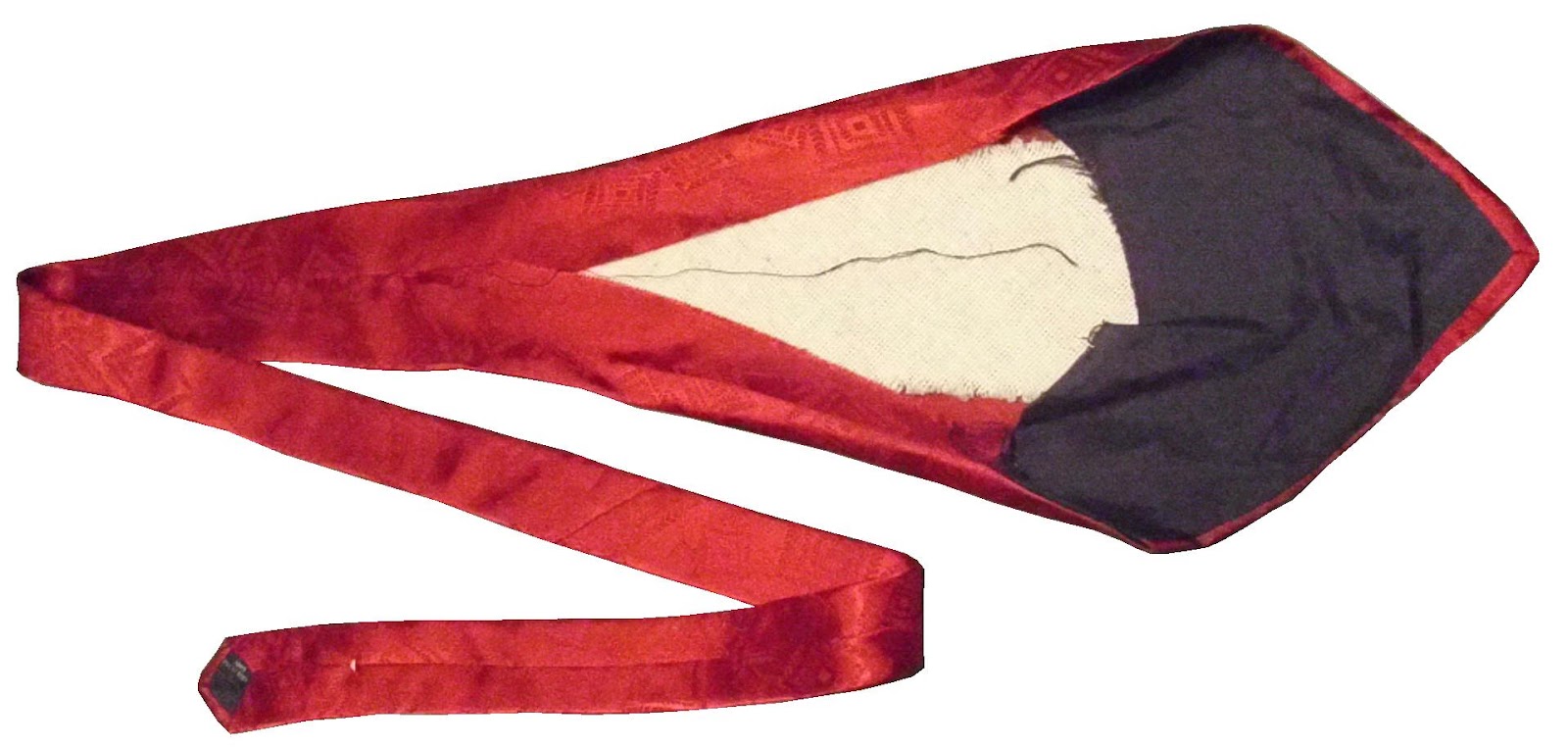
The back seam needs to be released about four inches up the back of the wide blade, to give a suitable width to the blade. Needless to say, don't do this with your favorite tie! Remove the label and tack-stitch, and then unzip the back.

After surgery. Leave the tip in place. You'll probably uncover the woolen interlining, but that's okay -- it won't show.


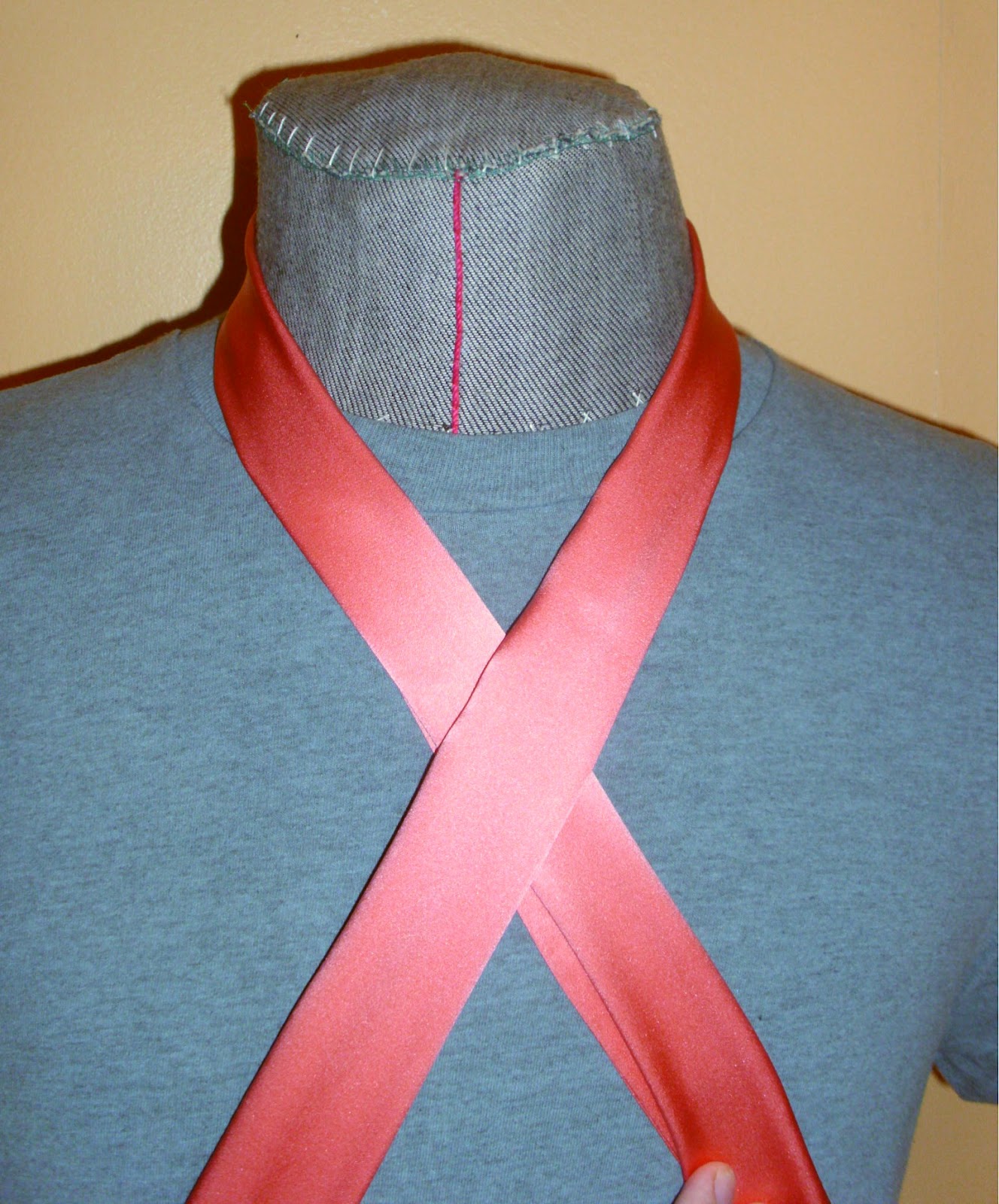
Pull the right end short, and cross over the left end.


Make the knot as before, spread the end out flat...


...and fold over the front.


The narrow end of the tie will hang down low. A convenient way to deal with this is to pull the narrow end up and pin it to the wide end. This will also give some weight to the blade and keep it from pulling free.

The effect after buttoning. Many secondhand ties that would be otherwise unwearable can be given second lives by wearing them as day cravats. 

So, we've seen that nearly anything can be tied under a shirt as a day cravat. Where, then, shall you wear it? 

In short, just about anywhere that you would go in shirtsleeves. Day cravats are sporty, outdoorsey things, just the ticket for those days when we slide into Autumn. Walks, picnics, croquet, bocce, lawn-bowling, or those sorts of traditional Anglophilic pursuits, of course. But, really, when's the last time you'd played bocce? I thought so. Think of it this way: you wear a long tie most days. On some days you wear a bow tie. That leaves a lot of days when you walk around with your shirt open. Nothing wrong with that -- you can't be buttoned up every day of your life. But now you have a little something new to put under your shirt on those days you do go tie-less. It's quick, easy, effortlessly elegant, and you just might get attached to them. You owe it to yourself to give it a try!

Click here to go to Part Eight of The Secret Life of the Tie.

Click here to go to the next essay chronologically.

Click here to go back to the previous essay chronologically, Part Six of The Secret Life of the Tie.

Click here to go back to Part One of The Secret Life of the Tie.

Click here to go back to the beginning.

Friday, September 14, 2012

You Bet Your Ascot

(Part 6 of the series, "The Secret Life of the Tie.")
Chapter 84
Well, here it is -- you knew it had to happen sooner or later. Yes, this week is your introduction to the ascot, the little-known, seldom-used daytime-formal neckwear option. Long ties are universal, and bow ties are becoming common enough that you may see one everyday, and you should certainly wear one at least occasionally. But a man can live his entire life and count with the fingers on one hand the times he's seen an ascot worn, and those usually only in the sort of movies that his wife watches -- and most men will play out their span of years never, ever having worn one. 

So woebetide the humble ascot, the orphaned neckcloth, the last remaining relic relegated to a bygone era of formalwear. It uniquely functions with one foot in the present and one foot in the past, but that doesn't mean it is a mode of clothing without purpose in today's world. 

For who wears morning dress anymore? Precious few even know what "morning dress" is, or when to wear it. Many "fashion bloggers" think that daytime formalwear is dead and buried, a relic of the nineteenth century. Others think it is a rigid and proscribed thing, that must be followed exactly lest one look an uneducated and bumbling fool, or (worse,) a poseur who doesn't know what he's doing. Both, are of course wrong, in Your Humble Author's perfect and inerrant opinion. 

Let's take a quick look and review a little, to make sure we're all singin' from the same sheet of music, so to speak. We've discussed evening wear a few times before, and critiqued countless celebrities, but rarely mentioned morning formals. Simply, formalwear is formalwear: the styles to be worn are different for daylight and nighttime, but they are worn to the same sorts of events. They aren't sombre or bleak, but party clothes, meant to be worn to festive events, balls, and situations where you should be enjoying yourself. The usual demarcation line is "before six" and "after six," but practically, it's the presence of sunlight when the event ends that counts. If the sun hasn't set when you're done -- morning wear. If the stars are out -- evening wear. Simple, in theory. 

The morning dress suit, is directly equivalent to the evening dress suit. They serve the same function, and represent the same relative level of formality. The cutaway coat sweeps away from the waist button and is quite long: longer than a tailcoat. Rather than black, the morning coat is dark grey. The trousers are light grey, in stripes or patterns. The waistcoat has a high crossover. And the colors --oh, the colors! Quite unlike the military precision and stark monochromatism of the evening suit, there is a tremendous amount of latitude in cut and color and expression in the morning suit. Unlike evening wear, much more particular attention must be paid to the season, the weather, and the venue, to use colors and patterns effectively.

The stroller suit is likewise the direct equivalent to the dinner suit. It is considered "undress," and in fact the stroller was not too long ago everyday business wear. In its particulars it is identical to the morning suit, with the exception of the jacket, which is not cut long. It usually has peak lapels and a single button, and is Oxford grey.

There are some critics that will descry the use of an ascot with a stroller, claiming that as an undress suit, it needs a fold collar and simple long tie. My response to that is simple: really? You wear a long tie every day of your life, you have one opportunity to wear a stroller, and you're gonna stick with another long tie? I say paugh to the pundits and nay-sayers: if you have an opportunity to wear morning dress, for crying out loud, for the sake of all that is beautiful and good in the world, wear it with an ascot.

That being said, let's look at the ascot itself. There is nothing more piteous than a pre-tied ascot, especially now in the twenty-first century when you may only have one opportunity to wear one properly! Study this diagram until you fully understand it. It's important. We will be referring to these seven steps throughout the remainder of this post.

You'll notice that an ascot isn't made like a long tie. For one thing, both ends are wide. You can purchase ascots today; most of them look like this, with wide paddles, a thin neckstrap, and a definite "right side" and "wrong side."

This, of course, makes the ascot a single-purpose item. Factor in that they are not inexpensive pieces of neckwear, and you have a couple choices ahead of you. The first is to make one yourself, or have one made for you. This illustration should tell you everything you need to know.

The other option is to do it the old-fashioned way, with a single piece of fabric. I picked this up at my favorite secondhand store. It's a woman's scarf, (I won't tell anyone if you won't,) silk, 4" by 70", and it's absolutely perfect for this purpose. It's just what would have been used historically. Like the rest of my tie demonstrations, I'm tying right on my tailor's form, without shirt or collar or waistcoat to get in the way of a clear view. Remember these are all worn with a waistcoat -- no exceptions -- and the collar can be either stand or fold. In keeping with the day/night symmetry, I would go with a stand collar for morning dress, and fold collar for the stroller, but that's just me. There are no hard and fast rules, really, and don't believe anyone that says there are. There are only traditions, and those traditions are not nearly so ingrained in morning dress as they are in evening dress, 

The first step is to fold the scarf over twice, to make a strap of about an inch to go around your neck. In the above diagram, this is Step 1, just before the LiCo maneuver in Step 2.

This is Step 4. At this point, take the two ends and unfold them to their full width.

This is Step 6...

...and this is Step 7, with the ends crossed and ready to pin to the shirt. A stick-pin is traditional, put through the two blades just below the knot, that hold the knot in place. 

To answer your next question, (you were going to ask a question, right?) this is the same knot, made with a scarf of single-thickness. These types of scarves are readily available, so it'd be great if they would work, but they are just too diaphanous and lightweight to hold the knot. You'd really have to go with a thick silk of double-thickness to tie an ascot, short of buying a purpose-built model.

If you've done your homework and studied the cravat constructions of a few weeks ago, the ascot should seem oddly familiar to you. Yes, this same knot, with a front-to-back-to-front wrap, is none other than a Cravate à l' Anglaise -- an unstarched Nœud Gordien cravat!

You can replicate all the classic cravats with a scarf like this, like this cravat à la Paresseuse. They have limited practical use because of the high neckline, BUT, with a high standing wing collar, you could have a bit of fun with a traditional cravat...at the right venue, when such a knot would be seen as a charming eccentricity, and not a gauche error in judgement. They tend to look more pleasant to modern eyes without the starch, but again that's just my opinion.

While we're talking about traditional knots, keeping the scarf folded along its length, and tying it in a simple square knot, results in the Steinkirk of yore, that we've looked at before.

The Ruche tie, which is simply an ascot tied like a four-in-hand, is sometimes used where the ascot would seem too showy, or where the personality of the wearer is not strong enough to carry off a true ascot. Some prefer the Ruche with a stroller, but as mentioned before, I don't hold with that. This example is tied with a Cross Kelvin knot, for a bit more interest.

The Ruche has roots in history, as this photo shows: it's not just a short-cut for those that don't know how to tie a proper ascot. Still, the universality of long ties makes the Ruche a bit twee as a formal option. I'd sooner wear it with an everyday suit!

The ascot can be approximated with a long tie. Although not my first option when others are available, this demonstrates that it can be done with acceptable results in a pinch. 

Why you'd find yourself at a daytime formal event with a suit but not a tie, I have no idea -- but in the interest of the acquisition of knowledge, I'll show you how it's done. 

We start inside-out and backwards, tying the thin end around the thick end. This would be Step 1. 

Step 2 would be a LoRiCo movement, like the beginning of an Oriental knot.

This is Step 4...

...and Step 6...

...and Step 7, ready to pin. As you can see, the thin end is completely covered by the thick end. With a stand collar, the neckstrap would have to be twisted so its right-side out, but it gives a very nice shape overall: the thick tie lining gives the knot some geometric interest.

The other method "normalizes" the tie ends, with the thick end tying around the thin end, also with a LoRiCo. It also starts inside-out. This is Step 1...

...Step 4...

...Step 5...

...and Step 7. The knot is large and square, and gives a much different ascot effect. This version looks nice with a fold collar.

So, to answer the rhetorical question posed earlier, who wears morning dress anymore? The answer: you can, if you go to the right venue. Full morning dress is still worn occasionally for daytime weddings in Europe and the UK, although strollers would most likely be the suit of choice for most American venues. Day outings, wine tastings, garden parties, luncheons, picnics, all hold promise for formal fun. If you want to exercise your right to formality, in most cases you'll have to be the instigator. Find a group of like-minded chums (or chums with like-minded wives, if it comes down to it,) and organize your own. You may have to blend in a few evening events to exercise those dinner suits as well. A Superbowl party with ascots and striped trousers? Why not? Why not, I say?