(Part 7 of the series, "The Secret Life of the Tie.")
Chapter 85
This week, we continue our walking-tour of the various forms of proper men's neckwear, and take a look at the unique and versatile day cravat. The first thing to learn is, don't call it an ascot. I know, most people do...but they are WRONG, and that error leads to much confusion. The ascot, as we saw last week, refers to a formal cravat worn in the daytime. Logically, you'd think that would be the thing called a "day cravat." Nope: the "day cravat" is more closely allied with the scarf, worn under the shirt against the neck. It is not a cravat at all, and it certainly was never acceptable to wear at Royal Ascot -- unlike the ascot, which was.
Confused? Don't worry, most people are. Take a deep breath, and empty your mind of your preconceived ideas and anything you think you know on the matter.
Now, absorb this: an ascot is a formal nœud Gordien or Ruche cravat, that is to be worn only with daytime formal wear. We covered it thoroughly last week. Nothing else is an ascot.
Next, absorb this: a day cravat is a loosely tied scarf, worn a certain way under an open-collar shirt. Nothing else is a day cravat.
Finally, absorb this:

Jeremy Piven is one of those people who are confused. He thinks this is an "ascot," and since ascots are "formal," he can wear it with a tuxedo to awards ceremonies. Wrong, wrong; oh, how horribly wrong.
A day cravat is sports wear, that has been worn since the 1920s. It was a rakish, comfortable alternative to wearing an everyday tie. It is leisure wear. It is resort, lounge, casual, day wear. It is in no way, shape, manner, or form, anything remotely related to anything close to approaching formal wear.
This is an important point, which is why I'm drilling it into your skull. Because a day cravat is not dressy, the opportunities to wear it in one's everyday life explode into endless possibility. Consider:
1. It is comfortable, more than any other mode of neckwear. It is worn loose around the neck, under an open shirt collar.
2. It is versatile. It can be worn under anything with a neck opening: button-down or dress shirts, sweaters, even tee-shirts and jackets.
3. It is easy to tie, simpler than the easiest long tie knot.
4. It is casual: no jacket or waistcoat is required, it looks just fine with shirtsleeves, and doesn't look as "studied" as a bow tie.
5. It is subtle. Unlike a dangling long tie, a day cravat affords the barest bit of color and interest at the neck.
6. It is elegant. Subtle as it is, it adds a note of insouciance to any casual outfit, without glaring out or resulting in an affected appearance.
7. It is nearly universal. Just about any scarf or square or scrap of fabric can be pressed into service as a day cravat.
It is this last point, on the universality of the day cravat, on which we'll spend some time today.

Day cravats can be purchased as ready-made items, of course. As a rule, they look like this, rather like wide-bladed ties that are pleated in the center. (Compare this to last week's ascot, and you will see that the two items look similar, but are made completely differently.) These can be purchased for the day-cravat-inclined, and are still sold in surprisingly large numbers by any number of retailers worldwide. Day cravat wearers are on the rise, although most of them will insist that they are wearing ascots. Like the ascot, ready-to-wear day cravats are not inexpensive, nor are they required for the novice or student cravatsman. Let's look at some day cravat options:

First, we'll make a day cravat out of a simple scarf. This one is silk, tasselled on the ends, and is 12 inches wide by 40 inches long: just fine for our purposes. (I picked it up at the local secondhand shop for a couple of dollars.) For this series, I'll use a neutral-color buttondown shirt over my tailor's form, to give a sense of the finished effect.

The first thing to do is lay out the scarf and fold it lengthwise into a narrow strap. For this one, folding in thirds, and then in thirds again, did the trick. Lay the strap across the back of your neck, the right end over the left.

Then, (using long tie notation) tie the knot with a Li Ro Li Co -- essentially, a simple Onassis finish to a four-in-hand. Spread out the end of the scarf...

...and fold it down over the knot. Straighten the cascade...

...and button your shirt to the first button. (Only cads wear day cravats with two buttons unfastened!) Adjust to show as much or as little pattern as you wish. The neckband can sit proud of the collar, with a prominant puff to the front, or it can sit low, with just a bit showing out the front.

Several previous installments have extolled the virtues of wearing an unlined jacket on the beach or at a resort, worn with a scarf in lieu of a shirt, and Bermuda shorts. Here is an example of that mode, and it is just about the most comfortable thing you can imagine.

Now let's look at another option, this one a kerchief, 26 inches square. (Same secondhand shop, one dollar.) Diagonally, it measures about 40 inches: good for our purposes! To form the neckband, lay out the square in a diamond shape. Fold in thirds by bringing the top and bottom points in. Fold in thirds twice more. Lay the strap across -- this time keep the left hand short and the right hand long. Cross the right over the left, and form the knot as before...

...but this time, "unfurl" the point before making the final Co move.

Bring the point over and down...

...button up, and adjust.

Here's the effect with a v-neck sweater instead of a shirt. (This is as much of a day cravat as you'd want to show: it works a bit better with a crewneck.) This looks quite sporty with a jacket. I have also mentioned the combination of a jacket, tee-shirt, and day cravat in a previous installment.
As you can see, a wide variety of scarves and fabrics can be used as day cravats. Most of these can be found in the ladies' section of Your Favourite Store. No fear, scarves are unisex for our purposes here. As long as it's at least six inches wide and somewhat longer than a yard long, it can be made to work. Remember that at most only a few square inches of the pattern will be seen under a shirt -- so a scarf that looks positively garish when seen all at once, may just work well as a day cravat. Keep your eyes and your mind open, scout for patterns, and you just may find pleasant surprises in the oddest places.

There is another option, that you may have in your closet right now. Yes, a common long tie can be made into a passable day cravat...but it requires a little minor surgery.

The back seam needs to be released about four inches up the back of the wide blade, to give a suitable width to the blade. Needless to say, don't do this with your favorite tie! Remove the label and tack-stitch, and then unzip the back.
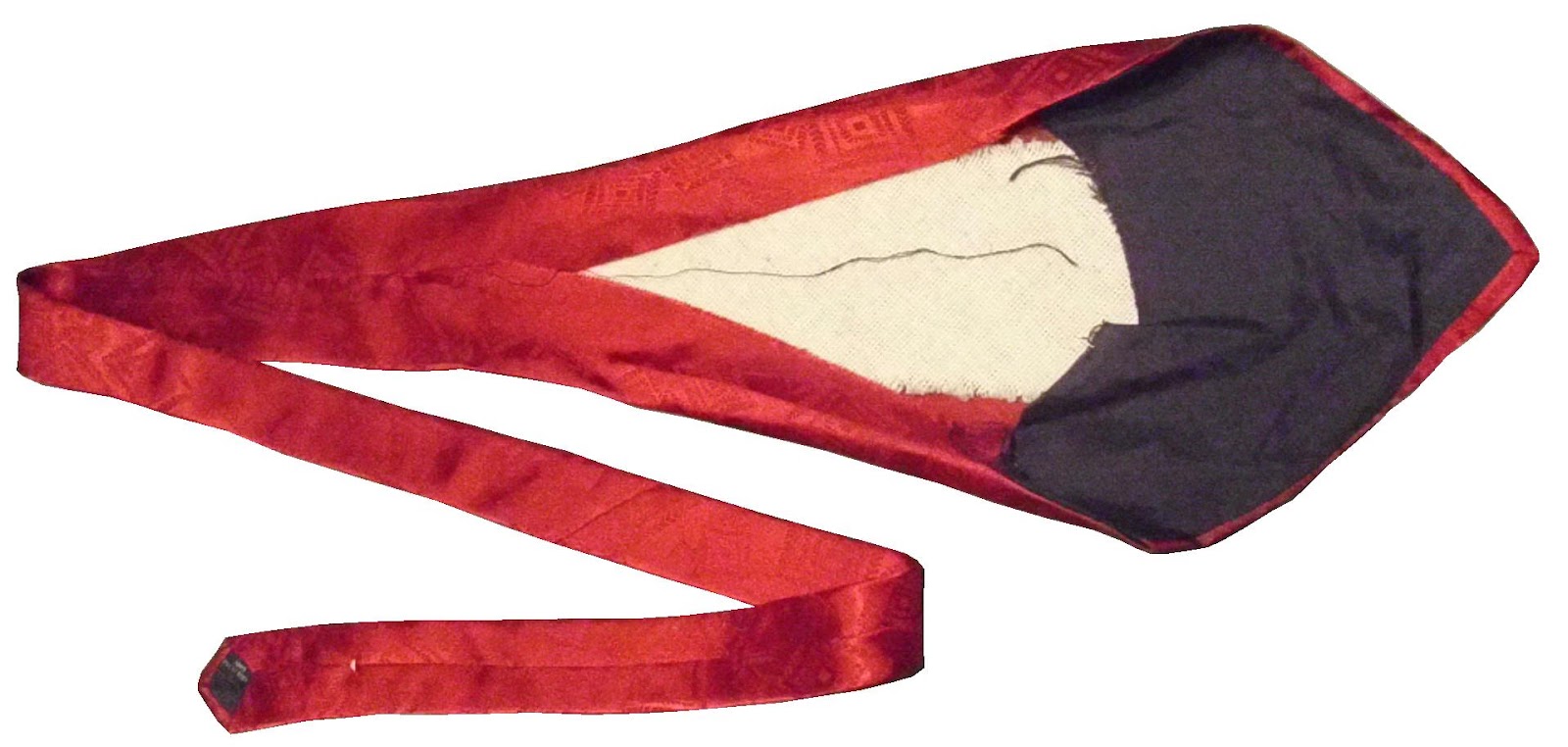
After surgery. Leave the tip in place. You'll probably uncover the woolen interlining, but that's okay -- it won't show.

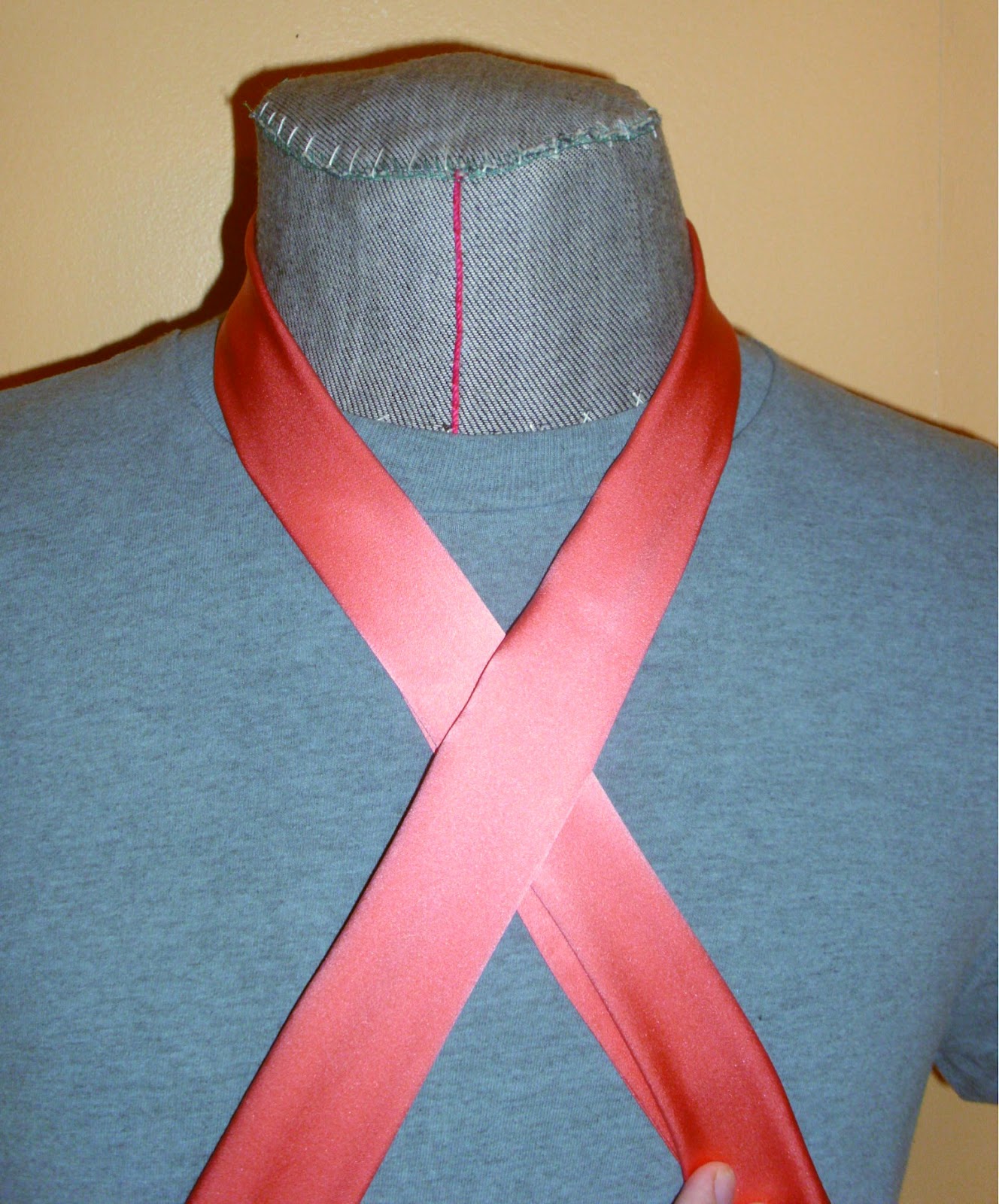
Pull the right end short, and cross over the left end.

Make the knot as before, spread the end out flat...

...and fold over the front.

The narrow end of the tie will hang down low. A convenient way to deal with this is to pull the narrow end up and pin it to the wide end. This will also give some weight to the blade and keep it from pulling free.

The effect after buttoning. Many secondhand ties that would be otherwise unwearable can be given second lives by wearing them as day cravats.
So, we've seen that nearly anything can be tied under a shirt as a day cravat. Where, then, shall you wear it?
In short, just about anywhere that you would go in shirtsleeves. Day cravats are sporty, outdoorsey things, just the ticket for those days when we slide into Autumn. Walks, picnics, croquet, bocce, lawn-bowling, or those sorts of traditional Anglophilic pursuits, of course. But, really, when's the last time you'd played bocce? I thought so. Think of it this way: you wear a long tie most days. On some days you wear a bow tie. That leaves a lot of days when you walk around with your shirt open. Nothing wrong with that -- you can't be buttoned up every day of your life. But now you have a little something new to put under your shirt on those days you do go tie-less. It's quick, easy, effortlessly elegant, and you just might get attached to them. You owe it to yourself to give it a try!
Click here to go to Part Eight of The Secret Life of the Tie.
Click here to go to the next essay chronologically.
Click here to go back to the previous essay chronologically, Part Six of The Secret Life of the Tie.
Click here to go back to Part One of The Secret Life of the Tie.
Click here to go back to the beginning.