Showing posts with label Hat. Show all posts

Friday, October 19, 2012

Da Capo

Chapter 89
Hello, Average Guys! As you know, I try to maintain a certain kind of balance here at Dress Like a Grownup!, and keep a few different kinds of plates spinning at once. Some plates are the equivalent of a doctoral degree, continuing education for lifelong dandies, all the way down to some plates that are Dressing 101, core curriculum for the freshman youth. After some time in the more advanced topics, like our recent History of Neckwear series, I like to go back and spend some time at the basics, for the benefit of Average Guys like yourself who are just starting along your mature sartorial journey. 

Of all the changes that need to be made, to cast off the shackles of the children's clothes you currently wear, and make a neat transition to the attire of adults, some are easier than others. The most difficult transition, is to that of a proper hat. 

This is understandable. The transformation of the core of your attire, trousers and shirts, is merely a shift in style from your current jeans and tee-shirts; as is the addition of a jacket. The metamorphosis from sneakers to proper shoes is likewise largely a shift of style: after all, you have always worn shoes of some sort: you are merely aiming to shift its nature. In other words, you are modifying your current articles of clothing to different, but related, articles. 

Not so the hat. For many, the inclusion of a hat is ex nihilo; the addition of an article that is totally new, and at first very strange. It is impossible to ignore a hat: it is always there, an unfamiliar pressure around your skull, an unfamiliar weight on your head, an unfamiliar sight at the periphery of your vision. You feel uncomfortable, and awkward, and uncertain; and your behavior will reflect that. And as you know, your attitude toward what you wear is just as important as the articles themselves -- if you feel awkward wearing a hat, others will feel awkward for you wearing a hat.

And yet, there are millions upon millions of Average Guys who think nothing of wearing a baseball cap. The odd little beanie-with-a-bill has become completely ubiquitous. But, just because everyone does something, doesn't mean it's right. If you're playing baseball, that's just fine -- wear a baseball cap. If you're not, don't -- wear a proper hat instead.

Fortunately, there IS a way for an Average Guy to transition into a proper hat easily and gently, without the jarring impact of the Sudden Fedora. If you are currently one of those fellows who does wear a baseball hat everywhere, this transition will be completely painless and very natural. If you have never worn a hat at all, it can be nearly an unnoticeable transition, for this particular sort of hat is actually very closely related to the baseball cap. 

I refer, of course, to the flat cap; also called the driver's cap, newsboy cap, taxi cap, dai cap, golf cap, ivy cap, or scally cap. They all refer to basically the same thing: low, wedge-shaped, with a visor in front instead of a brim all 'round.

They are universally worn, breaking boundaries of class, age, and nationality. In practice, they feel very much like the baseball cap with which you are familiar: snug around the circumference, sitting lightly upon the crown of the head, a brim over the eyes, the ears out in the open. Traditionally a sporty sort of outdoor hat, they can be worn pretty much anywhere today. If you are reticent about wearing a trilby or fedora until you get used to the idea, the flat cap is the ideal way for the Average Guy to break into the World of the Hatted.

The flat cap can trace its ancestry to the Tudor period. Tom Ring's 1566 Portrait of a Man wears a simply constructed cap.

The Tudor cap developed into to the widely-used military cap. They were constructed like this mau cap: rectangular front and back panels, a circular crown, and a demilune-shaped brim. The height of the front panel and the width of the brim were the same, so if the front panel was brought down and attached to the brim...
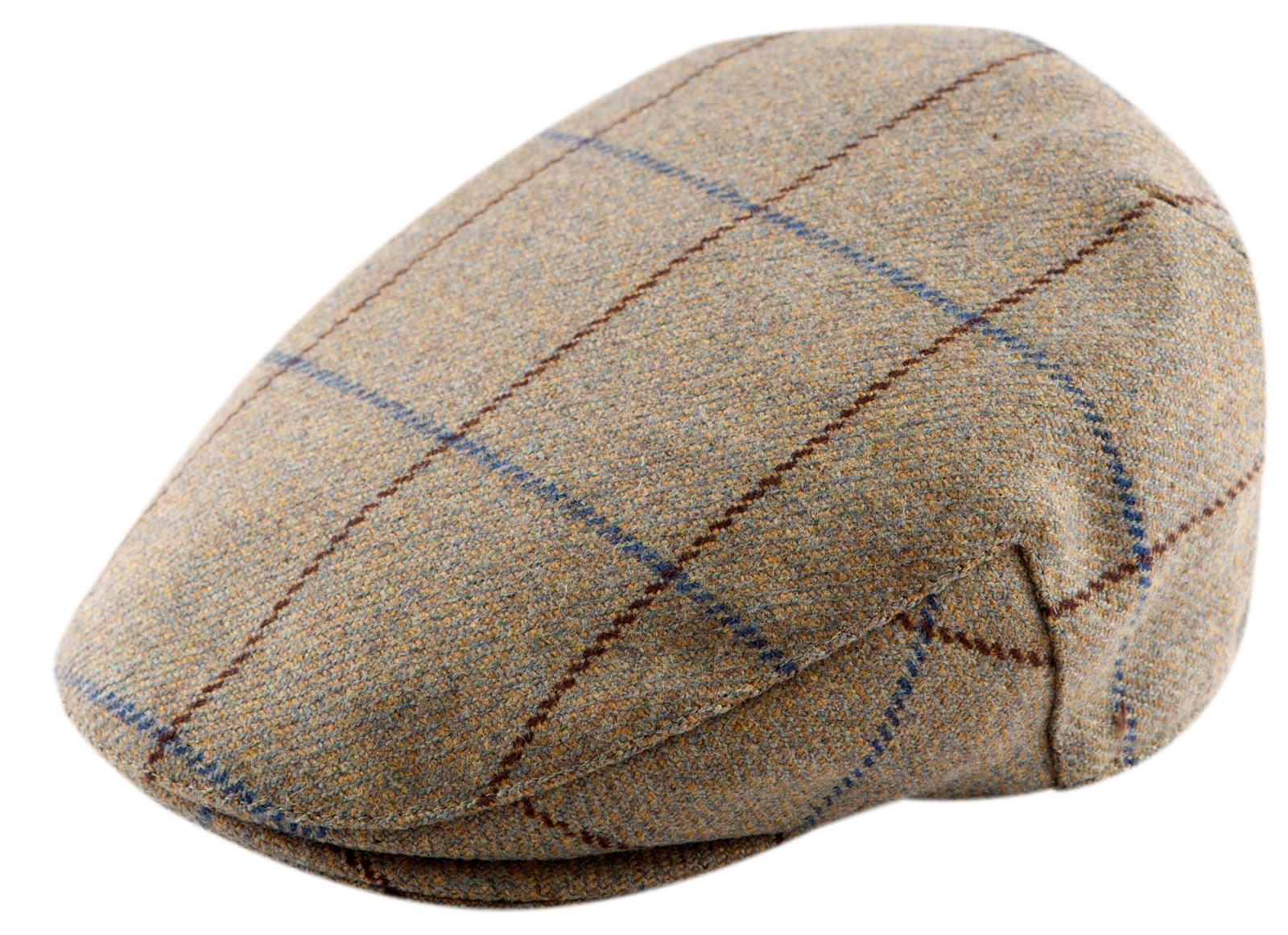
...the result was the distinctive wedge-shape of the flat cap. Notice the front panel remains, but the back panel is now in one piece with the crown. Many flat caps are made like this, but there are many variations. They are made from just about any fabric imaginable: cotton, tweed, felt, wool...even leather. One benefit of this type of cap is that it can be folded flat and put in a jacket pocket.

For cold weather, flat caps can have ear flaps for warmth; either tucked up inside or tied over the top when not in use.

Some flat caps are made of one piece of shaped and stretched fabric. As a rule, the smoother and plainer, with fewer seams a cap has, the more dressy it looks; since it takes more work to form the shape than just sewing panels together.


The ultimate expression of this is the ascot cap. They are in appearance like a flat cap, but shaped and blocked on a form like a fedora, with no seams. They are made of felt, and quite stiff.


There is another breed of flat cap, that is not derived from the Tudor military cap. It comes from another Tudor hat, like this one painted by Raphael in 1506 of Angelo Doni. It is made of pie-shaped wedges sewn together, with a drawstring around the circumference. It survives today virtually unchanged, in the form of the doctoral cap of academic regalia.

From it we get the eight quarter cap. Less wedge-shaped than the one-panel cap, the eight pieces that form the crown are topped by a button. You can see the resemblance to the baseball cap immediately.

The six quarter cap is identically constructed to the 8/4 cap, but with two fewer pieces for a slightly more streamlined profile.

The five panel cap is a hybrid of the two styles -- the front half is made with a half-circle crown and a front panel, the back half is made with pie wedges like an 8/4! 


There is a flat cap for every taste, and the shape and feel is similar enough to its cousin the baseball cap, that the Average Guy who finds himself hat-shy can slip into proper headwear without a second thought about it. After a time in a flat cap, with which you can practice proper hatiquette, you can decide to expand your horizons with a fedora or a trilby, or not. Many gents are content to spend their entire lives in a flat cap.

Click here to go to the next essay chronologically.

Click here to go back to the previous essay chronologically.

Click here to go back to the beginning.


Friday, June 29, 2012

To Save or Splurge?

Chapter 73
Last week's installment ended on a bit of a downer, tone-wise, with the sombre warning that the totality of our modern, advanced way of life will come crashing down about our ears if the delicate infrastructure of electronics and communication is disrupted -- and something as simple as an EMP will disrupt it quite thoroughly.

Let's continue in that dark vein this week, and we'll do so by looking at the economies of dressing well, and in the process cast a sideways glance at complete global economic collapse -- an utter financial meltdown.

It's not a foregone conclusion, but unless something is done very shortly, money in general will be tight for everyone, no matter where you live. America is borrowing and spending itself to bankruptcy, then through it, and far beyond, with deficits in the trillions, and no end in sight. The Euro is faring no better: the financial experiment that is the European Union is rapidly devolving into a shell-game between national banks.
A word is beginning to be bandied about more and more, and that word is austerity. It sounds drastic; so drastic that France took the "damn the torpedoes, full steam ahead" stance recently of ignoring the problem's existence entirely. The more socialist one's country leans, the more difficult it is for one to fathom decreasing one's reliance on the government; but decrease one must, if a debt problem is to be resolved.

The solution to over-spending is very simply to spend less; this works remarkably well with individuals, families, nations, or planets. Simple self-restraint, self-control, and budgeting -- in other words, living within your means -- is called for. Much of this can be achieved on a national level through one's individual actions. To continue the theme of last week: be content with your lot in life. Your most valuable commodity is time. Live with a conscious attention to the amount of free time that modern technology affords you, and take renewed possession of that leisure time and enjoy it to the full.

You may need to take a step back and evaluate if your financial reach exceeds your grasp. Far too many men are living lives pursuing huge bankrolls while simultaneously racking up huge debts. Are you one of those men who equate contentment with acquisition of stuff? Perhaps you should dial back on the "bigger and better" and the rat race, and simply pay off your existing debts. You may find life more comfortable with less stuff, plenty of leisure time, and completely in the financial black.

Voluntary austerity isn't as drastic as it sounds in our Futurific twenty-first century. In a remarkable study, it has been shown that as far as amenities and quality of life are concerned, the typical "poor" household in America is living the middle-class standard of 10 to 15 years prior. In other words, the middle-class luxuries of 1970 became de rigeur for those living at the poverty line in 1980. This means the "poor" of 2012 are equal to the "middle class" of 2002. The "poor" of 2002 are equal to the "middle class" of 1992, and so on.

The argument becomes largely academic when you realize the poorest Americans today live like kings compared to men of a mere century ago, with access to unimaginable luxuries like refrigeration, air conditioning, cable televisions, automobiles, and cell phones. For that matter, most Americans "in poverty" live in larger houses with more amenities than most Europeans. And they live in regal ease when compared to today's average in underdeveloped third world countries.

Humans have lived remarkably hard lives for millennia. The past hundred years have made men soft. Understanding that is the first step to appreciating what you have and making the most of it. If governmental decisions or terrorist activity take that soft living away from you, it will be a less jarring step in re-adjusting to your new life, without drastically changing your quality of life where it counts.

Applying this to what you wear isn't a great step of logic, but it does bear mentioning. It is possible, nay, imperative, necessary, and needful, to be properly dressed no matter your financial standing. A Captain of Industry may be laid low by a financial collapse and subsequent hyperinflation; a factory worker will have nothing to do without electrical infrastructure; a disabled vet will be left with his savings when the government can no longer write a check. There need not be any difference between the attire of these three examples, amongst themselves, or on either side of their fortunes; nor need the world plunge into Mad Max-style skins and rags.

The prevalent byline on the Blogosphere of Men's Fashion is usually something along the lines of "Buy the very best that you can afford." This is, I think, overly simplistic. Not the least of the errors is equating price with quality. The larger question is what defines "affordability?" Most men think this means 'take as much money as you can part with and buy as few things as possible.' Not so -- not so at all!

Let's look at when to save and when to splurge on your clothing, and how.

Surprisingly to some, I do not recommend buying bespoke as a rule. The level of art and exactitude and quality in a bespoke suit is unmatched. A bespoke suit is something akin to a lifetime commitment, a big-ticket purchase to be passed down to your heirs. Do you really want to wear the same suit for forty years? Will your body shape even remain constant that long? Do you want to be known as "That guy with that suit?" It may be more cost-conscious to rotate through more suits more often, purchasing and moving on, and retaining a tailor to alter your suits as necessary. We've discussed taking your own measurements,  going on quick-strike hunts at secondhand shops, and focusing on classic fit and style in previous installments, also covered in the Book.

Purchase used, hardy, provenanced articles, fine-tune the fit yourself or with a tailor's assistance, and rotate your suits out every couple of years, and you will have a personalized, elegant, classic, and continually updated look without appearing nouveau riche or "trying too hard." The same goes for ties, coats, trousers, sweaters, and shirts. Buy what fits, on the cheap, and rotate it out periodically.

The exception to the rule, the one time that bespoke is practically required, is formal wear. A dress suit is not the time to skimp; it is an long-term investment and splurge-worthy. Don't even think about wearing white-tie-and-tails without having it made for you. The cost will be breathtaking, but if you are invited to a white-tie event you will be able to afford it. Ditto the boiled-front shirt, detachable collar, shirt studs, cuff links, pumps, et cetera. Think of a dress suit as the masculine monetary equivalent to the wedding dress -- the difference being, if a woman is lucky she will wear a wedding dress only once; if a man is very lucky he will wear tails more than once.

Dinner suits should be bespoke as well, but as the cut is much more forgiving, bespoke is within the financial reach of the average man -- and the opportunity to wear it is much greater than for a dress suit. At the very least, in a pinch, a good tailor should be able to take a "bespoke-but-not-for-you" dinner jacket and alter it accordingly. The pique shirt and accessories are not a place to skimp, either. This really is an example of a suit you will buy once and use throughout your life, so you'd better make it count.

On the issue of undergarments, save; don't splurge. Hand-woven silk tee shirts and elaborate Italian socks may seem luxurious, but anything directly against your skin should be treated as disposable. It will wear out just as quickly as the cheap stuff from the box stores. If you pay a premium for fancy briefs, you will be temped to hold onto them until they are past their prime. Don't wait until your tee shirts turn grey, your elastic loses its snap, and the heels wear through your socks! Rotate them out for new items before these things happen, and you will feel better with fresher underthings more often.

Shoes, on the other hand, are an area in which to splurge. New shoes that fit and conform properly to your feet, are not only supportive and comfortable, they are better for your back and your posture. You should have several pairs in rotation, for shoes need to rest after being worn, and they should be treated to proper shines regularly. With care, shoes are an investment that will last for decades. The old saying is true: you're on your feet all day, so you need to treat them well.

Hats walk the fence between the realm of "splurge" and "save." Most new hats for everyday use are either too expensive to wear with insouciant abandon, or too cheap and shoddy to be any good. A good, lightly-worn vintage hat can be as well-built and serviceable as new, but yet not so dear that it will ruin your day if it blows off into the mud. A hat with some years on it can be re-steamed and bashed to your preference, will fit with a comfortable and broken-in "set," and can take a day's worth of constant doffing and donning. If you are a true hatophile, splurge on "Sunday hats," a black Homburg to wear with your formals, or a specialty new or refurbished hat for special occasions.

Enough of the doom and gloom! Next week we will eliminate the negative, accentuate the positive, and get back to the business of dressing well, despite the ridiculousness that happens around us. Stay tuned!


Click here to go to the next essay chronologically.

Click here to go back to the previous essay chronologically.

Click here to go back to the beginning.

Friday, December 16, 2011

Drastic Measures Required

 (The Great Computer Crash of 2011, part 1 of 3)
Chapter 45
Every human's nightmare scenario came to pass the other day. My computer is comatose. A dastardly piece of malware infiltrated my firewall, and despite the valiant efforts of the little blue-glowing men in the TRONworld inside my computer, this time Sark and his red-glowing henchmen won. The registry files were run through a blender.

End of line.

So, whilst the old difference engine sits in the shop awaiting brain surgery, and with it all the pictures, files, and articles associated with the burgeoning TT&S empire, I'm inputting this week's installment on...(drum roll)...an Amazon Kindle3.

Which, as it turns out, is only slightly more aggravating than programming a VAX using punch cards. So, the next few weeks will be shorter than usual, and to a greater or lesser extent, off topic. The Island of Misfit Clothes will have to go on a short break...as will all the other neat stuff I had planned. Just until my computer comes to its senses, which will probably be after Christmas some time.

I was sitting in a conference room a few days ago with about 30 other people. All the people there were there by invitation, all had plenty of notice to prepare, and the meeting was in a professional building during business hours. I was sitting toward the back, and as I was a bit bored, I started counting hats. One older gentleman came in wearing a black fedora, which he (correctly) took off soon after entering before he sat down. One man wore a black toboggan throughout. Three --THREE, mind you-- wore hoodies. With the hoods up. For the entire hour. In a 73 degree conference room. What surprised me, though, were the number of baseball caps.

Off hand, I would have said there were three or four. A specific head count, though, revealed TEN capwearers. A third of the attendees -- one in three -- thirty three point three bar percent -- think a baseball cap was completely acceptable headwear for the occasion.

More puzzling to me, though -- why there were so many 'invisible capwearers' that didn't make themselves apparent to me until a specific count? Have we, I, us, become so desensitized to the hoards of caps, their presence so ubiquitous that our brains no longer register them, while a glimpse of a single fedora immediately arrests our attention?

Caps or hats or toboggans or touques or hoods; for crying out loud, people, learn the rules of courtesy and take them off in private spaces!

Click here to go to the next essay chronologically.

Click here to go back to the previous essay chronologically.

Click here to go back to the beginning.

Friday, July 1, 2011

Hatiquette

Chapter 21
Hat-deficient folks today make up the bulk of Western society. By and large, they fall into two camps. The first camp don't wear hats, ever. For whatever reason, they are irrationally hatophobic. Even when the situation demands a hat, they, like David Beckham at the royal wedding, would prefer to stand outside in the sun, awkwardly holding their hat, than deign to let headwear block their coif from view. The second camp wear a single piece of headwear with disturbing regularity, even when it doesn't make any sort of sense; whether it be a baseball cap to church, a knit toboggan in the middle of summer, or a head-scarf...well, ever.

Both groups of people, even though they manifest different symptoms, have similar psychological hangups: the obsessive not-hat-wearing, and the obsessive always-hat-wearing, are both loathe to change their ways. Just as one will never wear a hat, the other will never take it off. These people need to address a greater issue before they can be truly well-dressed, and that is a situation between themselves and their psychiatrists; I do not have the time nor the patience to deal with such hangups in this venue.

The balance, of course, and as always, is right in the middle. Hopefully it is where you live your life: the take-it-or-leave-it middle of the road non-obsessive, who desires to dress properly, and understands it will take changes in your habits and customs occasionally. To be well-dressed includes being hatted, but here lieth the minefield: to merely plunk on a hat at the beginning of the day, and take it off at the end, is a much worse offense than simply not wearing a hat at all.

Just as there is not one proper hat for all occasions, (and in fact you should have a variety of hats for different seasons, weather conditions, and degrees of formality,) there are myriad rules for when to wear your hat during the day, and when to remove it. You should remove and replace your hat many, many times during your average day. Should you watch any vintage film, it is apparent that men used to know these rules, until following them became nearly an unconscious act, and if you're not familiar with them, it can be frankly befuddling.

There are books, websites, and blogs galore that attempt to make the arcane art of hat-removal accessible to modern men. Most of them are lists of dos and don'ts, with exceptions, and exceptions to the exceptions. It usually starts with "wear a hat outdoors, don't wear one indoors," and goes on from there. The indoor/outdoor matrix, I think, somewhat misses the point, however. A much more logical starting place is based upon the premise of public/private spaces.

If you want an easy-to-remember rule to guide you with your hat-wearing, here's the cornerstone on which to hang your hat (pardon the pun:) You have the option to wear your hat in public spaces. Doff it in private spaces. Everything else you need to know is just elaboration upon this thesis.

Always wear your hat outdoors works, simply because "outdoors" is nearly always a public space.

A private space is defined as "cash or key:" a place where people live, work, or pay a price to enter. More simply -- it's any space that is not a public space.

Some examples of how this works:

A house is a private space, but the entryway, foyer, or vestibule just inside the front door is considered public. This goes back to the history of great houses, when the butler greeted guests at the door and took their coats and hats.

A church is a private space; it is after all "God's house."

An apartment is a private space; but the lobby, corridors, and parking areas of the apartment building are public.

A hotel lobby, check-in, and corridors are public. The rooms of course are private, but the areas only open to guests (gyms, pools, game rooms, lounges, etc.) are private spaces as well. 

In an office building, lobbies and corridors are public. Offices are private space. The area of a cubicle farm is all private, not just the cubicles themselves. (In other words, the area is treated as one large office.)

In a doctor's office, if there is a separate reception area it is public, but the waiting area is private (the concept here is that you have paid for the doctor's services by this point.)

A hospital building is treated as all private beyond the main entry; this goes back to the days when hospitals were run by the Church.

Any club that requires dues of its members, i.e. not open to the public, is treated as a private residence.

A theater is private space, since you pay for a ticket. If you buy the ticket in the lobby, the lobby is public, since anyone can enter. If you buy the ticket outside and then enter, the lobby is private as well, since presumably you cannot enter without a ticket.

An outdoor stadium sporting event, even though a private ticketed venue, is still treated as public, by virtue of its being al fresco -- unless it's in a domed stadium. Then it's hat's-off.

Get it? With a little bit of brainpower, it's very easy to figure out hats-on or hats-off, without memorizing a bunch of rules. There are a couple of oddball situations that aren't intuitive, since their origins are in antiquity. The "foyer rule" is an example of this. The other examples:

An elevator is a private space, even when the corridors are public. This goes back to a concept that you are in the elevator operator's "office." Human operators are long gone, but the tradition remains.

A restaurant is a public space, but when you are seated at your table, your table becomes a private space, as you are paying for being there. The bar, however, remains public, even if you are sitting and drinking.

If you are in motion, your hat remains on, whether the transport be public, private, enclosed, open, indoor, or outdoor. This harkens back to the days when transport was basically all done outside: walking, horseback, or open carriage. Today, we have planes, trains, automobiles, moving sidewalks and tramways, trolleycars and cable lifts; but the old way persists, despite new technology.

And that's all there is to it. With the public/private model, you have everything you need to cultivate proper hatiquette, but we still need to touch on the foundation of why we do these things. Uncovering the head is a sign of deference, subservience, or reverence going back to the beginning of time. In private spaces, it is a concession of intrusion into another's domain, a show of gratitude for favor, or a foment of intimacy among equals: in each case, it is an unconscious symbol that one has let down one's guard and has endorsed a non-threatening behavior. It has at its root a common genetic behavior among not just men, but many animals as well.


Behold mine neck, wilt thou
loppeth it from mine noggin asunder?
This brings us to the old tradition of tipping the hat...is it of any use today, or just a musty anachronism? Bowing or genuflecting is a hard-wired animal behavior, that physically puts oneself at a lower level than another, and displays oneself in a vulnerable way whilst diverting one's eyes. Anyone who has a cat or a dog is aware of this behavior: it's a familiar stance in the animal kingdom. In Men, to bow deeply from the waist was the accepted affectation for millennia: removing one's hat was necessary to prevent it from hitting the floor.

I would bow, but I fear my
collar prevents it.
As bowing became less extreme through the nineteenth century, removal of the hat became less necessary, but was performed anyway. By the twentieth century, the bow was curtailed to a nod of the head and a slight lift of the hat, and the hat-tip was born. Social changes in the West made broad class distinctions among men inconsequential, and hat tipping was reserved for women.

A bit more subtle than
Mr. Kadiddlehopper here.
Here in the twenty-first century, not just class, but gender distinctions, are increasingly unimportant. Refinements such as removing your hat when talking to a woman on the street, can today be inexplicably seen as sexist. Taking the deconstructed hat-tip to the modern day, when greeting a women while wearing a hat, a subtle touch of the brim is sufficient. It is enough to be selectively appreciated or ignored as needed. And never tip your hat to another man: it was traditionally an insult, the equivalent of calling him a girl.


An automatic hat tipper, for when
your hands are occupied.
Yes, it was that important.
Hats are selectively removed at certain instances where your hat would otherwise remain on, most notably at outdoor sporting events. This causes some men undue consternation, but it need not be so. Just remember that removing the hat is a sign of deference, subservience, or reverence. A prayer is directed at God, as is a hymn, so it is obviously a hat's-off moment. In the U.S., the Pledge of Allegiance is a prayer to the State, and the National Anthem is a hymn to the State, and is accorded the same reverence as is given to God. Your mileage may vary according to your particular country, of course, but this guideline will do for most.

Dressing like a grownup, as we are continuing to see, extends beyond simply what you wear. It's how you wear it, and what you do with it: not merely a stiff mannequin who stands static like a fashion plate, as many are wont to do. Start making mental notes of public/private transitions, even when you are hatless. Practice, and more practice, will make a man who will effortlessly doff his top without thinking, without self-consciously drawing attention to his actions.

Click here to go to the next essay chronologically.

Click here to go back to the previous essay chronologically.

Click here to go back to the beginning.

Thursday, June 23, 2011

The Hats of Summer

Chapter 20
It's summer, and you need a hat. Yes, you do. The blazing rays of our celestial nuclear furnace are beating down upon you, and you need to shield yourself. "I don't like hats," you might object. "They're hot, they make my head sweat, I'm not outside that much, I'm better in summer without one, thank you very much," etc. Balderdashery -- stop whining and get thee to a haberdashery!

You might be thinking of a baseball cap. Not the best choice for summer headgear: it sits tight to your scalp, absorbs heat and transfers it to your head; and the bill, while keeping some sun out of your eyes, will do nothing for your ears and back of your neck, which will be sizzling like crispy strips o' bacon in short order.

For torrid summer heat, nothing beats a real hat. You don't need to lay down loads of oof for a suitable one either; your local Chinese-Clothing-Import-Big-Box-Mart will have a cheap selection, at least one of which should be in a suitable summer style. You get what you pay for, of course, so you'd best treat it like a seasonal disposable; unless you shell out hundreds for the high-end stuff, which you can wear for decades.

Regular hats, whether of felt, fur, tweed, or cloth, are usually matched to your jacket to a greater or lesser degree: summer hats are by nature a more casual breed, that can be worn more as an afterthought accessory which matches everything. Whilst a felt fedora or tweed trilby looks a bit odd with shirtsleeves, a summer hat doesn't look out of place with a polo shirt and Bermuda shorts, making it perfect for, well, summer.

So what makes a good summer hat? A light color is essential, to reflect radiant energy and keep your noggin from broiling. A brim, all the way around, to keep the UV rays off your ears and neck. A high crown that sits a bit off the top of your head, to prevent conduction heating. And a slightly loose fit, to prevent undue sweating from contact with a too-tight sweatband.

The best material is, and always has been, straw; being lightweight, light in color, and of a loose enough weave to permit a little airflow through the crown. Cotton is a good compromise material, as is thin felt; the tradeoff is durability and waterproofity for lightness and airflow.

Most people think straw hats are "Panama hats." While all Panamas are straw, not all straw hats are Panama hats! A real Panama hat must be hand-woven in Ecuador from Jipijapa palm straw. They're made in a variety of styles, but the most iconic is the Optimo Panama.

You can tell an Optimo by its open crown
with characteristic ridge down the center.
And as with everything, the style of your hat is of no small importance. The best styles of summer hat are those which mimic real hats: most notably the fedora and homburg.
 
"Toquilla" by Monterrey, a true Panama in
the classic fedora shape.
"Eldorado" by Dobbs, with the center crease and
turned-up brim of the more formal Homburg.
Trilbys and stingy-brim styles are more for fashion than function: their brims are too narrow to be of any practical use, and make poor summer hats.

The Stetson "Mercer" trilby, for example,  
is too thin of brim to provide any real shade.
At the other extreme, unless you are a gaucho, stay away from any version of sombrero.

The first extreme: a resounding No.

The other extreme, "Charlie" porkpie by Bailey:
fashionable enough, but you won't look like much
of a hepcat with burned ears.
Those in the American West, where there is a legitimate precedent for the wearing of cowboy hats, can wear them in a summer style. Those that merely want to emulate the working Western hat, (and there are many,) can do so with a summer fedora that has a less dramatic Western-style brim and crown than the real article.
The Colorado Straw is a good cowboy-style
treatment without going over the top.
Cloth or canvas bucket hats, or fishing hats and their ilk, are too casual for public use. Use them for fishing, gardening, or at the poolside, but don't wear them "out." All summer hats are not created equal: although they are all casual, there are those you can wear out to dinner, and those you can't.

Make no mistake, the Canadian "Airflo" by Tilley is one
phenomenal fishing hat. Just don't wear it in town.
Merely wearing a hat to keep the sun off isn't enough, however. Admission into the World of the Hatted comes with some ground rules. The cap-wearing masses largely ignore these rules, and as a result the rules are quickly becoming forgotten. Learn them, and you can add that extra, subtle dash of panache to your grown-up sartorial arsenal. The rules seem complicated to the uninitiated, but next week I'll break all the hat-rules down to their essentials...and it's not as complicated as you think!

Click here to go to the next essay chronologically.

Click here to go back to the previous essay chronologically.

Click here to go back to the beginning.

Friday, April 1, 2011

Proper Toppers

Chapter 8
When you go about refining your outfit and defining your personal style within the reasonable bounds of Classic Style, the finishing touch is always a hat. You've certainly been used to wearing baseball caps all of your life, and I have introduced you briefly to fedoras and trilbys and other "soft felt" styles of hat in previous installments. But you are not fully dressed without an introduction to the absolute expression of pre-eminent hatting: the Top Hat.

The good old "topper," in various forms, has been worn continuously since the late seventeenth century, and its parallel development and use alongside the Classic Style suit since its inception in the 1830s, ties it inextricably to what we know as the "suit" today. It has admittedly been seen less in the U.S. since the Kennedy presidency, which had attempted to ban male hat-wearing altogether. Succeeding generations are finally shaking off those musty old-fashioned restrictions of the late-twentieth century and are again beginning to wear hats, and with it, the top hat is enjoying a refreshing renaissance. The cutting edge of classic fashion for all ages is all about the top hat; so to dress like a grown up today, it is becoming imperative to own at least one, and preferably more styles, of this type of classic headwear. 

First, of course, we need to look at the top hat's history and development. It was originally stiff and rigid, and was designed as a protective helmet when the leisure class went joyriding on horseback. Horseback accidents usually did not, as today, involve lateral collisions at greater than 30 mph, but vertical collisions involving one's cranium and the earth beneath. The hat was thus built to be gradually crushable: as it met the ground before the top of your head, it slowed the moment of impact, thus minimizing damage to you; at the sacrifice, unfortunately, of your hat. It was, in fact, the first vehicular crumple zone, Volvo not having been invented yet.

The crash-helmet origins of the top hat eventually became secondary to its striking appearance: eventually, hats were made in "town weight:" much lighter, but offering proportionately less crash protection. Sort of like the modern motorcycle helmet's relation to the bicyclist's foam Wiffle-helmet, which legislation has forced the hapless bicyclist to wear in an effort to make him look even more ridiculous than he already does.

(It is axiomatic that what the leisure classes wear as sports wear, becomes the next generation working-classes' formal wear. Riding coat and crash helmet thus became top hat and tails. Following the trend through the centuries, this explains why people will get married in a Polo shirt and Dockers today, and if something isn't done soon, your grandchildren will get married completely naked. But I digress.)

Until the 1850s, top hats were largely constructed of felt made of beaver fur. This was replaced by felted silk when beavers were hunted to near-extinction. Felted silk hats became the standard until the aforementioned Kennedy administration in the early 1960s. Soon after, the last person to remember how to make felted silk died off, and the looms fell into disrepair and were destroyed. For the last fifty years, the top hat has either been made of wool felt, rabbit fur felt, or satin.

Most soft hats are make of but one layer of felt, formed over a mold called a block, and steamed into shape. A proper top hat, by contrast, is a highly constructed piece of engineering, either in "country weight" or "town weight." Because it is rigid, it needs to be carefully fitted to the shape of one's head with a hatter's conformature and formillion, not merely sized by circumference. It is constructed of a shell of gossamer: layers of calico fabric proofed in shellac and ammonia. When cured and dry, it takes on the consistency of plywood. The gossamer is formed and shaped on a cylindrical block, the crown is added, and the shape is seamed by heating the gossamer, which softens the shellac and binds the edges together. The brim is built up of further layers of gossamer over a form, covered in felt and edged in silk. When the form is dry, the silk (or fur, or felt) covering is slipped on, and ironed to the gossamer, softening the varnish underneath and binding it in place. The hatband and interior of the hat is added as usual. The "country weight" hat was constructed of two to three times more gossamer than "city weight" hats.

The top hat with which you may be most familiar is the High Silk Hat, which is always worn with formal wear. It is characterized by a high crown, subtly flared, a curled brim, and brushed and polished to an extremely shiny lustre. It is made in the traditional manner, as just described.

A more convenient hat is the Opera Hat. A clever device, it is not rigid and inflexible; indeed,  four spring-loaded rods that connect the brim to the crown make it collapsible, folding completely flat for convenience when you will have to store or check your hat at a venue. It typically has a flatter brim, a thinner band, and duller sheen than other top hats, and is made most often of satin.


Drab shell in dove grey
This is all fine for formal occasions and nights on the town, of course, but for everyday wear, black is unacceptably formal. Formality in top hats is determined by color, size, and sheen: the duller felts (called "drab shell" hats) may be worn in colors for casual use, but the most formal is always black and highly glossy. For day wear, a crown height of four to six inches is standard; for evening wear, six inches or greater.

Polished fur melusine

When choosing a colored top hat to wear during the day, it is important to have an eye for quality. Felt toppers abound, but many are of such poor quality as to be horridly unacceptable, just cheap costume wear. Preferable to drab shell is fur melusine, which, unlike felt, has a directional nap like plushed silk, and can be polished nicely to an acceptable sheen. Quality can be most readily seen along the top edge of the hat: a lesser quality hat's sides and crown are blocked in one piece. A good quality hat will have a sharp edge, for the crown and sides are attached separately, and the crown will be completely flat. The degree of curvature of the brim is an area of note as well; lesser quality hats as a rule have a flatter and less elegant brim. When wearing a top hat, as with all things, the quality of detail differentiates the poseur from the flâneur.


Summerweight straw

Colors are best kept to earthy tones and dark blues, as bright primary colors tend to lose the element of elegance: at the lightest, mid-tan or dove grey, but preferably dark autumnal hues. The summer months give a good opportunity to wear a straw option, either traditionally or as a sporty skimmer.

John Bull in brown
As with any factor related to dressing like a grown up, price need not be a limitation, if you do not fall prey to the cheap-and-easy road of shoddy craftsmanship. Online auctions and estate sales can reveal solid, wearable examples for much less than buying new, and a competent hatter is able to repair, reblock, and resize a decent worn example to like-new condition. The resurgence in top hat couture is reflected in the increased numbers of makers of low-crown and John Bull-style hats in various colors, in addition to the silk high hats. For those with cash to burn, bespoke top hats of any color and fashion can of course be made.

Suede, leather, and animal skins are becoming popular options for top hats. This should be ignored as an annoying youthful fad that will soon go away, and the sooner the better.

In addition to the usual sources for used and vintage items, these vendors are well-worth a mention.
Lock & Co. hatters, founded in 1676, offers a selection of hats in silk, fur, and drab, in black and grey colors. 
Ascot Top Hats offers a large variety of colors and styles, including opera, John Bull, and dressage; in black, greys, and browns, both new and refurbished antiques. 
Patey Hats is a bespoke hatter of renown. 
Silk Top Hats Dot EU is a Danish restorer who offers a variety of vintage silk hats as well as new-made ones.(Their inventory is sporadic, and have been out of service for a while. I'm hoping they will add items again soon.)
Hatcrafters Dot Com offers a wide variety of styles, but caution is called for to cull the well-made hats in elegant styles from the cheap costumery. They are worth a look, however, for their low-crown drab shells in a wide variety of attractive colors, and their fine straw toppers.

As a minimum, I would recommend the inclusion of four top hats to your wardrobe: 

1) A formal high silk or polished melusine of at least a 6" crown, for evenings out.
2) A summer straw of no greater than 5" crown, for casual vacation or country wear.
3) A John Bull or flared low-crown drab, in brown, for day wear.
4) A city-weight low-crown fur melusine variant in blue.

Melusine low crown in navy

Additions to these basic four should be a black opera hat, additional low-crowned drabs in differing shapes and colors, and a high straw variant for summer resort evening wear.

Armed thusly, you now have the information to go forth and hat yourself in a manner befitting the classically styled man, while at the same time riding the crest of the wave of Fashion, and be well-hatted no matter the occasion or time. Tally-ho!

Click here to go to the next essay chronologically.

Click here to go back to the previous essay chronologically.

Click here to go to the beginning.

Thursday, March 24, 2011

Spring Break Experimentation!

Chapter 7
It's a dangerous trend when a firm and distinct distinction is not made between childhood clothes and grown-up clothes. When men don't know how to dress like men, they tend to not act appreciably different than children. This juvenilification is especially noticeable in the formative college years, but men of all ages can take something away from this week's installment.

Spring Break! -- That yearly 7th-inning-stretch taken by college students. Millions upon millions of young people, newly freed from parental control, woefully unprepared to deal with the action/consequence paradigm, spend several days running afoul in a beery haze, and making generally poor decisions in unfamiliar places.

So what does Spring Break have to do with dressing well? Instead of giving a straight answer, (which you know I'm loathe to do!) here's a mental experiment: send two identical university students on their spring break. They will travel to the same destination, stay in the same hotel, attend the same parties, ingest the same number of beverages, perform the same pranks, schmooze with the same sorts of ladies. One is dressed as per "The Standard," tee-shirt, cargo shorts and flippy-flops. The other is dressed in a more classically elegant and proper fashion.

At the end of the week, let us quantify which man had the "better time," assessing a number of criteria. Who appeared more self-possessed and confident? Who comported himself with more grace and dignity? Who was more likely to be admitted to private soireés? Who attracted more favorable attention from the girls?  Who was more likely to be believed by the constabulary in case of an unfortunate infraction? In short -- the man who was dressed like a grown-up.

Even with all other behaviors being equal, dressing with more finesse will result in the appearance of greater decency, and will set you apart from your peers -- even when the extent of your objective is just more and better spring break action. Hopefully, though, your goal is less nefarious.

Dressing well on holiday is not beyond the scope of even the most cash-strapped underclassman. It takes no more effort to dress well, than it does to dress badly. It does involves planning for different situations: an outfit suitable for the boardwalk at noon is distinct from an outfit for casual dinner in the evening. It doesn't take much of a stretch to make the transitions, though. Here are some tips for casual vacation wear to help you on your way, whether you are a student or a retiree.

First, let me make it perfectly plain that this is vacation wear. You wear this when you are somewhere else, and it is obvious your sole objective is holiday enjoyment. You don't wear this in town, to the store, or as everyday wear. This is not everyday summer wear. Resort-style situations only. Am I clear? Good.

Sneakers are still not appropriate, unless you are playing tennis or a three-on-three pickup game of hoop. Nor are flip-flops -- EVER. There are too many other very nice options: boat shoes, suede bucks, spectators, saddles, and loafers of all descriptions are great alternatives to the same ol' same ol'.

Ditch the cargo shorts in favor of shorts of the Bermuda style, with clean lines and a proper waist. It's a subtle difference that looks much nicer. Similarly, delete the jeans in favor of light-colored and lightweight trousers. Khaki is the standby, but white or light colors add an essence of elegance.

Tee-shirts: no. Substitute collared shirts. Loose, short sleeve prints or fitted golf shirts, or anything in between. Use your ingenuity -- as long as it has buttons and a collar.

Socks; either none, or white low-rise ankle socks with shorts. Stick to light colors or patterns with trousers, with Classic Style rules -- high enough to show no leg-skin when worn.  

No baseball caps allowed. Vacation is a perfect time for light straw hats with a moderate brim, Panama style. No sombreros, hombre.

No fanny-packs, man-bags, or other silliness. You're on vacation, so leave your luggage in your room. Carry the basics and no more: it's so much more elegant that way.

Wear a jacket. WHAT?! Yeah, that's right, a jacket. Not all the time, obviously, but the use of a jacket can really take your resort attire to the next level of excellence, either paired with slacks or the "Bermuda suit" of jacket and shorts. Wearing a traditional jacket of light fabric, unlined or just lightly structured, is no warmer than a windbreaker or flannel shirt, breathes easier, keeps the sun off, looks amazingly classy, and it's just as easy to wear. There really is no downside to going with the classics, even on vacation.

Here are some illustrations by way of example. They follow all the proportionate principles of Classic Style, so they are just as correct to wear today. Some details of fashion change over time, but there is no reason these can't look just as sharp as they did 'way back when they were new.


Let's start off with the guy in the red. See just how easy it is to alter the Old Standard into a classic ensemble? By merely swapping out a tee-shirt for a light sweater, cargos for Bermudas, and sneakers for white canvas boat shoes, you simply and easily stand out from the massed legions in their mass-produced crapwear. The guy on the left sports a prime example of a casual Bermuda suit.  His shoes might as well be modern Sperrys, and the light linen blazer he wears over a short-sleeved golf shirt keeps things breezy.  A straw hat, and bandanna in his breast pocket finishes the elegant look: all are just minor tweaks to the basic outfit. 


If you're off the shore and on the streets, don't discount a light summerweight suit for strolling around town. This tan suit with madras tie, suede blucher shoes and straw fedora would certainly look good at a nice dinner or walking the local shops. Notice especially the use of the scarf with the other outfit. Don't downplay the importance of the light scarf: loosely tied as a day cravat around the neck, it enables the jacket to be worn over a tee-shirt while avoiding the dated Miami Vice vibe. Use it with a jacket over a shirt without a collar, or paired with a jacket instead of a shirt altogether -- (be sure to keep the jacket buttoned unless you are going for the Yul Brynner look.)


There's no need to be tied slavishly to the jacket, though. Notice how the use of basic white slacks with a simple striped golf shirt can be just as striking. The details, like the white suede shoes with red rubber soles, and day cravat, make the simple outfit timeless and classic. Don't fear the day cravat. The day cravat is your friend.


This demonstrates just how easy it is to make a regular "home" outfit that one might wear in the summer, into one equally suitable for vacation wear, just by swapping out dark slacks for light grey ones, a brown trilby for a white Panama hat, and conservative brown captoe shoes for flashy spectators.


Here's the other extreme in resort wear -- probably as far as you'd want to push this classic ideal without crossing over into costumery. The chap on the left looks a bit ordinary, what with the shorts and plaid top. 
By swapping the shirt for an unstructured jacket, and adding a square scarf, you get a whole different "old money" vibe that works today, right down to the blue Sperrys. Worn with no shirt and a neckerchief, the jacket becomes the primary covering. With an unlined jacket, this way is actually more comfortable than wearing no shirt at all -- you have free cooling airflow while keeping off the direct sun.

As with any of these suggestions, possessing the force of character to be able to pull off these ensembles is a mitigating factor. Let's face it, some people can do the day cravat look, and some can't. The trick is to not wear anything self-consciously. If you are uncomfortable in an outfit, others are guaranteed to be uncomfortable with it as well. If you wear your clothes indifferently and well, all others will notice is how good you look. Give the Bermuda suit a shot when you go "on holiday" this spring and summer!

Click here to go to the next essay chronologically.

Click here to go to the previous essay chronologically.

Click here to go back to the beginning.