Friday, July 29, 2011

The Fighting Yank Is Laid Low

(Part One of the series, "The Fighting Yank Trilogy")
Chapter 25
Instead of droning on and on as per usual, imparting the wisdom of my age and experience, this week, I'd like to tell you a story. It's a true story, and will in some small way serve to illustrate the points I've been trying to make to you lo these many months.

It's a story of a small town in the southern Piedmont of North Carolina. Adjacent to Charlotte, it was first settled by Old Worlders in the 1750s, and called Fort at the Point. A hundred and twenty years later, this small town was a watering-stop along the Atlanta and Richmond Air Line Railway, and was called Garibaldi Station. Shortly after, Belmont Abbey was founded nearby, a school run by Benedictine monks. In 1883, the town's name was officially changed from Garibaldi to Belmont. In 1900, the town's population was only 145. And then came the textile mills. Nearby Gastonia had already undergone an industrial and economic boom, and was the center of textile production in the world. By 1930, there were twenty mills in Belmont, and the population swelled to 3,800. There were libraries and schools and parks, and the little town was doing pretty well for itself.

The Chicago Yank.
The little town got a statue, which it put in the yard of the Belmont High School. It was called "Spirit of the Fighting Yank," an eight-foot tall bronze, sculpted by famous artist Ernest Moore Viquesney in 1943, only 4 years after WWII began. While Viquesney produced many GI-themed pieces with the coming of World War II, most of them were miniatures: this was the only one produced as a life-size monument, and was cast by the Raphael Groppi Studio of Chicago. The statue depicts a U.S. soldier, ready to lob a grenade with his right hand, a Thompson submachine gun in his left, standing on a granite base engraved with the words ""Erected In Honor Of All Who Served In World War II And Dedicated To The Everlasting Memory Of Those Who Gave Their Lives."

Only five copies of the statue were cast: in Chicago, Illinois; Bloomington, Indiana; Oil City, Pennsylvania; Port Huron, Michigan; and the little town of Belmont, North Carolina.


Standing guard at Belmont High.

The Pennsylvania Yank, showing
his Tommy gun properly in place,
and gilded against corrosion.
Belmont's version of the statue was dedicated in November 1946, a mere month after Viquesney had died. And the Fighting Yank stood vigil over Belmont High School for decades, through Wars, Conflicts, and Crises, through winters and summers, through boom times and recessions, as the trees around him grew tall, and the students came and went, year after year. After twenty years, high school vandals stripped the Fighting Yank of his Tommy gun, and his hand was patched with a wood block. But still the Fighting Yank stood vigilant.

The Belmont Yank.
In 1964, the High School grew too small for the population. A new high school was built, and Belmont High School became a junior high. Without any maintenance, the Fighting Yank began to show his age. The dark brown copper oxide surface began to show the warning signs of sulphation: light green patches on the horizontal surfaces where water pooled and ran off. The granite base became the victim of graffiti and neglect. The Junior High was rechristened a Middle School in 1997, and the Fighting Yank got a facelift. The granite base got a sandblasting, in any case; the Yank himself, although still standing guard, was marred by the run-off streaking of copper sulfides. Few paid any attention to the Yank, and even fewer knew who he was, who his brothers were, or Viquesney.

And so he stood, holding a silent vigil to the memories of the veterans of a long-forgotten war. For seven long decades, strong, silent, and ignored, galvanic corrosion setting in, as the zinc and copper in his bronze skin began its own slow electrical war.

Until earlier this week.


For reasons unknown, the Fighting Yank was brought down. Hurled from his pedestal in the night, his head was rudely hacked from his shoulders and stolen. Why was this done? Perhaps the vandal watched too much of The Simpsons, and thought there would be no real harm done. After all, when Bart defaces the statue of Jebediah Springfield in the town square, it's always there in the next episode. Or maybe, by virtue of a deficient education and a misunderstanding of  the word "Yank," he confused World War II with the Civil War, and avenged his misguided pride. Or maybe he just saw a big chunk-o-metal that might be melted down and sold for its weight in pennies.

A granite copy of the
Indiana Yank: the original
is in a museum.
I don't know the perpetrator or perpetrators, their age, ethnicity, citizenship status, education, height, weight, or color. One thing I feel absolutely certain of, however: I know how they were dressed.

They were dressed like children.

Most likely a tee-shirt, shorts or baggy jeans, sneakers...in warmer weather, perhaps a hoodie. How can I be so assured of this? Because men in button-down Oxfords, trousers, and balmorals don't tear down statues. This is why parents need to dress their children properly. This is why the Coronet instructional films worked. This is why schools with mandatory uniforms turn out better-educated and better-behaved students. Dress like children, act like children. I will post pictures of these cretins when they are caught...and I will make an example of ridicule out of them.

I'll return next week with more sartorial goodness. Right now, I'm gonna go stare at an empty granite pedestal at the middle school...and wonder why I didn't pay more attention to the Fighting Yank while I had the chance.


Friday, July 22, 2011

Kitted Out

Chapter 24
Welcome back! In contrast to last week, which took a peek at the accessories of yesteryear, today we'll look at your personal, portable bric-a-brac in light of the Modren Age in which we live.

The catchphrase for the twenty-first century is 'Less Is More', when it comes to convenience items. The average fella of a century ago had the benefit of sturdy fabrics and abundant pockets, in which to tuck away all the various-and-sundry that he might need throughout his day. Today, not only do we have thinner fabrics and better-fitting clothes, we have fewer pockets -- especially in the summertime.

Being properly attired for a given occasion should extend naturally to what you carry with you, and in the hot season, your pocket options are usually limited to only four: two side and two rear trouser pockets. It is not a difficult proposition, really, to carry solely what you require when you are out. The less you carry in your trouser pockets, the better, especially without a jacket: otherwise, your bulging pockets will not only look awkward and unsightly, they will pull and stretch the fabric, causing wrinkles and premature wear along the pocket area.

In the fall, when we don our jackets, sportcoats, and blazers again, our pocketing options will expand somewhat, and we'll discuss more optional doodads to carry with us -- but the summer season is the time to pare down to the minimums, both for comfort and appearance.

The three essential requirements nowadays are wallet, keys, and cellphone, so let's address these can't-do-without-'em items.

If it were only possible to exist without a cellphone! How we lived for thousands of years without the expectation of constant contact with everyone else is a mystery. How I wish we could turn back the clock, when being alone meant being alone, and "I'll be gone" meant "you can't get in touch with me." The flip side of this, of course, means I'll never be broken down and stranded by the side of the road, and the seedier element cannot commit a crime without the near certainty of immediate 911 calls and images of the perp from a dozen different people. We have met Big Brother, and he is us, for good or ill.

At least the size and prices of cellphones are going down, even as their complexity goes up. This now means, it is entirely within reason to own several cells for different purposes on one account, merely by swapping your SIM card from one phone to the other. It is not always necessary to carry a big ol' Blackberry or I-phone with their oversized screens and keyboard. There's nothing wrong with these phones, if you need one -- if you don't, though, and are only carrying one out of habit, may I suggest the smallest, lightest, most basic model you can find, to drop in your trouser's side pocket. This will give you some reassurance that in case something goes sideways, help is only a phone call away, without the bulk of a full-featured model banging around your hip all day. Of course, you will have to resist the urge to Tweet every move you make to your legions of followers -- but to take your nose out of your phone, actually look around you, and interact with the world in real-time, is a very good thing to do, (and is at least as enjoyable as texting.)

Many men measure their importance by how many keys they carry. A big, fat, jangling wad of keys used to say "look at me! I can open many doors that are closed to others!" This is, today, a bit passé. We live in an era of passwords and logins rather than locks and bolts. Like the cellphone, if you don't actually need it for where you are going, leave it at home. What need do you have for your office keys, if you are not going to the office? Or car keys, if you are not driving? Or house keys, if you are not leaving the house unattended? Or a bulky, dangly key fob -- for any reason? Try it, you may find it refreshing to strip your key ring to the bare essentials. Carry only the one key (or two) that you will need when you leave the house, and drop it in your trouser pocket with your cellphone.

Likewise, a big, fat wallet jutting out of your rear trouser pocket is a sign of living in the previous century. Strip it down, like everything else: Get the thinnest, lightest wallet you can, and only put in it what you will need. You will have to break your habit of using your wallet as a combination file cabinet and time capsule -- yes, I know you do it, we all do -- and "optimize" it for each trip out. At the minimum, carry only your driver's license and one debit card: sufficient to cover identification and access to money. There's no need to cart around all the extra plastic unless you need it! (Similar to carrying extra keys: if you're not going to the library, leave the library card at home.) Slip the wallet in your rear pocket.

If you're craftily inclined, the thinnest wallet is always the
one you make yourself! Here is an easy method to make
one out of a single sheet of paper. (Click on the image to enlarge it.)
If your wallet has a compartment to tuck in a couple of keys, so much the better! -- it will clear out your front pocket and keep your keys from jangling.

You now have all you need, with a minimum of excess bulk and weight.  It may take some getting used to -- most men feel undressed without the subconscious awareness of his wallet and keys -- but you will look the better for it, and begin to feel unencumbered and unfettered to boot.

Now that the Big Three have been attended to, what else do we need to be properly kitted out in the summer months?

A pocket knife, useful in previous decades for a number of things, now not so much. There's not a lot of call for whittling or pen-sharpening nowadays. If you are the sort of man that likes to be overly prepared, there are a number of highly ingenious multi-tools that take up no more space than a credit card, can be tucked away in your wallet, and add negligible bulk to your attire.


A stainless steel, heavy duty one piece tool is a rugged option.

Multi-tools from ToolLogic are available in many versions,
from compasses and knives to sparkboxes and flashlights,
all in the credit-card-sized format.


Lighthearted ambient light from ThinkGeek.com, also in
credit-card size. The Victorians should have been so lucky.

A good addition is a simple handkerchief. Folded, pressed, and wrapped around the cellphone in your pocket, it can be ever-present in case of need without adding too much bulk.

There's often a necessity to use cash for a small purchase or a tip, so it's a good idea to carry a little with you in addition to your debit card. The last thing you want is to increase your pocket's bulk with a surplus of dollar bills and pennies, so it's a very good idea to carry just enough cash to give you exact change for any purchase: to counter the inevitability of completing a purchase with more bulk than you had before. If before you leave the house, you place a twenty, a ten, a five, and two twos in your wallet, and exactly one dollar piece, one fifty-cent piece, one quarter, two dimes, one nickel, and four cents in your pocket, you will have exact change for just about anything, and be guaranteed that your pockets will be lighter and your wallet thinner at the end of the day than at the beginning.
(I'm rather unfairly assuming a dollar-based economy here: your currency may vary!)

As far as jewelry-type items go, summer is the time to get rid of extraneous items. (If you wear any body piercings or necklaces, shame on you! Go back to the very beginning and read this blog in its entirety before continuing any further.) However...

A very good accessory that is uniquely suited for summer is the wristwatch. Wristwatches can get in the way of long-sleeved shirts and jackets in the cooler months, but in the short-sleeved seasons, a watch can express the lighter side of the wearer's personality. Cell phones have rendered the wearing of any watch obsolete, of course, but the sporting and casual affectation of the wristwatch can be used to great effect at this time of year.

With that, I would strongly recommend you check out a marvellous website called Watchismo. There is a fantastic collection of vintage and new "artsy" watches to suit any taste or price range. And since I am such a huge fan and supporter of all things horological, we'll end this week with a shameless plug for some of Watchismo's wares.

Free advertising! Just because I like them THAT much.

 The Ziiiro "Aurora" is kinetic sculpture; the time is shown by the intersection of the colored sectors. One of the most futuristic and exciting watches I've seen in awhile.


The Beigert&Funk "Qlocktwo" tells the time in an innovative, elegant, and very literal sense.
The Mr. Jones "Observatory" depicts the passing hours in an intuitive sense with the sun, moon, and a 24-hour dial. An orbiting comet fills in the minutes.

If your tastes run to "more is less,"and abject minimalism is your thing, you can't beat the absurdity of the Vestal ZR3011 black-on-black-on-black numberless chronograph.


Of course, for some, "more" will always be, well, more. You can't get much more "more" than Diesel watches, like this Diesel "Mr. Daddy 2.0" DZ7311.

So enough of the horological escapades. Go check out what Watchismo offers; there's something for every taste. Get started stripping out your wallets, and I'll be back next week with more sartorial goodness!


Friday, July 15, 2011

Accessorial Tutorial

Chapter 23
Welcome back! This week, as happens every once in a while, we're going to take a little detour off the beaten trail of what's proper dress, and explore a bit of the incidentals. Dressing like a grownup, in addition to the clothes you wear, involves still another level of adornment. We call these accessories, and we shall look at these today. As the name implies, these are all those extra bits that are added to your attire, that aren't strictly necessary, but add a bit of personalization. Most of these will have individual chapters devoted to them in future; for now, however, an overview will suffice.

Let us start by defining what isn't an accessory. For the sake of our discussion, we shall start with shoes, trousers, shirt, and jacket: for you can be fully dressed wearing just these four things. (For the sake of perspicuity I will assume the use of undergarments in lieu of "going commando.")

The first category of accessories are those which are an integral part of your wardrobe; that is, those items which, although not obligatory, are fundamental to being fully dressed. They are those components that you have the greatest amount of latitude in, with respect to design and appearance.

Socks are an example: the patterns, colors, fabrics, and styles available are nearly infinite, and this small bit of individuality flashing below your cuff can add a great deal of personal interest to your outfit.

Similarly, a belt, suspenders, or braces, although little-seen under a jacket, is a palette for your sartorial creativity -- but when worn without a jacket, care must be exercised that these items do not overpower the outfit itself. Here also can be mentioned cufflinks, as well as the occasional shirtstuds.

A waistcoat is technically an integral accessory -- it has the capability of adding a great deal of individualism to an outfit. Traditionally, the waistcoat was given a considerable amount of latitude in regards to its style. Even when worn with otherwise somber suits, a waistcoat's button stance, collar shape, and pattern communicates a great deal of the wearer's personality.

Neckwear is the most-used and, it might be argued, the most important integral accessory of all: whether that be a scarf, ascot, cravat, day-cravat, bow, or long tie. It, as an apparatus autarchic, can convey not just a degree of formality, but your mood and emotional state as well -- all by the choice of neckwear, the manner in which it is worn, its color and pattern, and even the knot used to tie it.


In previous decades, it could be argued that a detachable collar was an accessory, as a selection from a wide variety of collars could give your shirt as much character as the tie it framed. Detachable collars are used so rarely today, and the available motifs are so few, that they are considered part of the shirt currently, rather than an accessory thereto.

Hats are an integral accessory, due to their highly personalized nature. Shoes, although also a highly personalized item, are not accessories: While going hatless is not sartorially incorrect, it is not an absolute requirement -- a statement which cannot be said about wearing shoes!

The second category of accessories are those which are adjutants to your wardrobe; those items which, if worn, are primarily decorative.

To this category belongs the pocket square and boutonnière -- two accessories which are particularly close to my heart -- and I am an enthusiastic supporter of their frequent use. As I am an artisan of these particular items, I shall not say much upon their use here, as I have written a great deal about them elsewhere: by clicking on the large banner ad to your left you may read all about them.

The tie tack, tie bar, stick pin, and tie chain all serve a similar function: to keep a long tie or cravat orderly and in place against the shirt.

A collar bar, attached to the points of your collar and worn with a long tie, keeps the knot in place and pushes it forward; a popular look in the 1930s that is enjoying a resurgence.

A lapel pin is purely decorative, and shows the wearer's affiliation or support of the organization associated with the pin's device. One might think that arms displayed on a blazer or reefer jacket, (boat club, country club, etc.,) as is sometimes seen, would fall into this category -- but as the logo is an integral part of the pocket of the jacket, it isn't an accessory, as it is not removable.

Kid gloves, umbrellas, spats, and walking sticks, although often used as accessories in bygone years, have largely passed into the realm of history. Gloves and sticks still have their place as evening-wear accessories. The full-size walking umbrella, despite its elegance and utility, is unfortunately seen but rarely today.

The final category of accessories is the largest and most diverse, those which are convenience accessories; those gadgets, mechanisms, and fixtures that are carried for the sake of convenience, most often kept out of sight in a pocket until needed.

In decades gone by, there were tremendous amounts of accessories that may have been used. Many of them were finely-finished items with utilitarian purposes which wouldn't seem out of place today; such as coin purses, money clips, calling-card cases, pen knives, notepads, firearms, fountain pens, and signet rings.

Not surprisingly, many accessories were tobacco-related. Above are shown a cigar case, lighter, cigarette case, and snuffbox. The lighter is a WWI-era "trench lighter" which worked well in adverse conditions, and was a popular item to attach to a double-Albert watch chain. Leisure-related items abounded; from pipe tools to flasks, to playing-card cases with compartments for dice.

This replica of the Hudson's Bay tinderbox is still being produced.
By striking flint on steel, a shower of sparks sets the tinder smouldering,
which can then light your pipe, cigarette, or fire. In the lid is a
magnifying glass for sunny-day use.
An alternative to matchboxes, or naphtha lighters like the Zippo and trench models, was the old-fashioned tinderbox. Carried even when more modern alternatives were available, it gave the user an air of rugged outdoorsmanship and independence. Not surprisingly, it still does.

Pocket watches of all levels of complexity were nearly universally carried, either on a fob or a chain, until WWII elevated the popularity of the wristwatch. Lesser-known items were pocket sundials like this one. In an era when knowing the time to the minute was not as important as it is now, and access to a watchmaker was a difficult and expensive proposition, a good sundial would serve just as well.

Another model, in a square format. A well-made sundial was a precision device that could be amazingly accurate, unless it was overcast. Or night.

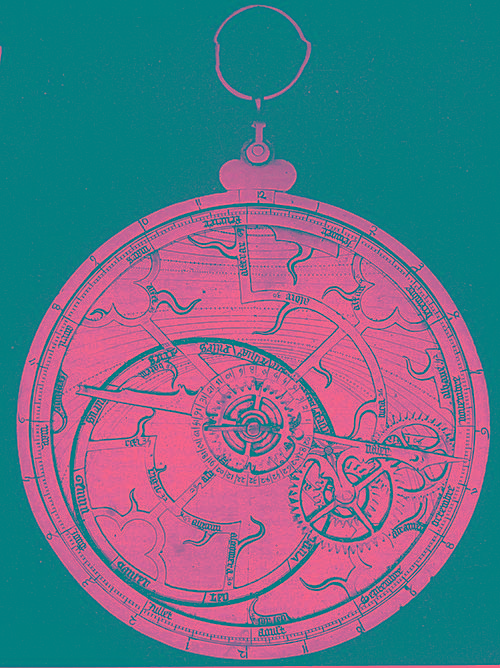
The benefit of carrying an analog computer in your pocket like an astrolabe, was the ability to tell time at night. It registered the date, the time, and the position of the stars; and by knowing two factors, you could determine the third -- with a surprising amount of precision.

Some of these items were superseded by cheaper mass-produced ones. The ornate, silver-plated works of art gave way to utilitarian cigarette packs, plastic butane lighters and Bic ball point pens -- merely disposable junk, rather than stylish accessories. Other items fell into obsolescence and disuse: taking snuff and carrying cards ran its course, wristwatches replaced the pocketwatch and its fob or waistcoat chain, hip-pocket wallets replaced money clips, and plastic cards replaced the need to carry cash and checks altogether.

Today, one universal convenience accessory has replaced most of the others: the cellphone -- a notebook and pocketwatch all in one, with "apps" for all manner of diverting, (and sometimes marginally useful,) functions. In fact, cellphone-wallet-and-keys has become the de facto accessorial standard for most men today. This doesn't mean we've reached the end of the accessorial line, however; even if choosing an accessory means it doubles one of your cellphone's functions.

Before we launch into what may make a proper accessorial combination for life in the twenty-first century, remember the less-is-more rule of formality: that is, the more formal something is, the plainer and simpler it is. Accessorizing is a game of choosing well those few necessary items you will need during your day, while leaving behind that which you will not need. And on that note, I shall leave you to mull over just what that might mean until next week. See you then!

Click here to go to the next essay chronologically.

Click here to go back to the previous essay chronologically.

Click here to go back to the beginning.