Friday, July 15, 2011

Accessorial Tutorial

Chapter 23
Welcome back! This week, as happens every once in a while, we're going to take a little detour off the beaten trail of what's proper dress, and explore a bit of the incidentals. Dressing like a grownup, in addition to the clothes you wear, involves still another level of adornment. We call these accessories, and we shall look at these today. As the name implies, these are all those extra bits that are added to your attire, that aren't strictly necessary, but add a bit of personalization. Most of these will have individual chapters devoted to them in future; for now, however, an overview will suffice.

Let us start by defining what isn't an accessory. For the sake of our discussion, we shall start with shoes, trousers, shirt, and jacket: for you can be fully dressed wearing just these four things. (For the sake of perspicuity I will assume the use of undergarments in lieu of "going commando.")

The first category of accessories are those which are an integral part of your wardrobe; that is, those items which, although not obligatory, are fundamental to being fully dressed. They are those components that you have the greatest amount of latitude in, with respect to design and appearance.

Socks are an example: the patterns, colors, fabrics, and styles available are nearly infinite, and this small bit of individuality flashing below your cuff can add a great deal of personal interest to your outfit.

Similarly, a belt, suspenders, or braces, although little-seen under a jacket, is a palette for your sartorial creativity -- but when worn without a jacket, care must be exercised that these items do not overpower the outfit itself. Here also can be mentioned cufflinks, as well as the occasional shirtstuds.

A waistcoat is technically an integral accessory -- it has the capability of adding a great deal of individualism to an outfit. Traditionally, the waistcoat was given a considerable amount of latitude in regards to its style. Even when worn with otherwise somber suits, a waistcoat's button stance, collar shape, and pattern communicates a great deal of the wearer's personality.

Neckwear is the most-used and, it might be argued, the most important integral accessory of all: whether that be a scarf, ascot, cravat, day-cravat, bow, or long tie. It, as an apparatus autarchic, can convey not just a degree of formality, but your mood and emotional state as well -- all by the choice of neckwear, the manner in which it is worn, its color and pattern, and even the knot used to tie it.


In previous decades, it could be argued that a detachable collar was an accessory, as a selection from a wide variety of collars could give your shirt as much character as the tie it framed. Detachable collars are used so rarely today, and the available motifs are so few, that they are considered part of the shirt currently, rather than an accessory thereto.

Hats are an integral accessory, due to their highly personalized nature. Shoes, although also a highly personalized item, are not accessories: While going hatless is not sartorially incorrect, it is not an absolute requirement -- a statement which cannot be said about wearing shoes!

The second category of accessories are those which are adjutants to your wardrobe; those items which, if worn, are primarily decorative.

To this category belongs the pocket square and boutonnière -- two accessories which are particularly close to my heart -- and I am an enthusiastic supporter of their frequent use. As I am an artisan of these particular items, I shall not say much upon their use here, as I have written a great deal about them elsewhere: by clicking on the large banner ad to your left you may read all about them.

The tie tack, tie bar, stick pin, and tie chain all serve a similar function: to keep a long tie or cravat orderly and in place against the shirt.

A collar bar, attached to the points of your collar and worn with a long tie, keeps the knot in place and pushes it forward; a popular look in the 1930s that is enjoying a resurgence.

A lapel pin is purely decorative, and shows the wearer's affiliation or support of the organization associated with the pin's device. One might think that arms displayed on a blazer or reefer jacket, (boat club, country club, etc.,) as is sometimes seen, would fall into this category -- but as the logo is an integral part of the pocket of the jacket, it isn't an accessory, as it is not removable.

Kid gloves, umbrellas, spats, and walking sticks, although often used as accessories in bygone years, have largely passed into the realm of history. Gloves and sticks still have their place as evening-wear accessories. The full-size walking umbrella, despite its elegance and utility, is unfortunately seen but rarely today.

The final category of accessories is the largest and most diverse, those which are convenience accessories; those gadgets, mechanisms, and fixtures that are carried for the sake of convenience, most often kept out of sight in a pocket until needed.

In decades gone by, there were tremendous amounts of accessories that may have been used. Many of them were finely-finished items with utilitarian purposes which wouldn't seem out of place today; such as coin purses, money clips, calling-card cases, pen knives, notepads, firearms, fountain pens, and signet rings.

Not surprisingly, many accessories were tobacco-related. Above are shown a cigar case, lighter, cigarette case, and snuffbox. The lighter is a WWI-era "trench lighter" which worked well in adverse conditions, and was a popular item to attach to a double-Albert watch chain. Leisure-related items abounded; from pipe tools to flasks, to playing-card cases with compartments for dice.

This replica of the Hudson's Bay tinderbox is still being produced.
By striking flint on steel, a shower of sparks sets the tinder smouldering,
which can then light your pipe, cigarette, or fire. In the lid is a
magnifying glass for sunny-day use.
An alternative to matchboxes, or naphtha lighters like the Zippo and trench models, was the old-fashioned tinderbox. Carried even when more modern alternatives were available, it gave the user an air of rugged outdoorsmanship and independence. Not surprisingly, it still does.

Pocket watches of all levels of complexity were nearly universally carried, either on a fob or a chain, until WWII elevated the popularity of the wristwatch. Lesser-known items were pocket sundials like this one. In an era when knowing the time to the minute was not as important as it is now, and access to a watchmaker was a difficult and expensive proposition, a good sundial would serve just as well.

Another model, in a square format. A well-made sundial was a precision device that could be amazingly accurate, unless it was overcast. Or night.
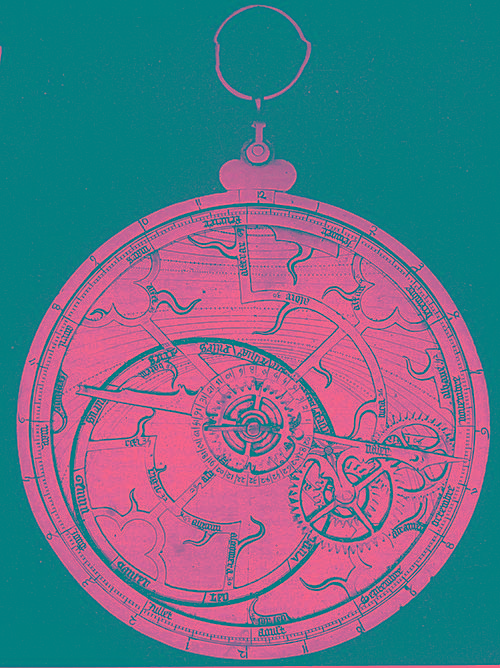
The benefit of carrying an analog computer in your pocket like an astrolabe, was the ability to tell time at night. It registered the date, the time, and the position of the stars; and by knowing two factors, you could determine the third -- with a surprising amount of precision.

Some of these items were superseded by cheaper mass-produced ones. The ornate, silver-plated works of art gave way to utilitarian cigarette packs, plastic butane lighters and Bic ball point pens -- merely disposable junk, rather than stylish accessories. Other items fell into obsolescence and disuse: taking snuff and carrying cards ran its course, wristwatches replaced the pocketwatch and its fob or waistcoat chain, hip-pocket wallets replaced money clips, and plastic cards replaced the need to carry cash and checks altogether.

Today, one universal convenience accessory has replaced most of the others: the cellphone -- a notebook and pocketwatch all in one, with "apps" for all manner of diverting, (and sometimes marginally useful,) functions. In fact, cellphone-wallet-and-keys has become the de facto accessorial standard for most men today. This doesn't mean we've reached the end of the accessorial line, however; even if choosing an accessory means it doubles one of your cellphone's functions.

Before we launch into what may make a proper accessorial combination for life in the twenty-first century, remember the less-is-more rule of formality: that is, the more formal something is, the plainer and simpler it is. Accessorizing is a game of choosing well those few necessary items you will need during your day, while leaving behind that which you will not need. And on that note, I shall leave you to mull over just what that might mean until next week. See you then!

Click here to go to the next essay chronologically.

Click here to go back to the previous essay chronologically.

Click here to go back to the beginning.

Friday, July 8, 2011

The Shirt Off Your Back

Chapter 22
This week, I'm going to say something that you might think out of the ordinary for a "men's fashion blogger" -- it's certainly a bit of wisdom that seems to go against the grain of what I've been saying for the past five months re: jackets, and that is, sometimes, you can ditch them.

That's right: shirtsleeves are fine. 'What!?' I can hear you shouting at your computer screens now. 'I've spent weeks hearing about how proper attire must always include the implementation of a jacket! Are you daft? Have you gone off your crumpet? What gives?'

Fear not, I have not taken leave of my senses. Dressing like a grownup, if I have taught you nothing else, is all about dressing appropriately. Just as t-shirt and cutoff jeans are never appropriate, sometimes, on occasion, an excession of layering is just as inappropriate. And this is just the time of year to mention it.
Unless you are one of my lucky readers who live somewhere up in the Arctic, or in the extreme southern latitudes, you are in the midst of summer right now. Not a pleasantly warm, breezy, partly-cloudy, sort of summer either, but a hellish blast-furnace that will try to kill you the moment you set foot in daylight.

For instance, I live in a part of America that is lovely for ten months out of the year -- the other two months, though, is the reason this area was sparsely settled until the invention of air-conditioning. The unforgiving fiery globe beats down mercilessly, bakes the ground, without so much as a wisp of cloud to provide relief. The air is stagnant, stale, heavy with humidity, and completely still. The ozone builds along the ground. And it continues this way for days. Hazy, hot, and humid, no wind, no clouds, no change, for weeks on end, until the weather finally breaks with a thunderstorm to temporarily relieve the monotony.

No, this is the heat of summer, and even the lightest jacket, the thinnest, loosest-weave, unlined blazer you can find, is too much. If you will remember back to Chapter Seven, Spring Break Experimentation, in the last week of March, we discussed resort wear, including such an aforementioned jacket over a bare chest, with a thin scarf tied in lieu of a shirt, paired with Bermuda shorts. That is fine for resort wear, where you are lounging about all day drinking rum cocktails, and the gentle breezes carry off any perspiration...but this ain't spring anymore, and you aren't on vacation, so walking around in a Bermuda suit without a shirt is not recommended.

Of course, for many people, the actual outside temperature isn't an issue. Air-conditioning, in a constant path from house, to car, to office, and back, means you never have to actually experience Summer; and since offices and shops seem to keep their summer thermostats at a chilly 65ºF, you can happily wear a suit all day even with the most torrid inferno blazing outside.

On the other hand, for those who, by choice or necessity, have to exist in a closer affinity to the atmosphere, it's a different story. There's no breeze to cool you; no clouds to shade you -- a jacket, no matter how thin, merely heats the air and traps it next to your skin, and the high humidity retards evaporation. The only relief is to physically wick the moisture away, and we have no recourse but to strip down to a t-shirt and short-sleeved shirt. But how do we manage this without looking like a schlub? Is it, in fact, possible to look like a well-dressed grown up, in just shirtsleeves?

Of course it is. Don't be silly. Well-dressed doesn't mean overdressed: it's merely a matter of choosing the correct clothing, just like any other situation. Many beginners, who try to dress like grown-ups for the first time, make the mistake of always overdressing. But, of course, there's a catch. There's always a catch, because the correct clothes aren't always the ones that are immediately or most easily available.

Ditch the jeans, and wear a light pair of thin slacks that fit properly, and sit at the right height. You don't lose a great deal of heat through your legs, and baring them to the world won't gain you that much comfort. If you must wear shorts, keep it to yard work or lounging at home; never in town. Boat shoes or loafers with a low vamp are cooler than lace-ups and can look just as nice as a balmoral. Wear socks: you need the wicking action to keep your feet cool, and protect your shoes. Sweating directly into a shoe is just gross.

Likewise, wear a cotton tee-shirt. The wicking action is what keeps you cool, and it will act as a sweat-sponge that will save your overshirt from collecting stains. Make certain your tee-shirt fits: it should have a collar that fits to your neck without gapping, has sleeves that won't bunch uncomfortably under the arm, and is reasonably fitted to your body. Remember, a tee-shirt is not a fashion statement, it is a utilitarian undergarment that serves a function.

The shirt you choose should be of an appropriate pattern and style. Golf shirts of the Polo or Izod vein have been the standby for decades, and are a safe choice for beginners.

A few things to watch out for when choosing a golf shirt for summer wear: Be sure it fits well through the body, in the shoulders, and around the neck. Extra fabric insulates and traps air, defeating the purpose of a summer shirt in the first place. Remember that golf collars do not always play well with jacket collars: choose a collar that fits your neck and sits close in -- it is good to at least have the option to pair a golf shirt with a jacket. The fabric itself should be light enough to breathe -- many golf shirts are made of a very thick cotton, suitable for an autumn weekend on the links, but would be suffocatingly hot in summer, despite the short sleeves.

Another option is the "short sleeve dress shirt," which is a bit of an oxymoron, but nevertheless is made along the standard open-collar or button-down form, merely with elbow length half-sleeves. Neither sporty enough for a true summer short-sleeve, or formal enough for business wear, it's a compromise. It's best used when summer outdoor-indoor use is required in professional settings, as a jacket can be slipped on indoors for a more proper look, and off again when it's required to brave the elements. In short, it looks like it "needs" a jacket; and in fact it does.

Harry Truman was a proponent of the
tropical shirt; this one is cut to be
worn untucked.
Summer heat gives a certain amount of latitude in design, and that brings us to the tropical shirt. At one extreme is the Hawaiian print, at the other is the guayabera shirt. The safari shirt and bowling shirt can be listed in this continuum as well. The prints may vary from floral, to geometric, to plain cloth and broad stripes. The cut of the shirts are similar: a collar that is designed to sit with the points laying flat against the collarbone, and worn open, with buttons down the front. A large armscye, and sleevelength just above the elbow. Pleats from the yoke that run down the back: either simple, box, or reverse-box pleats. And a generous shirttail. This last point is important. Among tropical shirts, there are those that are cut with skirts like a jacket: square all the way around, jacket-length, with hip pockets. Obviously, those must be worn untucked. Those that are cut with shirttails are preferable for our purposes, and must be worn tucked in.

Higgins' safari shirts are the conservative
alternative to the floral: khaki, with
bellows pockets and epaulets.
Tropical shirts are "true" summer shirts, as they look somewhat awkward with a jacket, due to the shape of the collar. Such shirts are available just about everywhere this time of year, but beware the caveat -- they must fit. You will remember from Chapter Five, The Science of Style, way back in the second week of March, we discovered the best fit for a suit, is that which fits the shape and proportions of the human form. It's the same thing with something as simple as a shirt.


Truman's shirt is representative
of the style: this one is cut
to be worn tucked in.
The proper fit can take a mundane article and turn it into something special. A ballooning, shapeless sail of a shirt doesn't look as sharp as that same shirt would if it was fitted to you. I don't mean skin-tight: just with all the extraneous fabric taken away. Tropical shirts are meant to fit somewhat loose, but if it looks baggy, it may need a little tailoring. Fortunately, shirts are simply constructed and easily altered, and it would take a competent tailor very little effort to take a too-large shirt and nip in the sides a bit.

The former President wore tropical shirts,
often and well.
I must here repeat the refrain I sang several months ago: find a good alterations or bespoke tailor in your area, and give them your business. Spending a few dollars to have your shirts or jackets taken in and shaped to fit you will make a world of difference in your appearance.

(Not the least of his problems:
a buttoned collar.)
If the shirt isn't cut like a jacket, tuck the shirt in. I know, purists will decry this, saying the Aloha shirt must be worn loose, only Thomas Magnum tucked his in, blah blah blah...To these purists, I must only respond that we are not in Hawaii, and are concerned mainly with looking like a grown-up, whilst wearing what is, at its base, a very silly shirt. And the way to do that, regardless of its flamboyancy of pattern, is to treat it like any other shirt -- pressed, tailored, and tucked in.

Going out in a well-fitted, crisply ironed, tropical shirt is a stylish way to beat the heat -- or at least meet it on its own terms. It's not a sartorial choice to indulge in all year long, but for those weeks when the air is thick as soup, your car's tires are melting, and the friction from your mower causes your lawn to catch fire, no one will begrudge you a little Summer madness!

Click here to go to the next essay chronologically.

Click here to go back to the previous essay chronologically.

Click here to go back to the beginning.

Friday, July 1, 2011

Hatiquette

Chapter 21
Hat-deficient folks today make up the bulk of Western society. By and large, they fall into two camps. The first camp don't wear hats, ever. For whatever reason, they are irrationally hatophobic. Even when the situation demands a hat, they, like David Beckham at the royal wedding, would prefer to stand outside in the sun, awkwardly holding their hat, than deign to let headwear block their coif from view. The second camp wear a single piece of headwear with disturbing regularity, even when it doesn't make any sort of sense; whether it be a baseball cap to church, a knit toboggan in the middle of summer, or a head-scarf...well, ever.

Both groups of people, even though they manifest different symptoms, have similar psychological hangups: the obsessive not-hat-wearing, and the obsessive always-hat-wearing, are both loathe to change their ways. Just as one will never wear a hat, the other will never take it off. These people need to address a greater issue before they can be truly well-dressed, and that is a situation between themselves and their psychiatrists; I do not have the time nor the patience to deal with such hangups in this venue.

The balance, of course, and as always, is right in the middle. Hopefully it is where you live your life: the take-it-or-leave-it middle of the road non-obsessive, who desires to dress properly, and understands it will take changes in your habits and customs occasionally. To be well-dressed includes being hatted, but here lieth the minefield: to merely plunk on a hat at the beginning of the day, and take it off at the end, is a much worse offense than simply not wearing a hat at all.

Just as there is not one proper hat for all occasions, (and in fact you should have a variety of hats for different seasons, weather conditions, and degrees of formality,) there are myriad rules for when to wear your hat during the day, and when to remove it. You should remove and replace your hat many, many times during your average day. Should you watch any vintage film, it is apparent that men used to know these rules, until following them became nearly an unconscious act, and if you're not familiar with them, it can be frankly befuddling.

There are books, websites, and blogs galore that attempt to make the arcane art of hat-removal accessible to modern men. Most of them are lists of dos and don'ts, with exceptions, and exceptions to the exceptions. It usually starts with "wear a hat outdoors, don't wear one indoors," and goes on from there. The indoor/outdoor matrix, I think, somewhat misses the point, however. A much more logical starting place is based upon the premise of public/private spaces.

If you want an easy-to-remember rule to guide you with your hat-wearing, here's the cornerstone on which to hang your hat (pardon the pun:) You have the option to wear your hat in public spaces. Doff it in private spaces. Everything else you need to know is just elaboration upon this thesis.

Always wear your hat outdoors works, simply because "outdoors" is nearly always a public space.

A private space is defined as "cash or key:" a place where people live, work, or pay a price to enter. More simply -- it's any space that is not a public space.

Some examples of how this works:

A house is a private space, but the entryway, foyer, or vestibule just inside the front door is considered public. This goes back to the history of great houses, when the butler greeted guests at the door and took their coats and hats.

A church is a private space; it is after all "God's house."

An apartment is a private space; but the lobby, corridors, and parking areas of the apartment building are public.

A hotel lobby, check-in, and corridors are public. The rooms of course are private, but the areas only open to guests (gyms, pools, game rooms, lounges, etc.) are private spaces as well. 

In an office building, lobbies and corridors are public. Offices are private space. The area of a cubicle farm is all private, not just the cubicles themselves. (In other words, the area is treated as one large office.)

In a doctor's office, if there is a separate reception area it is public, but the waiting area is private (the concept here is that you have paid for the doctor's services by this point.)

A hospital building is treated as all private beyond the main entry; this goes back to the days when hospitals were run by the Church.

Any club that requires dues of its members, i.e. not open to the public, is treated as a private residence.

A theater is private space, since you pay for a ticket. If you buy the ticket in the lobby, the lobby is public, since anyone can enter. If you buy the ticket outside and then enter, the lobby is private as well, since presumably you cannot enter without a ticket.

An outdoor stadium sporting event, even though a private ticketed venue, is still treated as public, by virtue of its being al fresco -- unless it's in a domed stadium. Then it's hat's-off.

Get it? With a little bit of brainpower, it's very easy to figure out hats-on or hats-off, without memorizing a bunch of rules. There are a couple of oddball situations that aren't intuitive, since their origins are in antiquity. The "foyer rule" is an example of this. The other examples:

An elevator is a private space, even when the corridors are public. This goes back to a concept that you are in the elevator operator's "office." Human operators are long gone, but the tradition remains.

A restaurant is a public space, but when you are seated at your table, your table becomes a private space, as you are paying for being there. The bar, however, remains public, even if you are sitting and drinking.

If you are in motion, your hat remains on, whether the transport be public, private, enclosed, open, indoor, or outdoor. This harkens back to the days when transport was basically all done outside: walking, horseback, or open carriage. Today, we have planes, trains, automobiles, moving sidewalks and tramways, trolleycars and cable lifts; but the old way persists, despite new technology.

And that's all there is to it. With the public/private model, you have everything you need to cultivate proper hatiquette, but we still need to touch on the foundation of why we do these things. Uncovering the head is a sign of deference, subservience, or reverence going back to the beginning of time. In private spaces, it is a concession of intrusion into another's domain, a show of gratitude for favor, or a foment of intimacy among equals: in each case, it is an unconscious symbol that one has let down one's guard and has endorsed a non-threatening behavior. It has at its root a common genetic behavior among not just men, but many animals as well.


Behold mine neck, wilt thou
loppeth it from mine noggin asunder?
This brings us to the old tradition of tipping the hat...is it of any use today, or just a musty anachronism? Bowing or genuflecting is a hard-wired animal behavior, that physically puts oneself at a lower level than another, and displays oneself in a vulnerable way whilst diverting one's eyes. Anyone who has a cat or a dog is aware of this behavior: it's a familiar stance in the animal kingdom. In Men, to bow deeply from the waist was the accepted affectation for millennia: removing one's hat was necessary to prevent it from hitting the floor.

I would bow, but I fear my
collar prevents it.
As bowing became less extreme through the nineteenth century, removal of the hat became less necessary, but was performed anyway. By the twentieth century, the bow was curtailed to a nod of the head and a slight lift of the hat, and the hat-tip was born. Social changes in the West made broad class distinctions among men inconsequential, and hat tipping was reserved for women.

A bit more subtle than
Mr. Kadiddlehopper here.
Here in the twenty-first century, not just class, but gender distinctions, are increasingly unimportant. Refinements such as removing your hat when talking to a woman on the street, can today be inexplicably seen as sexist. Taking the deconstructed hat-tip to the modern day, when greeting a women while wearing a hat, a subtle touch of the brim is sufficient. It is enough to be selectively appreciated or ignored as needed. And never tip your hat to another man: it was traditionally an insult, the equivalent of calling him a girl.


An automatic hat tipper, for when
your hands are occupied.
Yes, it was that important.
Hats are selectively removed at certain instances where your hat would otherwise remain on, most notably at outdoor sporting events. This causes some men undue consternation, but it need not be so. Just remember that removing the hat is a sign of deference, subservience, or reverence. A prayer is directed at God, as is a hymn, so it is obviously a hat's-off moment. In the U.S., the Pledge of Allegiance is a prayer to the State, and the National Anthem is a hymn to the State, and is accorded the same reverence as is given to God. Your mileage may vary according to your particular country, of course, but this guideline will do for most.

Dressing like a grownup, as we are continuing to see, extends beyond simply what you wear. It's how you wear it, and what you do with it: not merely a stiff mannequin who stands static like a fashion plate, as many are wont to do. Start making mental notes of public/private transitions, even when you are hatless. Practice, and more practice, will make a man who will effortlessly doff his top without thinking, without self-consciously drawing attention to his actions.

Click here to go to the next essay chronologically.

Click here to go back to the previous essay chronologically.

Click here to go back to the beginning.