Friday, November 9, 2012

The Political Uniform

Chapter 92
The election is over. This isn't a political blog, so I'll spare you any of that which you doubtless are already inundated. I was correct in my prediction as to the outcome, however:

The man in the black suit will win.

This isn't a large stretch of prognostication. Let's take a quick tour of the last couple of political months.

We'll start with the Republican nominating process. Observe: from left to right, black suit, black suit, black suit, black suit, black suit, and black suit. Not shown is Herman Cain, in a black suit, and Michelle Bachmann, who was not a man, and thus beyond the scope of this blog. So the Republicans chose the man in the black suit.

Let's skip to the conventions now. First, the Democrat convention. Obama at the podium, basking in the adulation with his court jester: black suit, and black suit.

Bill Clinton? Black suit.

Even Los Angeles Mayor Antonio Villaraigosa, the convention chair, provided comic relief with his "maybe you didn't understand the question" routine in a black suit.
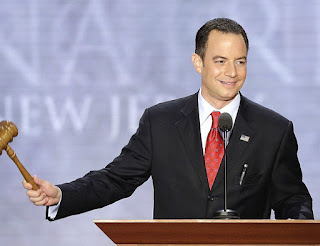
Perhaps there is a trend here. Let's compare this with the Republican convention: RNC Chair Reice Preibus -- black suit.

Reice and John Boehner? Black suit and black suit.

Ebullient Chris Christie -- in a slimming black suit.

Clint Eastwood, the Republican's answer to Villaraigosa, also a black suit.

Even Wisconsonian Sol Grosskopf, with a chessehead hat and purple polka-dotted bow tie, somehow can't shun the black suit.

Surely at the debates this dreary costume must be averted?

No. Presidential debates: black suit, black suit.

Vice presidential debate: black suit, black suit.

What do we see here? A depressing uniformity and a stultifying lack of imagination. Arenas full of ill-fitting black suits. A House and Senate full of black suits. A Capitol full of black suits. Men at the highest levels of American government, no matter their party, have given up on their sartorial free expression. And what happens on the surface is an indication of what is going on underneath.

Let's draw a quick comparison between the modern day and Presidents past -- and just to keep it fair, we'll look at past political conventions here as well. The dapper haberdasher, Harry S. Truman, makes his acceptance speech at the Democrat National Convention in style, with a double-breasted linen suit.

Notice the light, breezy, and confident air a bright suit gives. It's hard to tell in monochrome, but this is likely a very light eggshell or cream linen.

Let's jump forward to Eisenhower in 1952, greeting the press outside the Republican National Convention, at a constituent's house. Hardly a dark suit to be seen. Ike is most likely in a salt-and-pepper suit, whilst his glad-handed throng are in a variety of tans, creams, and rusts. Notice the straw fedoras, and the spectator shoes on the gents at the far left.

Here is a jubilant Richard Nixon also at the RNC in 1952, looking far from dour in a light, possibly straw-colored, suit.

Moving ahead to 1972, Ronald Reagan hands off the ceremonial chair's gavel to Gerald Ford at the RNC. Gerry's in a dark suit, perhaps a sign of things to come, while the Gipper is in what appears to be light grey.

Up until the 1976 Republican Convention, light suits were still seen, although less rarely than in previous years. RNC Chair Bob Dole is wearing a poly suit in what I think might be a then-fashionable light brick color. But beyond the bicentennial, dark tones predominated, and for the last several decades, color has disappeared completely from the palette of the politician.

When everyone wears black, it's more difficult to tell who the good guys are. If there are any, that is.

Click here to go to the next essay chronologically.

Click here to go back to the previous essay chronologically.

Click here to go back to the beginning.

Friday, November 2, 2012

The Fighting Yank 3: Yank's Revenge

(Part Three of the series, "The Fighting Yank Trilogy")
Chapter 91
This week, I've decided to postpone what I had planned to write, in light of recent meteorological events. Much of the northeast U.S. is still reeling from the effects of Hurricane Sandy, that slammed into the coast earlier this week. Despite being only a Category I storm, which was comparatively weak and slow, it was a big 'un. It became an extratropical storm, merged with a Western cold system, fed by the jet stream, during high tides boosted by an overhead full moon. It left tremendous damage to property from Virginia to Maine, left millions of people in the dark, and dozens of people dead. 

There is still no comparison to the Great Hurricane of the Antilles, which wiped out over 20,000 people in the Caribbean in 1780; or Hurricane Mitch, which killed 11,000 Central Americans in 1998. Many folk that live along the Gulf of Mexico may have rolled their eyes at the nonstop news coverage of Sandy, for they may regularly endure several Category I storms a year, which usually warrant no more than putting your trash cans in the garage to keep them from blowing away.

But an extratropical Sandy hit New York, a seething cauldron of tightly-packed (and tightly-wound) humanity, few of whom are used to dealing with hurricane-force storms. An extended storm surge of thirteen feet swamped the low-lying island, inundating tunnels and subway tubes, drowning generators and shorting power lines. Considering how many people are jammed into its borders, the number of deaths is actually amazingly low.

We've been steeped in a week of bad news, shown countless images of flooded streets and twisted piers, and stories of people ill-prepared to deal with a regional natural disaster of this nature.

So this week, I'm going off-book and taking a break from the sartorial angle, to share some good news with you for a change: news that involves the little statue that stands in my little town, that you've been introduced to before.

I told you last year about how an artist named Ernest Moore Viquesney cast five statues called "The Spirit of the Fighting Yank" in 1943, and how my little town in North Carolina was inexplicably chosen to get one of them in 1946. The statue kept guard over Belmont High School for sixty-five years, (despite a defacement in the early 1960's that stripped the Yank of his Tommy gun,) until he was torn down by vandals in mid-2011.

The Yank, after its visit to Washington.

Then, I posted a followup a year later, after the three culprits were apprehended, arrested, and sentenced (but not as severely as they should have been.) 

Lifted up on a sling by a forklift.


The Fighting Yank was professionally pieced back together, and restored, after a fashion. 

Hoisted up onto his pedestal.


The Yank's Tommy gun was not replaced: as it turns out, the statue's insurance only covered its repair or replacement to the extent that it existed at the time of the vandalization: so he was restored without his M1928A1 submachine gun.

Ron Foulk: Hero.


But it seems I wasn't the only person to notice its absence. Belmont City Councilman Ron Foulk noted, “It’s a shame for it to be up there and not be complete."

Belmont’s American Legion Post 144 agreed. They and Foulk raised $3,000 to re-hire Conservation Solutions to re-cast and attach the Yank's long-missing M1928A1 earlier this week. Many of the legionnaires were doubtless high school students in the early 1950's, when the Fighting Yank was in his glory.

Zeke makes some final adjustments.


Conservation Solutions conservator Zeke Schladen re-introduced the Belmont Fighting Yank to his firearm for the first time in fifty years. He installed the gun on the statue last Thursday afternoon.

Interestingly, the replacement gun was sand-cast; but the mold for the gun wasn't an original M1928A1 -- it was an Airsoft pellet gun, which is a perfect visual replica of the M1A1 Tommy gun. So if there are any parents who are offended at the presence of a gun at a (now) middle school, they can be mollified by the assurance that he's actually only holding a toy!

A close inspection of the other four full-size Fighting Yanks, as well as the various miniature versions, show some discrepancies among their guns: Viquesney wasn't slavish as to the accuracy of the Tommys he sculpted, although their silhouettes are instantly recognizable as Thompson submachine guns. So perhaps we shouldn't be too picky that the Belmont Yank's gun doesn't have barrel cooling fins or a muzzle brake, since despite that, it nevertheless now has the most accurate casting of any of the other four Yanks.

So our tale of the Fighting Yank has an interesting coda of good news, after all. Not only is the "Spirit of the Fighting Yank" now repaired, re-headed, and raised back where he belongs, the whole kerfuffle has raised enough interest in our little statue that after half a century, he's finally re-armed as well, complete and whole, as the artist intended. And hopefully he'll stand guard in Belmont for centuries to come, long after the statue's history of vandalism and the names of the culprits have been forgotten to the mists of time.

Click here to go to the next essay chronologically.

Click here to go back to Part Two of The Fighting Yank trilogy.

Click here to go back to the previous essay chronologically.

Click here to go back to Part One of The Fighting Yank trilogy.

Click here to go back to the beginning.

Friday, October 26, 2012

The Scariest Thing I've Seen This Year

Halloween Special
Chapter 90
Cue the theremin music and fire up the fog machines! Our yearly tradition is back -- the worst, most egregious, baddest, most doubleplusungood thing I've had the dire misfortune to witness since, well, since last Halloween.

The most scary thing I've seen this year might have been the image of bloody handprints on a wall of a CIA safe house/U.S. diplomatic mission in Benghazi, Libya -- terrifying horizontal streaks left by four Americans as they were hauled out bodily by a crowd of Islamic terrorists, who murdered them in a mindless orgy of violence, and torched the grounds, on the anniversary of the September 11, 2001 terrorist attacks.

That event has led to many scary things I've seen this year; and they look to be shaping into a complex political coverup that would be right at home in a cheap B-thriller horror movie. But our focus here is on Dressing Like A Grownup!, and Islamic terrorists dress as you would expect them, and sheriff's deputies wear their uniforms. So as grisly and stomach-churning as these events were, we have to look elsewhere for a sartorial horrorshow. 

And we have one.

On the 18th of this month, the Alfred E. Smith Memorial Foundation held its 67th annual dinner at the Waldorf-Astoria in New York. Founded by Francis Cardinal Spellman in 1946, to honor the memory of New York Governor Al Smith, the Foundation is a Catholic charity that assists the neediest children of New York. But the dinner is primarily known for two things: every four years, it hosts the two Presidential nominees, who spend the evening telling jokes. 

And it is a genuine, honest-to-goodness white tie affair. Dress suits, tailcoats, full-formal, whatever you want to call it, it is one of the few occasions that demands the dressiest of traditional clothing, with no short cuts. Most people would not notice what actually went on that evening. Everyone had fun, the candidates were both in rare form and actually blazingly funny, and the money all went to a good cause. So who cares what they looked like, really? After all, there was no red carpet, no paparazzi, no questions of "who were you wearing?" After all, it's just a tailcoat....

...right?

Wrong. Dress suits are the closest thing civilians have to military uniform. It's still party clothes, make no mistake; but there are explicit rules. These rules don't exist to make life needlessly difficult -- they are there because White Tie, done properly, is the ultimate expression of the First Great Secret of Dressing Well: it makes you look better than you really do, all the time, without exception -- if it is done correctly. These two men, vying for the position of head of the most powerful nation in the world, should know a thing or two about dress suits. Neither of them do. Governor Romney, joking about his wealth, said "It's nice to finally relax and wear what Ann and I wear around the house." A good line, but it's apparent that he's never actually worn a dress suit before. And neither has the President. 

It's painfully obvious that no one there has ever worn white tie and tails; because they are all getting it wrong. Coats are baggy, shirts are unstarched, waistcoats are too long. It's as if they were all at a high school dance...or Halloween party. No one knows what the hell they are doing. No one. And that's scary.

The President of the United States is wearing an unstarched fold-collar tuxedo shirt and pre-tied bow with his tailcoat. Which, sadly, is what the waiters would be wearing, to differentiate themselves from the guests, in decades past. Romney is also wearing a tuxedo shirt, with skimpy attached wing collar. His bow tie neckband is riding over the top of his coat collar, and is nearly jumping free of his shirtcollar. If these were fifteen-year old schoolchildren playing dress up with the clothes in their grandfather's steamer trunk it would be merely humorous. These are grown men, and it is nothing short of tragic.

But this brief image is proof that we are witnessing the next Fall of the Roman Empire. Directly behind the President is seated Chris Matthews. I don't even know how to register my complete and utter disgust. This is a full-dress event, and Matthews can't even be bothered to wear trousers? Let this image of low-rise belted pants scorch into your retinas, his shirt billowing out under his waistcoat, his cutaway fronts flapping impotently across his distended belly: this is the image of the tail end of Western civilization. 

Let us now compare this evening of atrocity to images of Presidents past, who have attended this selfsame dinner, wearing the same dress suits, but wearing them correctly. Notice President Reagan's dress suit, and how it is cut across the waist. The trouser waistband is high, the waistcoat is cut to be just shorter than the fronts of the tailcoat, and the angle of both are identical. 

Now observe President Ford's shirtcollar. It is starched, detachable, and much taller than that worn with a dinner suit: a full two and a half inches, with broad, elegant wings, and a broad, elegant bow tie to match it. His pocket square is arranged with nearly Razor Square precision.

Turning our attention to President Nixon, take a close look at the cut of his coat. This is why a dress suit must always be made bespoke. Notice that the sleeve falls without so much as a wrinkle. Notice especially the shaping through the chest and torso, the precision of line, the sculpting of the cutaway that looks molded to his body: the very definition of a body coat. Now compare this to the first picture of Romney above.

Now we'll step back farther, to President Kennedy. The thing to see here, is how the coat acts when in motion. Kennedy is reaching his arm forward, but the coat still holds to the small of his back, the tails follow the curve of his hips, and the cutaway points stay in place like they were welded there. Now look at the other fellow, who has both arms out, one in a handshake, the other on another gent's back: but his coat does not billow out, and stays snug into the waist. Notice, too, that he is starched from chin to navel -- the shirt front and waistcoat are both stiffly starched pique marcella, and neither his shirt nor his waistcoat shows as much as a wrinkle, despite his half-twist forward from the waist. One last detail: the man at the far right is not in a dress suit: he's in a double-breasted dinner suit. Is he a waiter? No, more likely a member of the media; you see, it's perfectly acceptable to wear a dinner suit to a full-dress event if you cannot afford a proper dress suit. (Memo to Chris Matthews.)

How have we descended so far, that at a White Tie dinner with the President of the United States, no one knows how to actually wear White Tie? The answer is, "down a long, gentle slope." White tie isn't difficult -- on the contrary, it is very simple. There is absolutely nothing to cause confusion. Step A, step B, follow the rules, and everything from cut to proportion to size to materials is clearly laid out for you, as simple as a Marine's uniform, and the result is guaranteed to be visual perfection.

Grown men don't know how to wear anything, anymore. Welcome to an era when even statesmen, Presidents, captains of industry, and media professionals can't follow a simple set of directions that have been set in stone for over a century.